Mental Math: Do’s and Don’ts

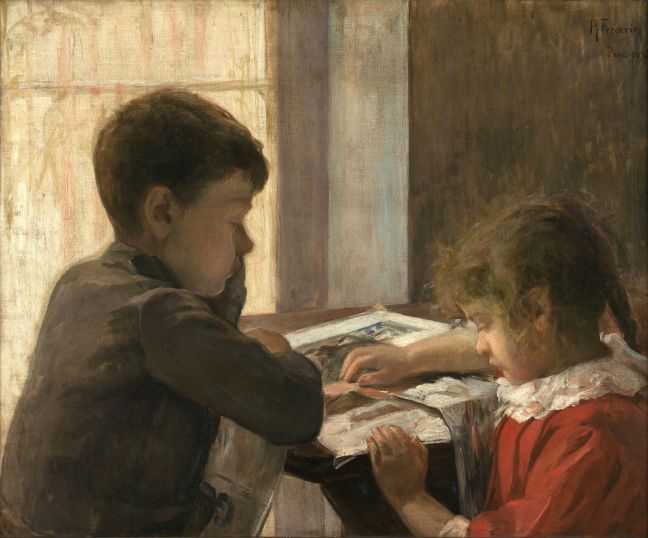
Father and son working on math homework

Over the course of this series, we’ve seen how mental math relies on a child’s own creative ways of thinking. In mental math, children develop understanding of how numbers interact with each other in many ways.

In this way, they learn the true 3R’s of math: to Recognize and Reason about the Relationships between numbers.

And the principles that underlie mental calculation are also fundamental to algebra, so that flexibility and confidence in mental math is one of the best predictors of success in high school math and beyond.

But as we went through the various example problems, did you find the written-out calculations hard to follow?

Don’t force your children to write down their mental math. It looks dreary when I write the calculations out step by step, but that’s not how it works in a child’s mind. With regular practice, this sort of thinking becomes second nature.

Continue reading Mental Math: Do’s and Don’ts

FAQ: Playful Math Journaling

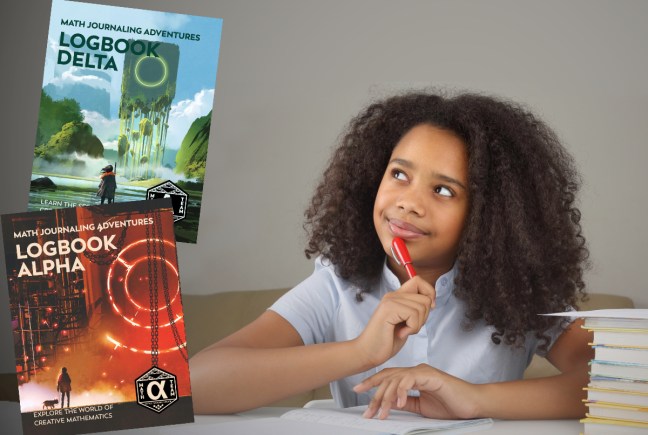
Girl student thinking about her math journal prompt

Ever since the school year started, I’ve been getting questions about how to use my new Math Journaling Adventures logbooks.

[SIDE NOTE: These logbooks are included in this month’s Thanksgiving Sale! You’ll get an automatic 10% discount off all print books, applied at checkout, no special code required.]

“I love the way your math books get my children thinking.

    “Finally, they are having fun with math!

      “But sometimes I have no idea what the journaling prompt is all about or how to teach it. Where can I buy a solutions manual?”

      Um, that’s not how math journals work.

      The cool thing about journaling prompts is that they have no “right” answer. They are explorations into different parts of the world of math, nature walks in the land of numbers, shapes, and patterns. Springboards into whatever our children want to investigate, whatever sparks their interest.

      A few of the problem-solving prompts may have specific answers, but it really doesn’t matter if our kids find the exact solution a math professional might give. If they write what makes sense to them, they’ve accomplished the goal.

      If later, they think of something they hadn’t noticed, or they want to change their answer — well, that is mathematical thinking, too.

      Continue reading FAQ: Playful Math Journaling

      Math Game Monday: Ben Orlin’s Row Call

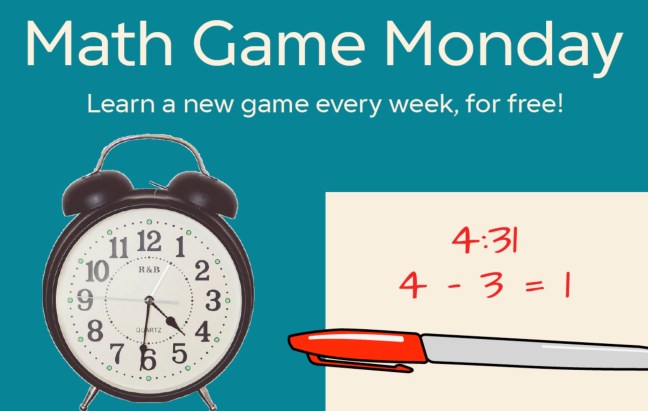
      Learn a new math game every week, for free

      This game is simple to learn, allowing kids to focus on their strategic thinking. Then ask your students to invent their own tic-tac-toe variation.

      Many parents remember struggling to learn math. We hope to provide a better experience for our children.

      And one of the best ways for children to enjoy learning is through hands-on play.

      Ben Orlin’s Row Call

      Math Concepts: Logic and strategic thinking.

      Players: only two.

      Equipment: pen and paper.

      Continue reading Math Game Monday: Ben Orlin’s Row Call

      Fun New Math Story

      Characters from Modultown math story

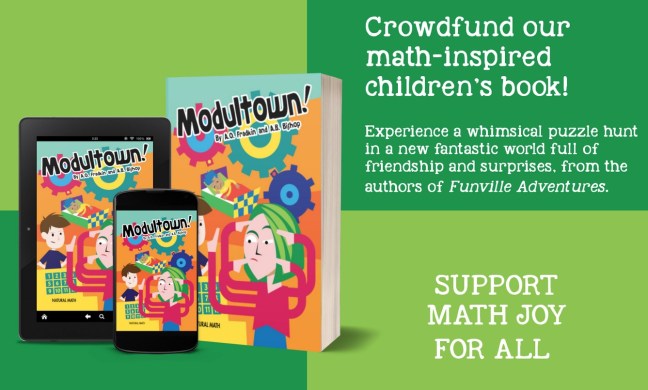
      Hey, look! A new book from the folks at Natural Math, now on Kickstarter:

      Modultown! A Math-Inspired Children’s Book

      Experience a whimsical puzzle hunt in a new fantastic world full of friendship and surprises, from the authors of Funville Adventures.

      When human siblings Emmy and Leo find themselves magically transported to Modultown, they make new friends and combine their different perspectives to solve challenges that flesh out the mechanics of modular arithmetic.

      Playing in Modultown unlocks pathways into number theory, computer science, genetics, and other essential modern fields.

      Back It Now

      NOTE: If you haven’t explored Kickstarter before, it’s a wonderful place to discover new books and products from creators around the world.

      In the old days, traditional publishing companies paid writers in advance to write the books the publisher wanted to see. In this new world, you get to choose and support the writers creating books you want to read.

      Support Math Joy for All

       
      * * *

      Images copyright ©2025 Natural Math.

      Two Hands-On Craft Projects

      photo: Cutting a paper square

      Here are a couple of fun foldable projects to try with your kids.

      Both of the projects below start with squares of paper. Do you know how to convert any piece of paper into a square? Here are two methods.

      • Can you tell why they work, how each method creates a true square?
      • What if you didn’t have a rectangular page to start with — could you still create a square?

      Minecraft Endless Card

      A square flexagon. If you don’t care for Minecraft, just create four square designs of your own to fold, cut, and paste.

      https://hattifant.com/minecraft-endless-card-paper-craft

      What math do you notice in the finished card? What questions can you ask?

      Origami Puzzle Purse

      Write a decorative note to a friend, then fold it into a compact little puzzle.

      https://hannaleetidd.com/blogs/news/how-to-make-a-victorian-love-token

      What do you notice? What do you wonder?

      Have fun folding math with your kids!

       
      * * *

      Are you looking for more creative ways to play math with your kids? Check out all my books, printable activities, and cool mathy merch at Denise Gaskins’ Playful Math Store. Or join my free email newsletter.

      This blog is reader-supported. If you’d like to help fund the blog on an on-going basis, then please join me on Patreon for mathy inspiration, tips, and an ever-growing archive of printable activities.

      “Two Hands-On Craft Projects” copyright © 2025 by Denise Gaskins. Image at the top of the blog copyright © Vejaa / Depositphotos.

      Mental Math: Three Basic Principles

      Doing mental math on the couch

      “We know that algorithms are amazing human achievements, but they are not good teaching tools because mimicking step-by-step procedures can actually trap students into using less sophisticated reasoning than the problems are intended to develop.”

      — Pam Harris, Math Is Figure-Out-Able Podcast

      Whether you work with a math curriculum or take a less-traditional route to learning, do not be satisfied with mere pencil-and-paper competence. Instead, work on building your children’s mental math skills, because mental calculation forces a child to understand arithmetic at a much deeper level than is required by traditional pencil-and-paper methods.

      Traditional algorithms (the math most of us learned in school) rely on memorizing and rigidly following the same set of rules for every problem, repeatedly applying the basic, single-digit math facts. Computers excel at this sort of step-by-step procedure, but children struggle with memory lapses and careless errors.

      Mental math, on the other hand, relies on a child’s own creative mind to consider how numbers interact with each other in many ways. It teaches students the true 3R’s of math: to Recognize and Reason about the Relationships between numbers.

      The techniques that let us work with numbers in our heads reflect the fundamental properties of arithmetic. These principles are also fundamental to algebra, which explains why flexibility and confidence in mental math is one of the best predictors of success in high school math and beyond.

      Your textbook may explain these properties in technical terms, but don’t be intimidated by the jargon. These are just common-sense rules for playing with numbers.

      Continue reading Mental Math: Three Basic Principles

      Musings: Mathematical Beauty

      photo of child making footprints on the beach

      Memories…

      We were eclectic homeschoolers back in the Dark Ages before there was an internet. Our primary curriculum was the public library.

      As we went along, I noticed how many of our homeschooling friends felt uncomfortable with math, and even hated or feared the subject.

      Math anxiety runs rampant in Western culture. By one researcher’s estimate, more than 90% of adults experience some level of math anxiety — that is, discomfort, avoidance, and even emotional pain when faced with a math calculation.

      So I became a sort of “math evangelist” in the homeschooling community, spreading the news that we can find beauty and fun even in math.

      Continue reading Musings: Mathematical Beauty

      ALL Mathy Merchandise on Sale Now

      Cool Cats Play Math T-shirt

      April has been a crazy month here at my little one-person business, which means promotion fell through the cracks.

      I try to run a sale on something every month, to give you a reason to drop by my Playful Math Store. And I’m supposed to post blogs and social media about the discount, so nobody misses saving money on something they’ve been waiting for.

      This month’s sale was a hefty 20% off every bit of mathy merchandise in the store. Cool T-shirts, fun mugs, handy totebags, and more!

      My plan was to offer a big discount before all the tariffs kick in and mess up my pricing, since even items that are produced in the US often use components from overseas, which makes me expect prices to rise over the coming months.

      Continue reading ALL Mathy Merchandise on Sale Now

      Math Journal: The 1-2-3 Puzzle

      colorful numbers 1, 2, 3

      Math Journaling Adventures series by Denise GaskinsThere’s still time to check out my Math Journaling Adventures project and discover how playful writing activities will help your students learn mathematics. Preorder your books today!

      Meanwhile, here’s a math puzzle to share with your kids…

      Write down any whole number. It can be a single-digit number, or as big as you like. For example:

      64,861,287,124,425,928

      Now, count up the number of even digits (including zeros), the number of odd digits, and the total number of digits your number contains. Write those counted numbers down in order, like this:

      64,861,287,124,425,928
      even 12, odd 5, total 17

      Continue reading Math Journal: The 1-2-3 Puzzle