Holiday Math Puzzles and Activities for Christmas, Winter Break

Hapollonian Holidays from my Math Circle kids, and best wishes for a grace-filled holiday season.
Hapollonian Holiday Greetings from my co-op class kids, and best wishes for a grace-filled holiday season.

Do you know of any great math-related seasonal games, crafts, or activities I missed? Please add them to the comments section below.

As you scroll through the links below, you find several puzzle graphics from the wonderful Visual Patterns website.

Use them as conversation-starters with your kids: What do you notice? How does each pattern grow?

For older students: Can you write a formula to describe how each pattern? What will it look at stage 43?

Pattern #7, Trees

A Bit of Fun

Setting the mood: Enjoy this bit of seasonal fidgeting from Vi Hart. If you don’t understand some of the references, that’s normal! Pick a phrase, Google it, and enjoy the fun of learning something new.

Advent Math Activity Calendars

Every year, some of my favorite websites offer a seasonal selection of activities to encourage your children’s (and your own!) mathematical creativity, one for each day in the run-up to Christmas.

Colleen Young updates the list every year, so check out her pages:

Pattern #9, Snowflakes

Let It Snow! Let It Snow! Let It Snow!

  • Clarissa (@c0mplexnumber) demonstrates how to make beautiful, challenging origami snowflakes. She recommends beginners try the first few folds — which create a pretty cool design on their own. Let it Snow…
Pattern #20, Helmets

Happy Hanukkah

Pattern #30, from John Golden, Squares

Hands-on Holidays

Pattern #197, from Stephanie Bowyer, Symbols

Following Yonder Star

Pattern #132, from Math Curmudgeon, Diagonals

Mathy Christmas Cards

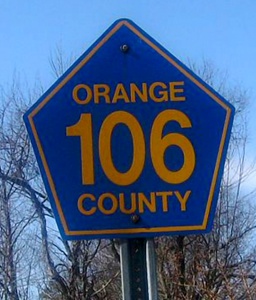
Pattern #98, Centers are collinear, Fraction of the original circle shaded

Santa Claus Is Coming

Pattern #8, Penguins

Rockin’ Around the Christmas Tree

Pattern #152, from John Golden, Circles

Puzzles Under the Tree

  • Unfortunately, the holidays come smack in the middle of flu season. Did you come down with The Grinch Bug?
Pattern #52, Cubes
  • Speaking of Christmas carols, the Christmas Price Index shows the current cost for one set of each of the gifts given in the song “The Twelve Days of Christmas.” I wonder what’s the cumulative cost of all the gifts, when you count each repetition in the song?

Christmas Adventures with Alexandria Jones

Alexandria Jones and her family are fictional characters from my old Mathematical Adventures newsletter. Their stories appear sporadically as I find time to transcribe them from the back-issues. You can find them all on this blog page.

Here are all the Alexandria Jones stories Christmas stories, with activity and craft ideas…

Pattern #174, from Katie Gates, Squares

What About Worksheets?

Do you need to keep your kids busy and work in a bit of math practice? Try these Christmas word problems:

Or visit the sites below for worksheets to cover all ages:

Pattern #28, Surface area

CREDITS: “Circle Packing” feature graphic (top) by fdecomite via Flickr (CC BY 2.0). Picture pattern puzzles from Visual Patterns website.

Playful Math Education Carnival 123: Hundred Chart Edition

Do you enjoy math? I hope so!

If not, browsing this post just may change your mind.

Welcome to the 123rd edition of the Playful Math Education Blog Carnival — a smorgasbord of delectable tidbits of mathy fun.

The Playful Math Carnival is like a free online magazine devoted to learning, teaching, and playing around with math from preschool to high school. This month’s edition features \left ( 1 + 2 + 3 \right )^{2} = 36 \: articles from bloggers all across the internet.

You’re sure to find something that will delight both you and your child.

By tradition, we start the carnival with a puzzle in honor of our 123rd edition. But if you would like to jump straight to our featured blog posts, click here to see the Table of Contents.

Or more, depending on how you count. And on whether I keep finding things to squeeze in under the looming deadline. But if there are more, then there are certainly 36. Right?

Continue reading Playful Math Education Carnival 123: Hundred Chart Edition

70+ Things To Do with a Hundred Chart

Do the holidays mess with your schedule? They sure do mine!

Every year, we get busy. Distracted. Just can’t focus on lessons.

I love easy activities that require minimal preparation so I can pull something out and play when we’re having one of those no-energy days.

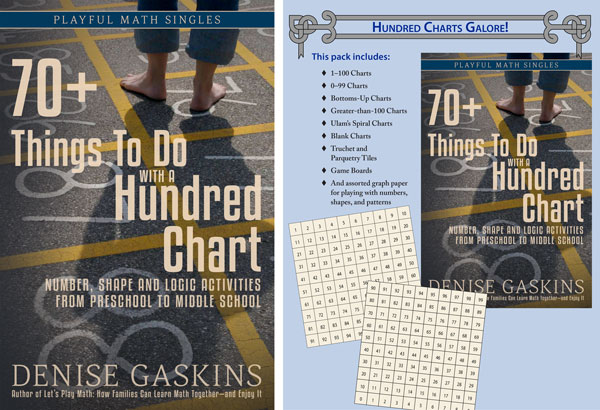
If that sounds good to you, too, then you’ll want to check out my new ebook 70+ Things To Do with a Hundred Chart: Number, Shape, and Logic Activities from Preschool to Middle School.

Long years ago, when I did workshops at homeschooling conferences, I used to share a list of seven ways to play with a hundred chart. The all-time most visited post on my blog offers 34 playful activities. Now I’ve more than doubled that total for this book.

So many ways to play! One of them is sure to be perfect for you and your children.

Take your child on a mathematical adventure with these playful, practical activities.

Who knew math could be so much fun?

Get your copy today!

“It is exactly the kind of math exploration that I want to undertake with my kids.

“After reading through the book, I noticed myself making more room to trust my kids’ ability to make connections and not try to dominate by telling them how math ‘should’ work.

“An excellent way for me to move outside my math and teaching comfort zones and explore math more deeply with my kids.”

— Olisia Barron, author of ThimbleberryHome.wordpress.com

P.S.: If you have a blog and would like to host a giveaway for 70+ Things To Do with a Hundred Chart (or any of my other books), I’d be glad to provide the prize. Leave a comment below or use the contact form on my “About” page, and we’ll set up all the details.
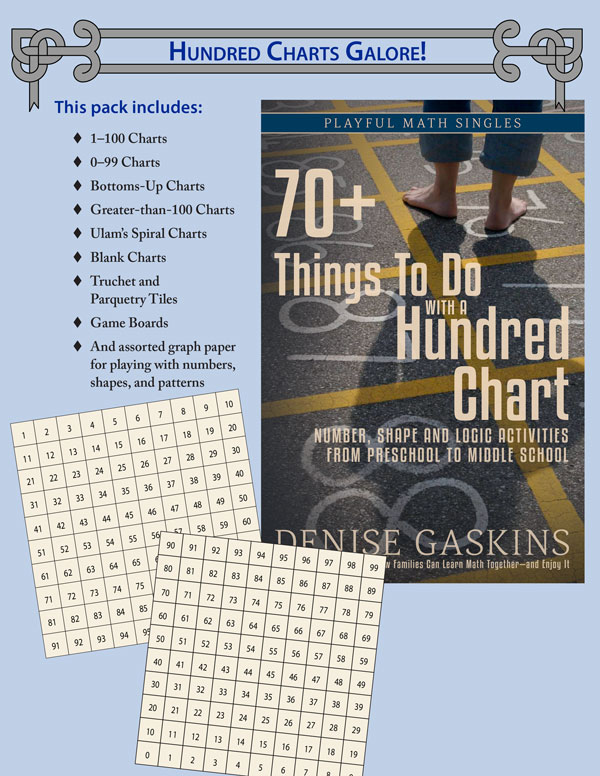

Hundred Charts Galore!

Check out my new printables for playing math with your kids:

The free 50-page PDF Hundred Charts Galore! file features 1–100 charts, 0–99 charts, bottom’s-up versions, multiple-chart pages, blank charts, game boards, and more. Everything you need to play the activities in my new 70+ Things to Do with a Hundred Chart book.

Download Hundred Charts Galore

Or you can use these charts with the activities in my all-time most popular blog post:

Playful Math Education Carnival 115—Women of Mathematics

Welcome to the 115th edition of the Playful Math Education Blog Carnival — a smorgasbord of links to bloggers all around the internet who have great ideas for learning, teaching, and playing around with math from preschool to pre-college.

In honor of Women’s History Month, this carnival features quotes from fifteen women mathematicians.

If you would like to jump straight to our featured blog posts, click here to see the Table of Contents.

Let the mathematical fun begin!

The Women of Mathematics

They came from many countries and followed a variety of interests.

They conquered new topics in mathematics and expanded the world’s understanding of old ones.

They wrestled with theorems, raised children, published articles, won awards, faced discrimination, led professional organizations, and kept going through both success and failure.

Some gained international renown, but most enjoyed quiet lives.

They studied, learned, and lived (and some still live) as most of us do — loving their families and friends, joking with colleagues, hoping to influence students.

I think you’ll find their words inspiring.

“What I really am is a mathematician. Rather than being remembered as the first woman this or that, I would prefer to be remembered, as a mathematician should, simply for the theorems I have proved and the problems I have solved.”
Julia Robinson (1919–1985)


“All in all, I have found great delight and pleasure in the pursuit of mathematics. Along the way I have made great friends and worked with a number of creative and interesting people. I have been saved from boredom, dourness, and self-absorption. One cannot ask for more.”
Karen Uhlenbeck (b. 1942)

Continue reading Playful Math Education Carnival 115—Women of Mathematics

2018 Mathematics Game — Join the Fun!

Let’s resolve to have fun with math this year. Ben has posted a preview of 2018’s mathematical holidays. Iva offers plenty of cool ways to think about the number 2018. And Patrick proposes a new mathematical conjecture.

But my favorite way to celebrate any new year is by playing the Year Game. It’s a prime opportunity for players of all ages to fulfill the two most popular New Year’s Resolutions: spending more time with family and friends, and getting more exercise.

So grab a partner, slip into your workout clothes, and pump up those mental muscles!

For many years mathematicians, scientists, engineers and others interested in mathematics have played “year games” via e-mail and in newsgroups. We don’t always know whether it is possible to write expressions for all the numbers from 1 to 100 using only the digits in the current year, but it is fun to try to see how many you can find. This year may prove to be a challenge.

Math Forum Year Game Site

Rules of the Game

Use the digits in the year 2018 to write mathematical expressions for the counting numbers 1 through 100. The goal is adjustable: Young children can start with looking for 1-10, middle grades with 1-25.

  • You must use all four digits. You may not use any other numbers.
  • Solutions that keep the year digits in 2-0-1-8 order are preferred, but not required.
  • You may use +, -, x, ÷, sqrt (square root), ^ (raise to a power), ! (factorial), and parentheses, brackets, or other grouping symbols.
  • You may use a decimal point to create numbers such as .2, .02, etc., but you cannot write 0.02 because we only have one zero in this year’s number.
  • You may create multi-digit numbers such as 10 or 201 or .01, but we prefer solutions that avoid them.

My Special Variations on the Rules

  • You MAY use the overhead-bar (vinculum), dots, or brackets to mark a repeating decimal. But students and teachers beware: you can’t submit answers with repeating decimals to Math Forum.
  • You MAY use a double factorial, n!! = the product of all integers from 1 to n that have the same parity (odd or even) as n. I’m including these because Math Forum allows them, but I personally try to avoid the beasts. I feel much more creative when I can wrangle a solution without invoking them.

Click here to continue reading.

Holiday Math and More: Playful Math Education Carnival 114

Do you enjoy math? I hope so! If not, the links in this post just may change your mind.

Welcome to the 114th edition of the Math Teachers At Play math education blog carnival — a smorgasbord of articles by bloggers all around the internet who have great ideas for learning, teaching, and playing around with math from preschool to pre-college.

If you would like to jump straight to our featured blog posts, click here to see the Table of Contents.

By the way, I found a cool, semi-self-referential trivia tidbit about our carnival number: 27 − 14 = 114. And if you put 114 dots into a 1←7 Exploding Dots machine, you’ll get the code 222. Pretty neat!

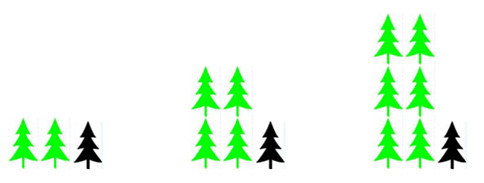
As you scroll through the links below, you find several puzzle graphics from the wonderful Visual Patterns website. Use them as conversation-starters with your kids: What do you notice? How does each pattern grow? For older students: Can you write a formula to describe how each pattern? What will it look at stage 43?

Pattern #7, Trees

A BIT OF FUN

Setting the mood: Enjoy this bit of seasonal fidgeting from Vi Hart (@vihartvihart).

If you don’t understand some of the references, that’s normal! Pick a phrase, Google it, and enjoy the fun of learning something new.


TABLE OF CONTENTS

And now, on to the main attraction: the blog posts. Some articles were submitted by their authors; others were drawn from the immense backlog in my rss reader. If you’d like to skip directly to your area of interest, click one of these links.

Let the mathematical fun begin!

Continue reading Holiday Math and More: Playful Math Education Carnival 114

Check Out These Cool Math Sales

I’ve been following Sonya’s Arithmophobia No More blog for a couple of years, and I love the work she is doing. But this month, she’s teamed up with Lacy at Play, Discover, Learn (another great blog to follow!) to offer a humongous bundle of playful math.

You get math journaling pages, games, creative task cards, thought-provoking worksheets, and video training resources to help you build your child’s understanding of math from arithmetic to early algebra. Wow!

These activities are perfect for homeschooling families or anyone looking to supplement their child’s current math curriculum with effective discovery-based activities. If you’ve ever wondered what to do with those Cuisenaire rods you picked up on sale way back when, this bundle is for you.

I’m so looking forward to using some of these ideas with my elementary homeschool co-op kids next year!

Sale price is $30 from December 2-15.

Cuisenaire Rod Activities Blowout Bundle

But Wait, There’s More

If you’ve been reading my blog for very long, you’ve probably seen how much I love the blog, books, and classes available from the Natural Math folks.

Their newest book is just off the presses — Funville Adventures, a math adventure chapter book.

And until December 20, they’re having a holiday sale. Make your own bundle of any Natural Math books. Playful algebra, calculus for 5-year-olds, inquiry problems and more: Great deal!

Natural Math Book Sale

Stock Up on My Playful Math Books

Finally, if you’ve been wanting to pick up a paperback copy of Let’s Play Math or some of my game books, or maybe a set of dot-grid math journals, I’m currently offering a discount on bulk orders.

Bundle ANY assortment of titles. Stock up on books for your family, friends, or homeschool group.

  • 2–4 books: 15% discount off retail prices
  • 5–9 books: 25% discount
  • 10–19 books: 35% discount
  • 20+ books: 35% discount, and free Continental U.S. standard shipping or the equivalent discount off other shipping options

Bulk Order Playful Math Paperbacks

(US customers only: We’re sorry we can’t offer bulk discounts for our international readers, but the complexities of international duties and tax laws are too much for this very small family business.)

Do You Know of Any Math Deals?

Apollonian greetings from my homeschool co-op kids, and best wishes for a grace-filled holiday season.

If you’ve seen a great deal or holiday price on a math resource you love, please share!

Add your deal to the comment section below, so we can all take advantage of the math joy this season.

How to Succeed in Math: Answer-Getting vs. Problem-Solving

You want your child to succeed in math because it opens so many doors in the future.

But kids have a short-term perspective. They don’t really care about the future. They care about getting through tonight’s homework and moving on to something more interesting.

So how can you help your child learn math?

When kids face a difficult math problem, their attitude can make all the difference. Not so much their “I hate homework!” attitude, but their mathematical worldview.

Does your child see math as answer-getting? Or as problem-solving?

Answer-getting asks “What is the answer?”, decides whether it is right, and then goes on to the next question.

Problem-solving asks “Why do you say that?” and listens for the explanation.

Problem-solving is not really interested in “right” or “wrong”—it cares more about “makes sense” or “needs justification.”

Homeschool Memories

In our quarter-century-plus of homeschooling, my children and I worked our way through a lot of math problems. But often, we didn’t bother to take the calculation all the way to the end.

Why didn’t I care whether my kids found the answer?

Because the thing that intrigued me about math was the web of interrelated ideas we discovered along the way:

  • How can we recognize this type of problem?
  • What other problems are related to it, and how can they help us understand this one? Or can this problem help us figure out those others?
  • What could we do if we had never seen a problem like this one before? How would we reason it out?
  • Why does the formula work? Where did it come from, and how is it related to basic principles?
  • What is the easiest or most efficient way to manipulative the numbers? Does this help us see more of the patterns and connections within our number system?
  • Is there another way to approach the problem? How many different ways can we think of? Which way do we like best, and why?

What Do You think?

How did you learn math? Did your school experience focus on answer-getting or problem-solving?

How can we help our children learn to think their way through math problems?

I’d love to hear from you! Please share your opinions in the Comments section below.

CREDITS: “Math Phobia” photo by Jimmie (blog post title added) via Flickr (CC BY 2.0). Phil Daro video by SERP Media (the Strategic Education Research Partnership) via Vimeo.

Rabbit Trails and Fibonacci Poetry

Homeschool Memories…

Well, I hadn’t planned on spending my day that way. But one of the great things about homeschooling is the freedom to follow rabbit trails.

While browsing the Carnival of Homeschooling, I found a link to Farm School blog’s article Fib Foolery, which sent me to Gotta Book for his articles The Fib and More Fibbery (read the comments on both threads, but be warned that some are crude) and several other posts, all of which set me off on a morning of poetic fun.

A “Fib” is a Fibonacci poem. It’s based on syllable count, like a haiku, but the lines follow the Fibonacci counting series: 1, 1, 2, 3, 5, 8… Each number is the sum of the previous two numbers.

I knew what I was going to share at our Tuesday Teatime and Poetry Reading that afternoon.

Continue reading Rabbit Trails and Fibonacci Poetry