The Function Machineย Game

Math concepts: odd numbers, even numbers, greater-than/less-than, rounding off, addition, subtraction, multiplication, division, fractions, negative numbers, prime numbers, square numbers, problem solving, mental math
Number of players: two or more
Equipment: pencil (or pen) and paper for every player

Continue reading The Function Machineย Game

How to Teach Math to a Struggling Student

photo by MC Quinn via flickr (CC BY 2.0)

Paraphrased from a homeschool math discussion forum:

“Help! My daughter struggles with arithmetic. I guess she is like me: just not a math person. She is an outstanding reader. When we do word problems, she usually has no trouble. She’s a whiz at strategy games and beats her dad at chess every time. But numbers — yikes! When we play Yahtzee, she gets lost trying to add up her score. The simple basics of adding and subtracting confuse her.

“Since I find math difficult myself, it’s hard for me to know what she needs. What’s missing to make it click for her? She used to think math was fun and tested well above grade level, but I listened to some well-meaning advice and totally changed the way we were schooling. I switched from using workbooks and games to using Saxon math, and she got extremely frustrated. Now she hates math.”

Continue reading How to Teach Math to a Struggling Student

Math Games by Kids

Photo by Mike Licht, NotionsCapital.com.

The cold came back and knocked me flat, but there are compensations. The downtime gave me a chance to browse my overflowing bookmarks folder, and I found something to add to my resource page. Princess Kitten and I enjoyed exploring these games and quizzes from Ambleweb.

Continue reading Math Games by Kids

Backwards Math

Photo by Complicated.

Princess Kitten is recovering from her cold and getting some energy back. She came to me and said wistfully, “I wish I could do backwards math.”

I looked up from my keyboard. “Backwards math? What do you mean?”

“Umm. It’s kinda hard to explain, but I can show you.”

Continue reading Backwards Math

Subtracting Mixed Numbers: A Cry for Help

Photo by powerbooktrance.

Paraphrased from a homeschool math discussion forum:

“Help me teach fractions! My son can do long subtraction problems that involve borrowing, and he can handle basic fraction math, but problems like 9  -  5 \frac{2}{5} give him a brain freeze. To me, this is an easy problem, but he can’t grasp the concept of borrowing from the whole number. It is even worse when the math book moves on to 10 \frac{1}{4}  -  2 \frac{3}{7} .”

Several homeschooling parents replied to this question, offering advice about various fraction manipulatives that might be used to demonstrate the concept. I am not sure that manipulatives are needed or helpful in this case. The boy seems to have the basic concept of subtraction down, but he gets flustered and is unsure of what to do in the more complicated mixed-number problems.

The mother says, “To me, this is an easy problem” — and that itself is one source of trouble. Too often, we adults (homeschoolers and classroom teachers alike) don’t appreciate how very complicated an operation we are asking our students to perform. A mixed-number calculation like this is an intricate dance that can seem overwhelming to a beginner.

I will go through the calculation one bite at a time, so you can see just how much a student must remember. As you read through the steps, pay attention to your own emotional reaction. Are you starting to feel a bit of brain freeze, too?

Afterward, we’ll discuss how to make the problem simpler…

Continue reading Subtracting Mixed Numbers: A Cry for Help

Math Links for Fun and Charity

Numbers
Photo by James Cridland.

Aargh! My computer died again. So I borrowed my daughter’s laptop and ran off to the coffee shop to write blog articles — and discovered that all the outlets on the wall here are fake. Why would they do that? Anyway, before the laptop battery dies, I want to share a couple of math links with you…

Continue reading Math Links for Fun and Charity

How Should We Teach Arithmetic?

Dave Marain of MathNotations is running a poll about how to teach multiplication, but the question has broader application:

How should we teach the arithmetic algorithms
— or should we teach them at all?

Algorithms are step-by-step methods for doing something. In arithmetic, we have standard algorithms for addition, subtraction, multiplication, and long division. Once the student masters the steps for any particular algorithm, he can follow the steps to a correct answer without ever thinking about what the numbers mean.

Continue reading How Should We Teach Arithmetic?

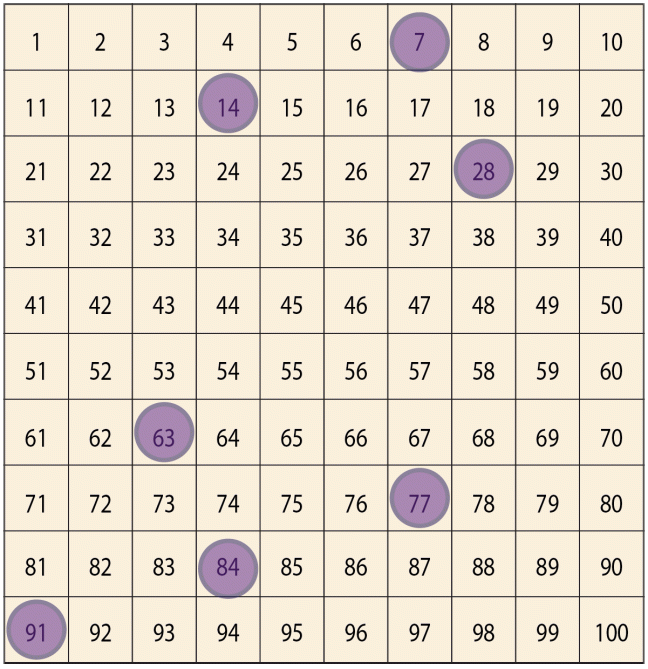
Euclid’s Game on a Hundred Chart

Math concepts: subtraction within 100, number patterns, mental math
Number of players: 2 or 3
Equipment: printed hundred chart (also called a hundred board), and highlighter or translucent disks to mark numbers — or use this online hundred chart

Set Up

Place the hundred chart and highlighter where all players can reach them.

How to Play

  • Allow the youngest player choice of moving first or second; in future games, allow the loser of the last game to choose.
  • The first player chooses a number from 1 to 100 and marks that square on the hundred chart.
  • The second player chooses and marks any other number.
  • On each succeeding turn, the player subtracts any two marked numbers to find and mark a difference that has not yet been taken.
  • Play alternates until no more numbers can be marked.

Continue reading Euclid’s Game on a Hundred Chart

2008 Mathematics Game

Are you ready for a challenge? Join us for the 2008 Mathematics Game. Here are the rules:

Use the digits in the year 2008 and the operations +, -, x, รท, sqrt (square root), ^ (raise to a power), and ! (factorial) — along with parentheses, brackets, or other grouping symbols — to write expressions for the counting numbers 1 through 100.

  • All four digits must be used in each expression.
  • Only the digits 2, 0, 0, 8 may be used.
  • Multi-digit numbers such as 20, 208, or .02 MAY be used this year.
  • The square function may NOT be used.
  • The integer function may NOT be used.

By definition:
0! = 1
[See Dr. Math’s Why does 0 factorial equal 1?]

For this game we will accept the value:
{0}^{0} = 1
[See the Dr. Math FAQ 0 to the 0 power.]

Continue reading 2008 Mathematics Game