Egyptian Fractions: The Answer Sheet

Remember the Math Adventurer’s Rule: Figure it out for yourself! Whenever I give a problem in an Alexandria Jones story, I will try to post the answer (relatively) soon afterward. But don’t peek! If I tell you the answer, you miss out on the fun of solving the puzzle. So if you haven’t worked these problems yet, go back to the original post. Figure them out for yourself — and then check the answers just to prove that you got them right.


The Secret of Egyptian Fractions

Alex made a poster of Egyptian-style fractions, from 1/2 to 9/10. Many of the fractions were easy. She knew that…

\frac{5}{10}  = \frac{4}{8}  = \frac{3}{6}  = \frac{2}{4}  = \frac{1}{2}

Therefore, as soon as she figured out one fraction, she had the answer to all of its equivalents.

She had the most trouble with the 7ths and 9ths. She tried converting these to other fractions that were easier to work with. For example, 28 has more factors than 7, making 28ths easier to break up into other fractions with one in the numerator.

Continue reading Egyptian Fractions: The Answer Sheet

The Secret of Egyptian Fractions

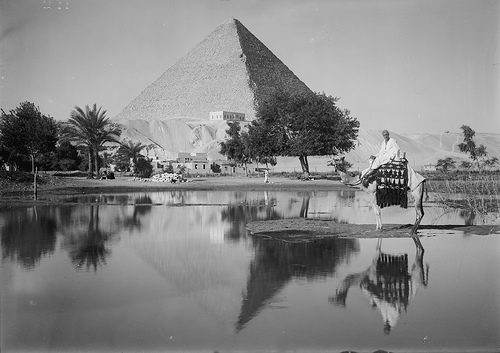
Photo from Library of Congress via pingnews.

Archaeology professor Dr. Fibonacci Jones came home from a long day of lecturing and office work. Stepping inside the front door, he held up a shiny silver disk.

“Ta-da!” he said.

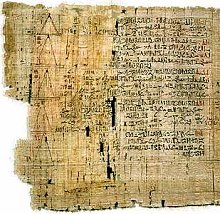
Rhind papyrus

“All right!” said his daughter Alexandria. “The photos are here.”

They had to chase Alex’s brother Leon off the computer so they could view the images on the CD, but that wasn’t hard. He wanted to see the artifacts, too. Alex recognized several of the items they had dug up from the Egyptian scribe’s burial plot: the wooden palette, some clay pots, and of course the embalmed body.

Then came several close-up pictures of writing on papyrus.

Photo from MathsNet.net.

How to Write Egyptian Fractions

“I remember how to read the Egyptian numbers,” Alex said, “but what are these marks above them?”

Dr. Jones nodded. “I thought you would catch that. Those are fractions. The scribe places an open mouth, which is the hieroglyph ‘r’, over a number to make its reciprocal.”

“I know that word,” Leon said. “It means one over the number. Like, the reciprocal of 12 is 1/12, right?”

“That is right. 1/12 would be written as…”

The Rest of the Story

As I transcribed this article from my old math newsletter, I realized that it would require more graphics than I was willing to construct. LaTex does not handle Egyptian hieroglyphs — or at least, I don’t know how to make it do so. Instead, I decided to scan the newsletter pages and give them to you as a pdf file:

Right-click and choose “Save” to download:

The file includes a student worksheet for Egyptian fractions from 1/2 to 9/10.

Egyptian Fractions: The Answer Sheet

The answers are now posted.

To Be Continued…

Read all the posts from the January/February 1999 issue of my Mathematical Adventures of Alexandria Jones newsletter.

Fraction Models, and a Card Game

Fraction cards

Models give us a way to form and manipulate a mental image of an abstract concept, such as a fraction. There are three basic ways we can imagine a fraction: as partially-filled area or volume, as linear measurement, or as some part of a given set. Teach all three to give your students a well-rounded understanding.

When teaching young students, we use physical models — actual food or cut-up pieces of construction paper. Older students and adults can firm up the foundation of their understanding by drawing many, many pictures. As we move into abstract, numbers-only work, these pictures remain in our minds, an always-ready tool to help us think our way through fraction problems.

Continue reading Fraction Models, and a Card Game

How to Read a Fraction

Fraction notation and operations may be the most abstract math monsters our students meet until they get to algebra. Before we can explain those frustrating fractions, we teachers need to go back to the basics for ourselves. First, let’s get rid of two common misconceptions:

  • A fraction is not two numbers.
    Every fraction is a single number. A fraction can be added to other numbers (or subtracted, multiplied, etc.), and it has to obey the Distributive Law and all the other standard rules for numbers. It takes two digits (plus a bar) to write a fraction, just as it takes two digits to write the number 18 — but, like 18, the fraction is a single number that names a certain amount of whatever we are counting or measuring.
  • A fraction is not something to do.
    A fraction is a number, not a recipe for action. The fraction 3/4 does not mean, “Cut your pizza into 4 pieces, and then keep 3 of them.” The fraction 3/4 simply names a certain amount of stuff, more than a half but not as much as a whole thing. When our students are learning fractions, we do cut up models to help them understand, but the fractions themselves are simply numbers.

Continue reading How to Read a Fraction

Solving Complex Story Problems II

[Oops! I found one more post from my old blog. It apparently slipped off the back of my metaphorical desk and has been sitting with the dust bunnies.]

Here is a math problem in honor of one of our family’s favorite movies

Han Solo was doing some needed maintenance on the Millennium Falcon. He spent 3/5 of his money upgrading the hyperspace motivator. He spent 3/4 of the remainder to install a new blaster cannon. If he spent 450 credits altogether, how much money did he have left?

[Modified from a word problem in Singapore Primary Math 5B. Stop and think about how you would solve it before reading further.]

Continue reading Solving Complex Story Problems II

How Shall We Teach Fractions?

How did you fare on the Frustrating Fractions Quiz? With so many apparent inconsistencies, we can all see why children (and their teachers) get confused. And yet, fractions are vital to our children’s test scores — and scores are important to college admissions officers. What is a teacher to do? Must we tell our children, “Do it this way, and don’t ask questions”?

Parents and teachers are tempted to wonder if the struggle is worth it. After all, how often do you divide by a fraction in your adult life? If only we could skip the hard stuff…

Continue reading How Shall We Teach Fractions?

Quiz: Those Frustrating Fractions

[Photo by jimmiehomeschoolmom.]

Fractions confuse almost everybody. In fact, fractions probably cause more math phobia among children (and their parents) than any other topic before algebra. Middle school textbooks devote a tremendous number of pages to teaching fractions, and still many students find fractions impossible to understand. Standardized tests are stacked with fraction questions.

Fractions are a filter, separating the math haves from the luckless have nots. One major source of difficulty with fractions is that the rules do not seem to make sense. Can you explain these to your children?

Start with an easy one…

Question

If you need a common denominator to add or subtract fractions…

  • Why don’t you need a common denominator when you multiply?

Continue reading Quiz: Those Frustrating Fractions

Reading to Learn Math

[Photo by Betsssssy.]

Do you ever take your kids’ math tests? It helps me remember what it is like to be a student. I push myself to work quickly, trying to finish in about 1/3 the allotted time, to mimic the pressure students feel. And whenever I do this, I find myself prone to the same stupid mistakes that students make.

Even teachers are human.

In this case, it was a multi-step word problem, a barrage of information to stumble through. In the middle of it all sat this statement:

…and there were 3/4 as many dragons as gryphons…

My eyes saw the words, but my mind heard it this way:

…and 3/4 of them were dragons…

What do you think — did I get the answer right? Of course not! Every little word in a math problem is important, and misreading even the smallest word can lead a student astray. My mental glitch encompassed several words, and my final tally of mythological creatures was correspondingly screwy.

But here is the more important question: Can you explain the difference between these two statements?

Continue reading Reading to Learn Math

7 Things to Do with a Hundred Chart


This post has been revised to incorporate all the suggestions in the comments below, plus many more activities. Please update your bookmarks:

Or continue reading the original article…


Continue reading 7 Things to Do with a Hundred Chart

How Old Are You, in Nanoseconds?

Conversion factors are special fractions that contain problem-solving information. Why are they called conversion factors? “Conversion” means change, and conversion factors help you change the numbers and units in your problem. “Factors” are things you multiply with. So to use a conversion factor, you will multiply it by something.

For instance, if I am driving an average of 60 mph on the highway, I can use that rate as a conversion factor. I may use the fraction \frac{60 \: miles}{1 \: hour} , or I may flip it over to make \frac{1 \: hour}{60 \: miles} . It all depends on what problem I want to solve.

After driving two hours, I have traveled:

\left(2 \: hours \right) \times \frac{60 \: miles}{1 \: hour} = 120 miles so far.

But if I am planning to go 240 more miles, and I need to know when I will arrive:

\left(240 \: miles \right) \times \frac{1 \: hour}{60 \: miles} = 4 hours to go.

Any rate can be used as a conversion factor. You can recognize them by their form: this per that. Miles per hour, dollars per gallon, cm per meter, and many, many more.

Of course, you will need to use the rate that is relevant to the problem you are trying to solve. If I were trying to figure out how far a tank of gas would take me, it wouldn’t be any help to know that an M1A1 Abrams tank gets 1/3 mile per gallon. I won’t be driving one of those.

Using Conversion Factors Is Like Multiplying by One

If I am driving 65 mph on the interstate highway, then driving for one hour is exactly the same as driving 65 miles, and:

\frac{65 \: miles}{1 \: hour} = the \: same \: thing \: divided \: by \: itself = 1

This may be easier to see if you think of kitchen measurements. Two cups of sour cream are exactly the same as one pint of sour cream, so:

\frac{2 \: cups}{1 \: pint} = \left(2 \: cups \right) \div \left(1 \:pint \right) = 1

If I want to find out how many cups are in 3 pints of sour cream, I can multiply by the conversion factor:

\left(3 \: pints \right) \times \frac{2 \: cups}{1 \: pint} = 6 \: cups

Multiplying by one does not change the original number. In the same way, multiplying by a conversion factor does not change the original amount of stuff. It only changes the units that you measure the stuff in. When I multiplied 3 pints times the conversion factor, I did not change how much sour cream I had, only the way I was measuring it.

Conversion Factors Can Always Be Flipped Over

If there are \frac{60 \: minutes}{1 \: hour} , then there must also be \frac{1 \: hour}{60 \: minutes} .

If I draw house plans at a scale of \frac{4 \: feet}{1 \: inch} , that is the same as saying \frac{1 \: inch}{4 \: feet} .

If there are \frac{2\: cups}{1 \: pint} , then there is \frac{1\: pint}{2 \: cups} = 0.5 \: \frac{pints}{cup} .

Or if an airplane is burning fuel at \frac{8\: gallons}{1 \: hour} , then the pilot has only 1/8 hour left to fly for every gallon left in his tank.

This is true for all conversion factors, and it is an important part of what makes them so useful in solving problems. You can choose whichever form of the conversion factor seems most helpful in the problem at hand.

How can you know which form will help you solve the problem? Look at the units you have, and think about the units you need to end up with. In the sour cream measurement above, I started with pints and I wanted to end up with cups. That meant I needed a conversion factor with cups on top (so I would end up with that unit) and pints on bottom (to cancel out).

You Can String Conversion Factors Together

String several conversion factors together to solve more complicated problems. Just as numbers cancel out when the same number is on the top and bottom of a fraction (2/2 = 2 ÷ 2 = 1), so do units cancel out if you have the same unit in the numerator and denominator. In the following example, quarts/quarts = 1.

How many cups of milk are there in a gallon jug?

\left(1\: gallon \right) \times \frac{4\: quarts}{1\: gallon} \times \frac{2\: pints}{1\: quart} \times \frac{2\: cups}{1\: pint} = 16\: cups

As you write out your string of factors, you will want to draw a line through each unit as it cancels out, and then whatever is left will be the units of your answer. Notice that only the units cancel — not the numbers. Even after I canceled out the quarts, the 4 was still part of my calculation.

Let’s Try One More

The true power of conversion factors is their ability to change one piece of information into something that at first glance seems to be unrelated to the number with which you started.

Suppose I drove for 45 minutes at 55 mph in a pickup truck that gets 18 miles to the gallon, and I wanted to know how much gas I used. To find out, I start with a plain number that I know (in this case, the 45 miles) and use conversion factors to cancel out units until I get the units I want for my answer (gallons of gas). How can I change minutes into gallons? I need a string of conversion factors:

\left(45\: min. \right) \times \frac{1\: hour}{60\: min.} \times \frac{55\: miles}{1\: hour} \times \frac{1\: gallon}{18\: miles} = 2.3\: gallons

How Old Are You, Anyway?

If you want to find your exact age in nanoseconds, you need to know the exact moment at which you were born. But for a rough estimate, just knowing your birthday will do. First, find out how many days you have lived:

Days\: I\:have\: lived = \left(my\: age \right) \times \frac{365\: days}{year}

+ \left(number\: of\: leap\: years \right) \times \frac{1\: extra\: day}{leap\: year}

+ \left(days\: since\: my\: last\: birthday,\: inclusive \right)

Once you know how many days you have lived, you can use conversion factors to find out how many nanoseconds that would be. You know how many hours are in a day, minutes in an hour, and seconds in a minute. And just in case you weren’t quite sure:

One\: nanosecond = \frac{1}{1,000,000,000} \: of\: a\: second

Have fun playing around with conversion factors. You will be surprised how many problems these mathematical wonders can solve.


[Note: This article is adapted from my out-of-print book, Master the Math Monsters.]