Playful Math Carnival #154: The Math Journaling Edition

Welcome to the 154th edition of the Playful Math Education Blog Carnival — a smorgasbord of delectable tidbits of mathy fun. It’s like a free online magazine devoted to learning, teaching, and playing around with math from preschool to high school.

Bookmark this post, so you can take your time browsing.

There’s so much playful math to enjoy!

By tradition, we start the carnival with a puzzle/activity in honor of our 154th edition. But if you’d rather jump straight to our featured blog posts, click here to see the Table of Contents.

Try This Puzzle/Activity

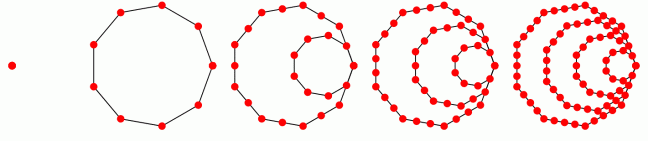
Since 154 is a nonagonal number, I think you might enjoy visiting some of my old “Adventures of Alexandria Jones” posts about figurate numbers:

And then try this math journaling prompt: Build or draw your own nonagonal numbers — numbers built from 9-sided polygons.

How many nonagonal numbers can you find? What do you notice? Does it make you wonder?
Click here for all the mathy goodness!

Playful Math #152: Auld Lang Syne Edition

Welcome to the 152nd edition of the Playful Math Education Blog Carnival — a smorgasbord of delectable tidbits of mathy fun. It’s like a free online magazine devoted to learning, teaching, and playing around with math from preschool to high school.

Bookmark this post, so you can take your time browsing. There’s so much playful math to enjoy!

We didn’t have a volunteer host for January, so I’m squeezing this in between other commitments. This is my third no-host-emergency carnival in the last year, which is NOT sustainable. If you’d like to help keep the Playful Math Carnival alive, we desperately need hosts for 2022!

By tradition, we start the carnival with a puzzle or activity in honor of our 152nd edition. But if you’d rather jump straight to our featured blog posts, click here to see the Table of Contents.

Math Journaling with Prime Numbers

Cool facts about 152: The eighth prime number is 19, and 8 × 19 = 152. When you square 152, you get a number that contains all the digits from 0–4. You can make 152 as the sum of eight consecutive even numbers, or as the sum of four consecutive prime numbers.
But 152 has two real claims to fame:

  • It’s the smallest number that is the sum of the cubes of two distinct odd primes.
  • And it’s the largest known even number you can write as the sum of two primes in exactly four ways.

So here’s your math investigation prompt:

  • Play around with prime numbers. Explore their powers, their sums, and anything else about them you like.
  • What do you notice? What do you wonder?
  • What’s the most interesting number relationship you can find?

Continue reading Playful Math #152: Auld Lang Syne Edition

Playful Math Education Carnival 147

Welcome to the 147th edition of the Playful Math Education Blog Carnival — a smorgasbord of delectable tidbits of mathy fun. It’s like a free online magazine devoted to learning, teaching, and playing around with math from preschool to high school.
Bookmark this post, so you can take your time browsing. There’s so much playful math to enjoy!

By tradition, we start the carnival with a puzzle in honor of our 147th edition. But if you’d rather jump straight to our featured blog posts, click here to see the Table of Contents.

Continue reading Playful Math Education Carnival 147

Prealgebra & Geometry Games Now Available

Publication Day!

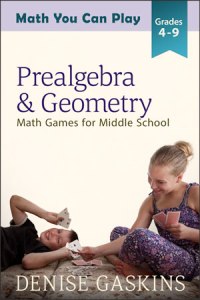
Prealgebra & Geometry: Math Games for Middle School hits the online bookstores today.

Check Your Favorite Store

You can prepare your children for high school math by playing with positive and negative integers, number properties, mixed operations, algebraic functions, coordinate geometry, and more. Prealgebra & Geometry features 41 kid-tested games, offering a variety of challenges for students in 4–9th grades and beyond.

A true understanding of mathematics requires more than the ability to memorize procedures. This book helps your children learn to think mathematically, giving them a strong foundation for future learning.

And don’t worry if you’ve forgotten all the math you learned in school. I’ve included plenty of definitions and explanations throughout the book. It’s like having a painless math refresher course as you play.

Continue reading Prealgebra & Geometry Games Now Available

Playful Math Carnival 144: Anniversary Edition

Welcome to the 144th edition of the Playful Math Education Blog Carnival — a smorgasbord of delectable tidbits of mathy fun. It’s like a free online magazine devoted to learning, teaching, and playing around with math from preschool to high school.
Bookmark this post, so you can take your time browsing.

There’s so much playful math to enjoy!

By tradition, we would start the carnival with a puzzle/activity in honor of our 144th edition. But this time, I want to take a peek back at the history of our carnival.

But if you’d rather jump straight to our featured blog posts, click here to see the Table of Contents.

Continue reading Playful Math Carnival 144: Anniversary Edition

Playing Math with Michael and Nash

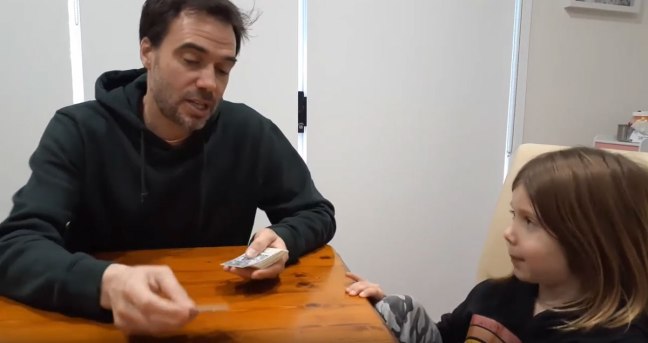
Michael and Nash have been creating and posting new math games with astonishing regularity throughout the pandemic. Their YouTube channel is a great resource for parents who want to play math with elementary-age children.

Today’s entry: Closest to Ten, a quick game for addition and subtraction fluency with a tiny bit of multiplication potential.

And here’s one of my favorites for older players: Factor Triangles, a card game for 2-digit multiplication.

Check out their channel, and have fun playing math with your kids!

Visit Michael and Nash on YouTube

How to Build Math Literacy

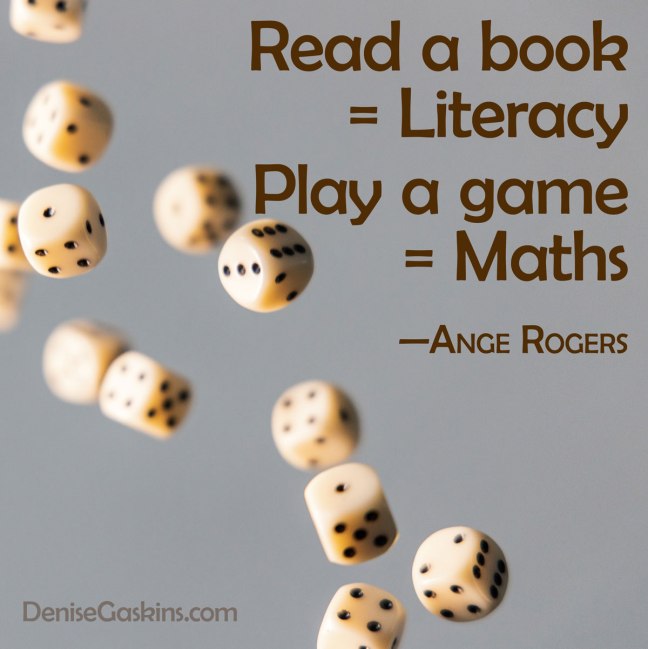
Here’s the full quote:

We all know reading a book each day to our child develops their love of literacy… well, playing games is the equivalent in maths.

Through playing card games and board games (just short and sweet ones) children develop problem solving, counting and so many other skills.

Imagine if every time you play a game you say, “Let’s do some maths.” What a positive association your child will develop with maths!

—Ange Rogers
Instagram post

Discover more creative ways to play math with young children at the Number Doctors blog.

CREDITS: “Falling dice” photo by Riho Kroll on Unsplash.

The Best Math Game Ever

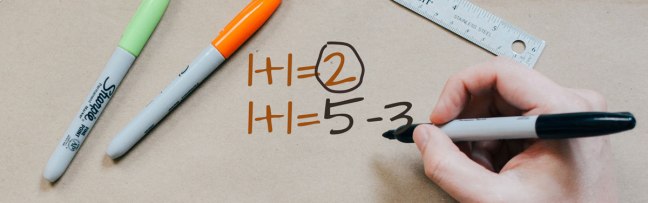
The Substitution Game features low-floor, high-ceiling cooperative play that works with any age (or with a mixed-age group) — and you can use it while distance learning, too. It’s great for building algebraic thinking.

Excerpted from my new book, Prealgebra & Geometry: Math Games for Middle School. Look for it at your favorite online bookstore.

The Substitution Game

Math Concepts: addition, subtraction, multiplication, division, order of operations, integers, fractions, equivalence and substitution.

Players: any number (a cooperative game).

Equipment: whiteboard and markers (preferred) or pencil and paper to share. Calculator optional.

Continue reading The Best Math Game Ever

Math Game: Hit Me

I believe this was the first math game I ever invented. Of course, ideas are common currency, so I’m sure other math teachers thought of it before I did. But to me, it was original.

I’ve blogged about the game before, but here’s the updated version as it appears in my new book Prealgebra & Geometry: Math Games for Middle School — scheduled for publication in early 2021. Sign up for my newsletter to get updates.

Hit Me

Math Concepts: integer addition, absolute value.

Players: two or more.

Equipment: playing cards (two decks may be needed for a large group).

Continue reading Math Game: Hit Me