March 14th is Pi Day, and it’s also Albert Einstein’s birthday. In honor of Einstein, MinutePhysics is posting a series of videos on his “wonder year” of 1905, when he published several papers that eventually earned him the Nobel Prize.
What I’m Reading: Fermat’s Enigma
Homeschooling is much more than just doing school at home — it’s a lifelong lifestyle of learning. And thanks to the modern miracle of inter-library loan, even those of us who live in the middle of nowhere can get just about any book sent directly to our tiny home-town libraries.
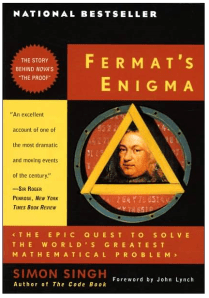
As I mentioned in Math Teachers at Play 46, I’m trying to add more living books about math to our homeschool schedule, including my own self-education reading. So, a copy of Fermat’s Enigma: The Epic Quest to Solve the World’s Greatest Mathematical Problem finally showed up at my library, and I am thoroughly enjoying it.
Review and Fibonacci Puzzle
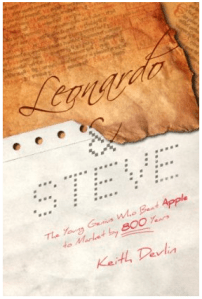
Thanks to author Keith Devlin’s generosity, I am giving away FIVE copies of his new e-book Leonardo and Steve: The Young Genius Who Beat Apple to Market by 800 Years (at the end of this review post), PLUS a signed copy of his latest print book, The Man of Numbers: Fibonacci’s Arithmetic Revolution.
Update: Giveaways are over. Congratulations to the winners!
What Leonardo did was every bit as revolutionary as the personal computer pioneers who in the 1980s took computing from a small group of “computer types” and made computers available to, and usable by, anyone. Like them, most of the credit for inventing and developing the methods Leonardo described in Liber Abbaci* goes to others, in particular Indian and Arabic scholars over many centuries. Leonardo’s role was to “package” and “sell” the new methods to the world.
The appearance of Leonardo’s book not only prepared the stage for the development of modern (symbolic) algebra, and hence modern mathematics, it also marked the beginning of the modern financial system and the way of doing business that depends on sophisticated banking methods.— Keith Devlin
Fibonacci’s ‘Numbers’: The Man Behind The Math
excerpt from The Man of Numbers
* Leonardo of Pisa, also known as Fibonacci, used two b’s in the word “calculation” (abbaci) to distinguish his methods from the use of an abacus.
Can You Solve This Fibonacci Puzzle?
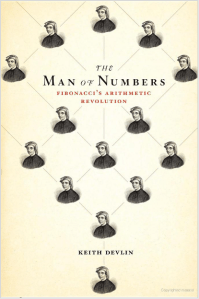
If you want a chance to win a personally signed copy of The Man of Numbers: Fibonacci’s Arithmetic Revolution, all you have to do is solve this riddle.
The Fibonacci sequence arises in the solution to a problem about a breeding rabbit population that Leonardo gave in Liber Abbaci.
But there is evidence that in another book he gave the problem in terms of different creatures.
- What were they?
Hint: The answer is in the e-book, Leonardo & Steve. But this is a no-purchase-necessary contest: There are at least two places to find the answer online, if you search carefully.
Update: I received a wide variety of answers to the Fibonacci riddle, including sheep, mice, donkeys, kittens, chambered nautilus, spiders, cow, dog, fox, sunflowers, humans, and an amoeba. Honeybees were by far the most popular wrong answer. Seven people managed to discover the correct creature. (No, I’m not telling! The answer is in the e-book, and it’s an interesting story to read.) Our official winner is Ken. Congratulations! I’ve sent you an email.
Math History E-book: Leonardo & Steve
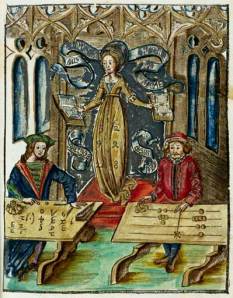
When teachers share stories from the history of math, we help students build a mental picture of the ebb and flow of ideas through the centuries: how men and women wrestled with concepts, made mistakes, argued with each other, and gradually developed the knowledge that today we take for granted.
I taught my Math Club to use a medieval counting board, but still I have trouble imagining the historical setting. What was it really like to work and think in Roman numerals, and then to suddenly learn this new way of calculating? In Leonardo & Steve, Keith draws a parallel between Leonardo’s work and the personal computer revolution — and having lived through the latter helps me understand what it was like when the Hindu number system changed the world.
To the reader today, Leonardo’s text describes something we have been familiar with since our early childhood math classes, but at the turn of the thirteenth century, elementary arithmetic was entirely unknown. When Leonardo was writing his mammoth work, the information it contained was as new to him as to his future readers. In many cases he was working out the examples for the first time ever. He was working them out for himself as much as for his later readers.
— Keith Devlin
Leonardo and Steve, Kindle locations 258-261
A Math History Mystery
 In addition to the title characters’ stories in Leonardo & Steve, I found the mystery of the abbacus books interesting. These were small math instruction books for the lay reader, like the Treviso Arithmetic. Hundreds, perhaps thousands, of people across Italy published abbacus books (at first handwritten, later printed) in the years after Leonardo wrote Liber Abaci. And then the books disappeared from history, until scholars rediscovered and began to write about them in the 1960s.
The abbacus books were not written by people doing original mathematics, but by people who learned the new way of working with Hindu-Arabic numbers, found it exciting, and wanted to share it with others. [Sort of like math teacher blogs?]
It would have made sense if the abbacus books had been copied from Leonardo’s Liber Abbaci — but they weren’t. So where did this flood of arithmetic books come from? Keith tells a story of historical forensics, as modern-day literary detectives sift clues to find the original source of the abbacus writings.
Despite the fact that medieval authors copied freely from one another all the time, hardly any of the abbacus books contained any passages from Liber Abbaci. The vast majority of abbacus books, including all the known early ones, had almost nothing in common with Leonardo’s masterpiece. Clearly, the authors of those early abbacus books found their material elsewhere than in the dense pages of Liber Abbaci.
— Keith Devlin
Leonardo and Steve, Kindle Locations 378-393
How to Enter the E-book Giveaway
For a chance to win a copy of the e-book Leonardo & Steve (in your choice of format), you have two ways to enter the contest:
- Scroll down and leave a comment on this post answering one (or both) of these questions:
What is your favorite math history resource, or favorite math story?
Do you use math history in your teaching — and if so, how? - Post about this contest on your own blog, tweet about it, or otherwise share the news, and then come here and leave a comment telling me about your link.
You may do both (comment on the questions and link to the giveaway), to double your chances — but please make sure your link is in a separate comment from your answer to the questions, or I may forget to count it separately.
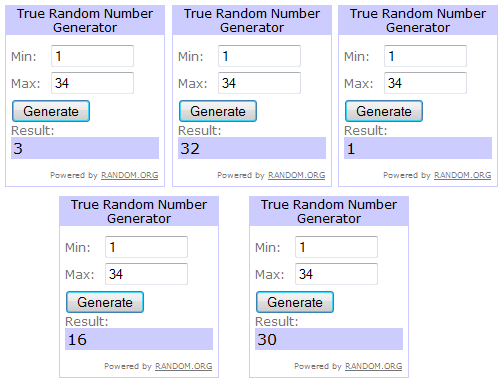
Update: Omitting the comments by Keith Devlin and the blog carnival pingbacks, we had 34 entries in the e-book giveaway. Congratulations to Judy, Katie, Penney, Rachel, and Charlotte. I will forward your email addresses to Keith, and you should be receiving a download code for your e-book soon. Thank you all for participating!
Would You Buy Math History for the Price of a Latte?
If you don’t win the giveaway, Leonardo & Steve is available at Barnes & Noble or Amazon or Smashwords for a mere $2.99. Keith would like to hear your reaction to the book:
As an author, the short, cheap, e-book format is new to me, and I think this is the first ever popular mathematics e-book. So please let me know what you think. In addition to knowing your views of the content, I’m eager to know your reaction to the format and the price. Many fascinating stories about mathematics can be told in 15,000 words, so if authors like myself can get it right, this could be a major part of the future of popular mathematics writing.
— Keith Devlin
Author comment on Leonardo and Steve
[Keith’s name above is an email link, or you can find his email address here.]
Free Math from Dover Publications

I love Dover books, don’t you? They publish so-o-o-o-o many interesting titles at reasonable prices. I always have several Dover books on my wishlist, waiting for my next bit of extra cash.
But you don’t have to wait to enjoy free math from Dover books. Sign up for the Dover Sampler, and each week they will send an email with links to content from all sorts of books. Or try the Dover Children’s Sampler and Dover Teacher’s Sampler for coloring books, mazes, literature, and more. All the Dover samplers are completely free, and you can cancel at any time.
From Last Week’s Sampler
Last week’s email included a section on “Exploring Mathematics”:
- Mathematical Fun, Games and Puzzles
- The Magic of Numbers
- Makers of Mathematics
- How to Solve Applied Mathematics Problems
And that’s only the beginning. Below, I’ve listed a wide variety of math-related links collected from past samplers. Though be warned: Dover does change its website from time to time, so these pages may disappear without notice.
Download, print, enjoy!
Can You Find These AWOL Math Websites?

In the course of my bloggy spring cleaning, I’ve made some terrible discoveries. Some of my favorite resources have disappeared off the internet. Or perhaps they’ve moved, and I just haven’t found their new homes.
Do you know where these websites went?
A Very Short History of Mathematics
This irreverant romp through the history of mathematics by W. W. O. Schlesinger and A. R. Curtis was read to the Adams Society (St. John’s College Mathematical Society) at their 25th anniversary dinner, Michaelmas Term, 1948.
Internet Archive’s Wayback Machine found a copy, but I’d love to replace this link with the article’s new location:
[Warning: Do not attempt to read this article while drinking coffee or other spittable beverage!]
Update: James Clare found the article’s new home here. Thank you!
Bloggy Spring Cleaning Continues
Still on course with my state-sponsored blog overhaul, and Google Reader insists on displaying every old post as new. What a nuisance! The email feed seems unaffected. (And not everyone is having the problem with Reader, either — see Comments below.)
Amazon won the reader poll (and it’s my favorite, too), so I’m converting all my old affiliate book links to just-plain Amazon links. At the same time, I’m checking for dead links and other dust bunnies among the old posts. I’ve worked my way up to June 2007 — four more years to go — and then I’ll start on my blogroll (a monster task!) and other pages.
Like normal housecleaning, it never ends …
Does Anyone Know Where the La Habra Math Timeline Went?
The worst news so far is that the La Habra Math History Timeline has disappeared. What a shame! Does anyone out there know where it might have gone? I would love to link to its new site.
Thanks to the Wayback Machine, here’s a glimpse at the old site. Math discoveries, publications, and other tidbits — from paleolithic number bones to the present:
- Pre-historic and Ancient Times 1,000,000 B.C. – 500 A.D.
- Middle Ages 500 – 1400 A.D.
- Renaissance 1400 – 1550 A.D.
- Reformation 1517-1598 A.D.
- Baroque Era 1600-1700 A.D.
- Enlightenment 1700-1789 A.D.
- Age of Revolutions 1789-1848 A.D.
- Age of Liberalism 1848-1914 A.D.
- 20th Century … 1914-present A.D.
I changed the links on my Math Resources page to the wayback pages, too. My apologies to those who got sent to a junk site by the old, defunct links.
Renée’s Platonic Mobile
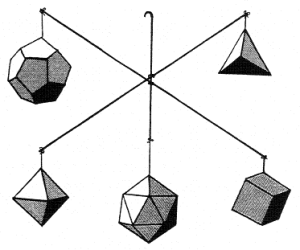 Alexandria Jones struggled to think of a Christmas gift that a one-month-old baby could enjoy, but finally she got an idea.
She cut empty cereal boxes to make regular polygons: 6 squares, 12 regular pentagons, and 32 equilateral triangles. Using small pieces of masking tape, she carefully formed the five Platonic solids. Then she mixed flour and water into a runny paste. She tore an old newspaper into small strips and soaked them in the paste. She covered each solid with a thin layer of paper.
Egyptian Math: Fractions
I have been enjoying James Tanton’s website. In this video, Tanton explains a foolproof method for creating Egyptian fractions:
See more posts on Egyptian math.
Math Project: Measure the Earth
Tomorrow, September 23, is the equinox — when night and day are equally balanced (or would be, if the sun appeared as a point, rather than a disc). If we lived on the equator, the sun would appear directly overhead at noon and would cast no shadow. Therefore, it’s a great day to perform Eratosthenes’ experiment of measuring the earth:
Math History Tidbits: The Battling Bernoullis
 July 27th is Alex’s birthday. She shares it with Johann Bernoulli, an irascible mathematician from the late 17th century. This coincidence intrigued her enough that she wrote a research paper on Johann and his mathematical brother, titled “Jeering Jacob and Jealous Johann.”
Of course, to make the alliteration work, she had to mispronounce Johann’s name — but she figured he kinda deserved that. Read the historical tidbits below to find out why one writer said the Bernoulli brothers were “the kind of people who give arrogance a bad name.”*
Continue reading Math History Tidbits: The Battling Bernoullis
 Denise Gaskins' Let's Play Math