Do you have trouble believing that math can be beautiful?
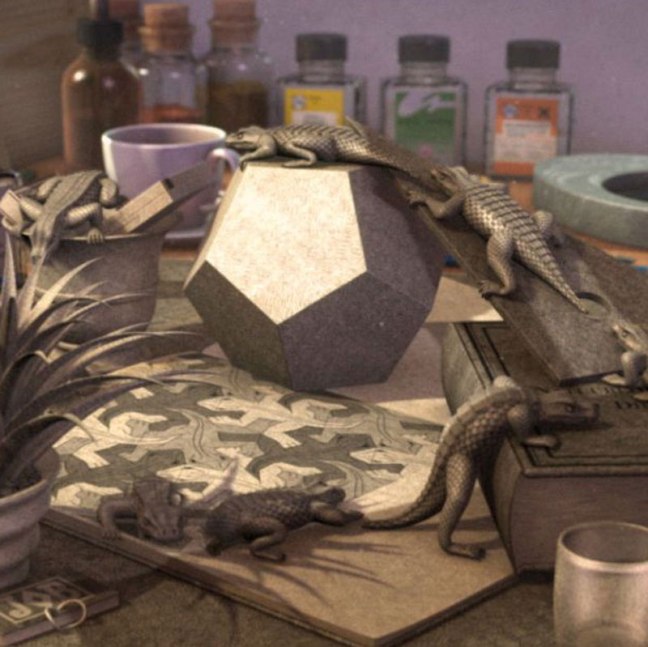
In “Inspirations,” artist Cristóbal Vila creates a wonderful, imaginary work studio for the amazing M.C. Escher. You’ll want to view it in full-screen mode.
Read about the inspirations, and then try making some math of your own.
“I looked into that enormous and inexhaustible source of inspiration that is Escher and tried to imagine how it could be his workplace, what things would surround an artist like him, so deeply interested in science in general and mathematics in particular. I imagined that these things could be his travel souvenirs, gifts from friends, sources of inspiration…”
Oops! I can’t believe I forgot to post these links when my latest book came out way back in March. Indie author fail…
Do you want your children to enjoy learning math?
Teach them how to play!
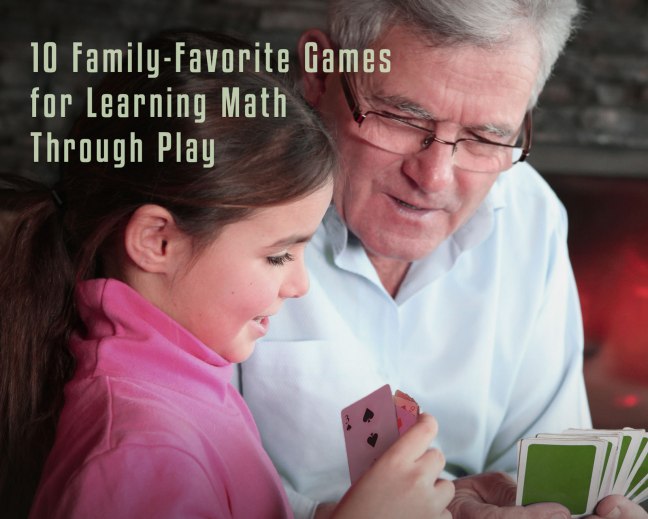
In excerpts from five of my most popular books, the Let’s Play Math Sampler features ten kid-tested games covering math concepts from counting to prealgebra.
Pick up a copy of the Let’s Play Math Sampler today, and make math a playful family adventure.
One of the most common questions I get from parents who want to help their children enjoy math is, “Where do we start?”
My favorite answer: “Play games!”
Math games meet children each at their own level. The child who sits at the head of the class can solidify skills. The child who lags behind grade level can build fluency and gain confidence.
And (as Peggy Kaye pointed out in her book Games for Math) both will learn something even more important — that hard mental effort can be fun.
Now I’ve put together a short, inexpensive book to help families begin playing with math.
Let’s Play Math Sampler: 10 Family-Favorite Games for Learning Math Through Play contains short excerpts from my most popular books, including a preview of two games from my work-in-progress Prealgebra & Geometry Games.
“Denise Gaskins is that sound voice of reason that comes into my head when I get agitated teaching. This isn’t performance — this is play. My kids aren’t on trial, they are learning to learn.”
—Sonya Post
“By exploring math in a playful way, your kids will be happy to learn and will discover an enjoyment of math in the process. You might even have fun, too! ”
The Playful Math Carnival is like a free online magazine devoted to learning, teaching, and playing around with math from preschool to high school. This month’s edition features articles from bloggers all across the internet.†
You’re sure to find something that will delight both you and your child.
By tradition, we start the carnival with a puzzle in honor of our 123rd edition. But if you would like to jump straight to our featured blog posts, click here to see the Table of Contents.
†Or more, depending on how you count. And on whether I keep finding things to squeeze in under the looming deadline. But if there are more, then there are certainly 36. Right?
Do the holidays mess with your schedule? They sure do mine!
Every year, we get busy. Distracted. Just can’t focus on lessons.
I love easy activities that require minimal preparation so I can pull something out and play when we’re having one of those no-energy days.
If that sounds good to you, too, then you’ll want to check out my new ebook 70+ Things To Do with a Hundred Chart: Number, Shape, and Logic Activities from Preschool to Middle School.
Long years ago, when I did workshops at homeschooling conferences, I used to share a list of seven ways to play with a hundred chart. The all-time most visited post on my blog offers 34 playful activities. Now I’ve more than doubled that total for this book.
So many ways to play! One of them is sure to be perfect for you and your children.
Take your child on a mathematical adventure with these playful, practical activities.
“It is exactly the kind of math exploration that I want to undertake with my kids.
“After reading through the book, I noticed myself making more room to trust my kids’ ability to make connections and not try to dominate by telling them how math ‘should’ work.
“An excellent way for me to move outside my math and teaching comfort zones and explore math more deeply with my kids.”
— Olisia Barron, author of ThimbleberryHome.wordpress.com
P.S.: If you have a blog and would like to host a giveaway for 70+ Things To Do with a Hundred Chart (or any of my other books), I’d be glad to provide the prize. Leave a comment below or use the contact form on my “About” page, and we’ll set up all the details.
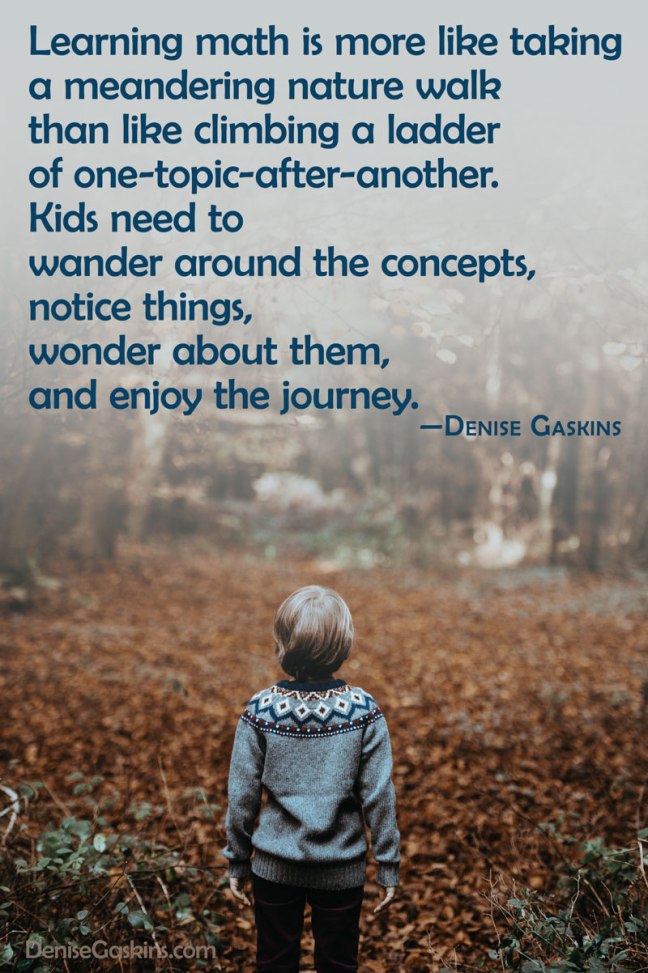
Learning math is more like taking a meandering nature walk than like climbing a ladder of one-topic-after-another. Kids need to wander around the concepts, notice things, wonder about them, and enjoy the journey.
This fall, my homeschool co-op math class will play with math journaling.
But my earlier dot-grid notebooks were designed for adults. Too thick, too many pages. And the half-cm dot grid made lines too narrow for young writers.
So I created a new series of paperback dot-grid journals for my elementary and middle school students.
I’m sure we’ll use several of these activities in my homeschool co-op math class this fall.
Noticing and Wondering
Learning math requires more than mastering number facts and memorizing rules. At its heart, math is a way of thinking.
So more than anything else, we need to teach our kids to think mathematically — to make sense of math problems and persevere in figuring them out.
Help your children learn to see with mathematical eyes, noticing and wondering about math problems.
Whenever your children need to learn a new idea in math, or whenever they get stuck on a tough homework problem, that’s a good time to step back and make sense of the math.
Kids can write their noticings and wonderings in the math journal. Or you can act as the scribe, writing down (without comment) everything child says.
For more tips on teaching students to brainstorm about math, check out these online resources from The Math Forum:
Problem-solving is a habit of mind that you and your children can learn and grow in. Help your kids practice slowing down and taking the time to fully understand a problem situation.
Puzzles Are Math Experiments
Almost anything your child notices or wonders can lead to a math experiment.
For example, one day my daughter played an online math game…
A math journal can be like a science lab book. Not the pre-digested, fill-in-the-blank lab books that some curricula provide. But the real lab books that scientists write to keep track of their data, and what they’ve tried so far, and what went wrong, and what finally worked.
Here are a few open-ended math experiments you might try:
Explore Shapes
Pick out a 3×3 set of dots. How many different shapes can you make by connecting those dots? Which shapes have symmetry? Which ones do you like the best?
What if you make shapes on isometric grid paper? How many different ways can you connect those dots?
Limit your investigation to a specific type of shape. How many different triangles can you make on a 3×3 set of dots? How many different quadrilaterals? What if you used a bigger set of dots?
Explore Angles
On your grid paper, let one dot “hold hands” with two others. How many different angles can you make? Can you figure out their degree without measuring?
Are there any angles you can’t make on your dot grid? If your paper extended forever, would there be any angles you couldn’t make?
Does it make a difference whether you try the angle experiments on square or isometric grid paper?
Explore Squares
How many different squares can you draw on your grid paper? (Don’t forget the squares that sit on a slant!) How can you be sure that they are perfectly square?
Number the rows and columns of dots. Can you find a pattern in the corner positions for your squares? If someone drew a secret square, what’s the minimum information you would need to duplicate it?
Does it make a difference whether you try the square experiments on square or isometric grid paper?
I’d love to hear your favorite math explorations or journaling tips!
Please share in the comments section below.
* * *
P.S.: Do you have a blog? If you’d like to feature a math journal review and giveaway, I’ll provide the prize. Send a message through my contact form or leave a comment below, and we’ll work out the details.
This blog is reader-supported.
If you’d like to help fund the blog on an on-going basis, then please head to my Patreon page.
If you liked this post, and want to show your one-time appreciation, the place to do that is PayPal: paypal.me/DeniseGaskinsMath. If you go that route, please include your email address in the notes section, so I can say thank you.
My son can’t stand long division or fractions. We had a lesson on geometry, and he enjoyed that — especially the 3-D shapes. If we can just get past the basics, then we’ll have time for the things he finds interesting. But one workbook page takes so long, and I’m sick of the drama. Should we keep pushing through?
Those upper-elementary arithmetic topics are important. Foundational concepts. Your son needs to master them.
Eventually.
But the daily slog through page after page of workbook arithmetic can wear anyone down.
Many children find it easier to focus on math when it’s built into a game.
“As we go through each lesson, it seems like my daughter has a good handle on the concepts, but when we get to the test she forgets everything. When I ask her about it, she shrugs and says, ‘I don’t know.’ What do you do when your child completely loses what she has learned?”
Forgetting is the human brain’s natural defense mechanism. It keeps us from being overwhelmed by the abundance of sensory data that bombards us each moment of every day.
Our children’s minds will never work like a computer that can store a program and recall it flawlessly months later.
Sometimes, for my children, a gentle reminder is enough to drag the forgotten concept back out of the dust-bunnies of memory.
Other times, I find that they answer “I don’t know” out of habit, because it’s easier than thinking about the question. And because they’d prefer to be doing something else.


 articles from bloggers all across the internet.†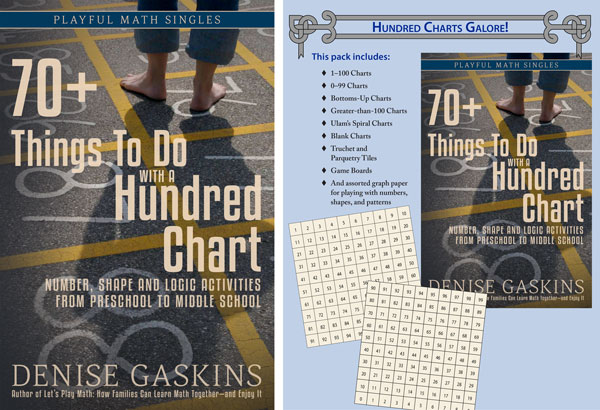



 I’d love to hear your favorite math explorations or journaling tips!

 Denise Gaskins' Let's Play Math