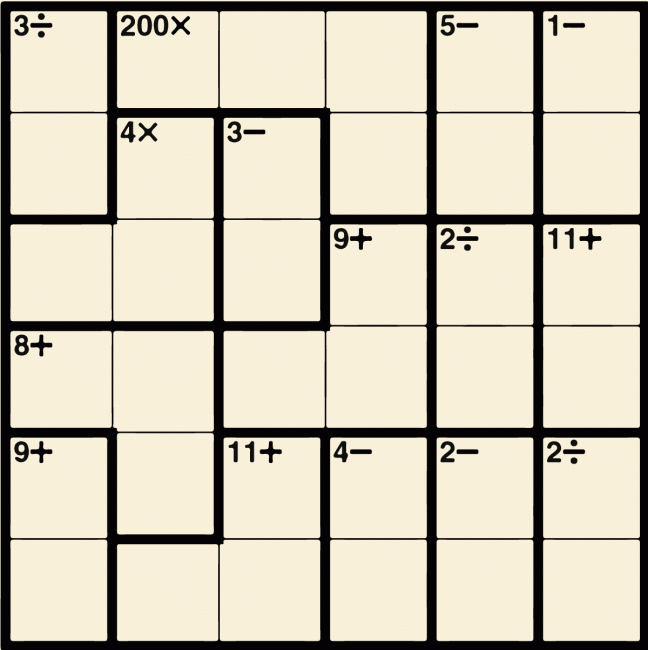
Kenken is Mathematical Play

It’s back-to-school time here in the States. And that means it’s time for the Kenken Classroom Newsletter. Yay for math puzzles!

KenKen arithmetic puzzles build mental math skills, logical reasoning, persistence, and mathematical confidence.

Free via email every Friday during the school year.

What a great way to prepare your children for success in math!

Sign up anytime:

Click Here for KenKen Classroom Newsletter

Continue reading Kenken is Mathematical Play

Journaling Pages

This afternoon, I’ve been working on the printable pdf math activity booklets I’ll be sending out as stretch goals to the backers of my Math You Can Play Kickstarter campaign.

Some of the booklets include dot grid pages for student journaling.

I love dot grid pages for writing because I can start a line anywhere on the page, and the dots help me keep things in line. (They’re also great for doodling.)

As students wrestle their thoughts into shape and create explanations, they do the same sort of work that mathematicians do every day. It’s difficult for children (or anyone) to pin down a thought and put it into words. But it’s great practice for life.

Journaling is a great practice for adult learners, too — and don’t we all want to be lifelong learners?

So I thought I’d share the journaling pages with you all, in case you’d like to get your children writing about math. There are three styles, ranging from plain to ornate parchment. Enjoy!

Download the Journaling Pages
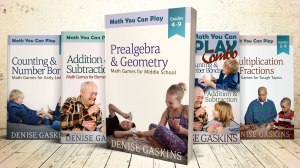
UPDATE: The Kickstarter deals have ended, but my playful math books are still available through your favorite online store or by special order at your local bookshop. (Except for the Prealgebra & Geometry Games book, scheduled for publication in early 2021. Sign up for my email list to get the latest news.)
The Experience of Mathematical Thinking

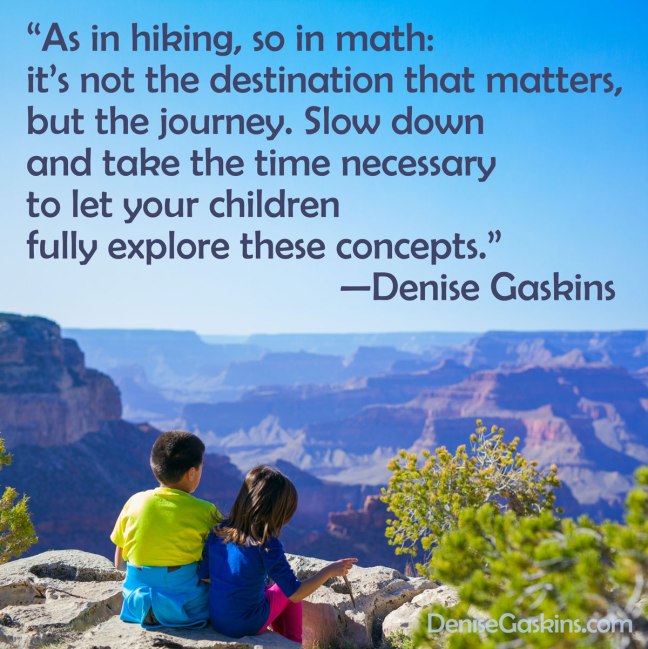
The full quote:

For children (and adults) who have always considered math to be memorized rules, the experience of mathematical thinking — though difficult at first — can be as refreshing as a hike in pure mountain air.

As in hiking, so in math: It’s not the destination that matters, but the journey. Yes, you could give your students a rule that would help them get correct answers, but that’s no better than riding a helicopter up the mountain.

Slow down and take the time necessary to let your children fully explore these concepts.

— Denise Gaskins
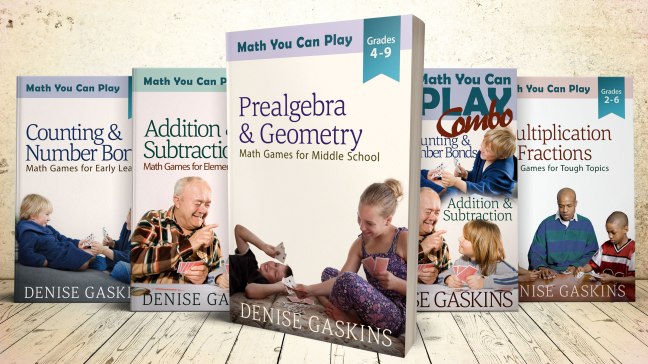
Prealgebra & Geometry: Math Games for Middle School

Excerpted from my upcoming book, Prealgebra & Geometry: Math Games for Middle School, scheduled for publication in early 2021. Sign up for my newsletter to get updates.

CREDIT: “On the edge” photo by Joseph Gonzalez on Unsplash.

A Gentle Reminder

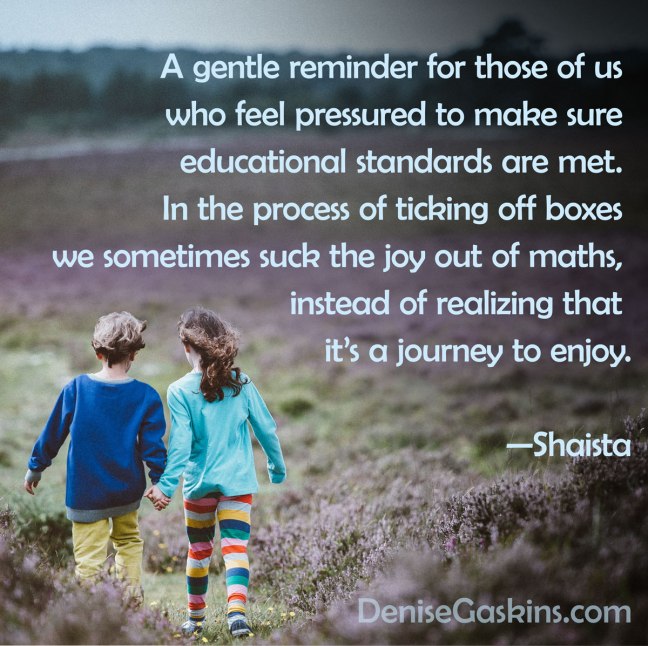
Shaista is a homeschooling mom who read an advance copy of my new book. Her response:

“I want to shout from the rooftops about it. It’s a wonderful read on the importance of play in maths — and a gentle reminder for those of us who know but feel pressured to make sure educational standards are met … and in the process of ticking off boxes we sometimes suck the joy out of maths, instead of realizing that it’s a journey to enjoy.”

— Shaista

Prealgebra & Geometry: Math Games for Middle School is scheduled for publication in early 2021. Sign up for my newsletter to get updates.

PHOTO CREDIT: “Outdoors kids” courtesy of Annie Spratt on Unsplash.

Math for Star Wars Day

May the Fourth be with you!

Here is a math problem in honor of one of our family’s favorite movies…

Han Solo was doing much-needed maintenance on the Millennium Falcon. He spent 3/5 of his money upgrading the hyperspace motivator. He spent 3/4 of the remainder to install a new blaster cannon. If he spent 450 credits altogether, how much money did he have left?

Stop and think about how you would solve it before reading further.

Continue reading Math for Star Wars Day

Homeschooling Tip #1: Start with Play

For children, learning always begins with play. This is how they wrap their minds around new ideas and make them their own.

“There should be no element of slavery in learning. Enforced exercise does no harm to the body, but enforced learning will not stay in the mind. So avoid compulsion, and let your children’s lessons take the form of play.”

—Plato, The Republic

If we want our children to enjoy learning math, our first job is to establish an attitude of playfulness.

This is especially important for anyone working with a discouraged child or a child who is afraid of math. The best way to help a discouraged child is to put away the workbook. Try something different, fun, and challenging.

Continue reading Homeschooling Tip #1: Start with Play

How to Homeschool Math

Far too many people find themselves suddenly, unexpectedly homeschooling their children. This prompts me to consider what advice I might offer after more than three decades of teaching kids at home.

Through my decades of homeschooling five kids, we lived by two rules:

Do math. Do reading.

As long as we hit those two topics each day, I knew the kids would be fine. Do some sort of mathematical game or activity. Read something from that big stack of books we collected at the library.

Conquer the basics of math and reading, then everything else will fall into place.

Continue reading How to Homeschool Math

FAQ: Math with Young Children

The question came up again:

“What is the best curriculum for my children? They are four and six years old, and I’m afraid of letting them fall behind.”

I remember being a young parent, eager to start homeschooling. I used to get mad (without letting it show, like a true introvert) when people told me, “They are young. Just let them play.”

Now I see the wisdom in it.

The most important thing for your children right now, by far, is for them to enjoy learning. The joy of learning is a child’s natural state. As a parent, your primary job is to keep yourself from stomping it out.

But our parental fears can push us into joy-trampling before we realize it.

And our own experience of school makes it hard for us to see how much of our children’s play really is learning. We expect education to look like schoolwork, but natural learning looks nothing like that.

Continue reading FAQ: Math with Young Children

Play Math with Your Kids for Free

One of the most common questions I get from parents who want to help their children enjoy math is, “Where do we start?”

My favorite answer: “Play games!”

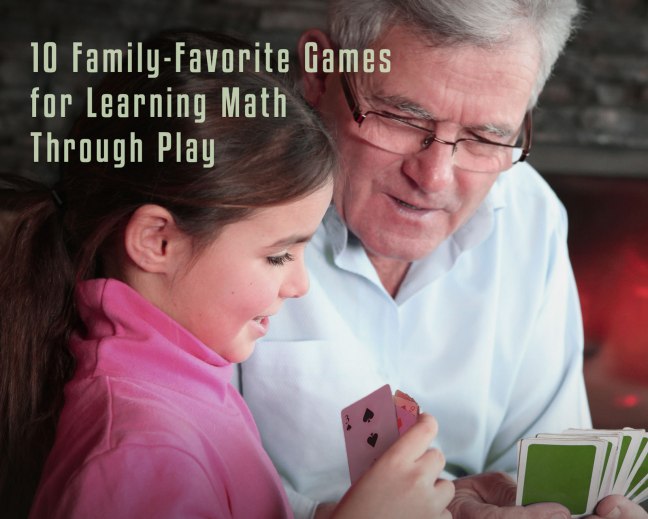
And as the world slowly recovers from the pandemic crisis, it’s even more important for families to play together. So my publisher agreed to make my ebook Let’s Play Math Sampler: 10 Family-Favorite Games for Learning Math Through Play free for the duration.

Continue reading Play Math with Your Kids for Free