Notice–Wonder–Discover: The Foundation of Learning Well

Notebook on desk, with the words "Notice. Wonder. Discover."

Most of us were never taught how to teach. And we certainly weren’t taught what to do when NOTHING is working.

My friend Sonya Post is offering a new course that will help you rethink how learning actually works, how you can stop second-guessing yourself and start seeing real growth.

I’ve taken the earlier iterations of her course, and I’d recommend it to all parents.

Truly wonderful insights!

Find More Information

What the Course Covers

The course consists of six weekly online workshops, plus an optional bonus session:

  • Session 1: Orientation – Why Learning Feels Hard
    The default scripts we carry from school, and how to overcome them.
  • Session 2: Notice – The First Act of Learning
    Before anything can be learned, it must be seen.
  • Session 3: Structure – Why Look for Structure?
    Structure is the beginning of understanding — and the root of algebraic thinking.
  • Session 4: Arbitrary vs. Necessary
    Not all information deserves equal weight. Here’s how to make space for thinking.
  • Session 5: Wonder – Curiosity That Moves Forward
    Wonder is not optional — it’s the engine of discovery, the heart of orientation, and the builder of wisdom.
  • Session 6: Discover – What Was Always There
    Discovery is our response to insight, how we orient inward and express outward after recognizing something true.
  • Optional Bonus Session
    Mothering as Orientation — A Christian Reflection.

The course begins October 14: Notice–Wonder–Discover Course.

More About Sonya

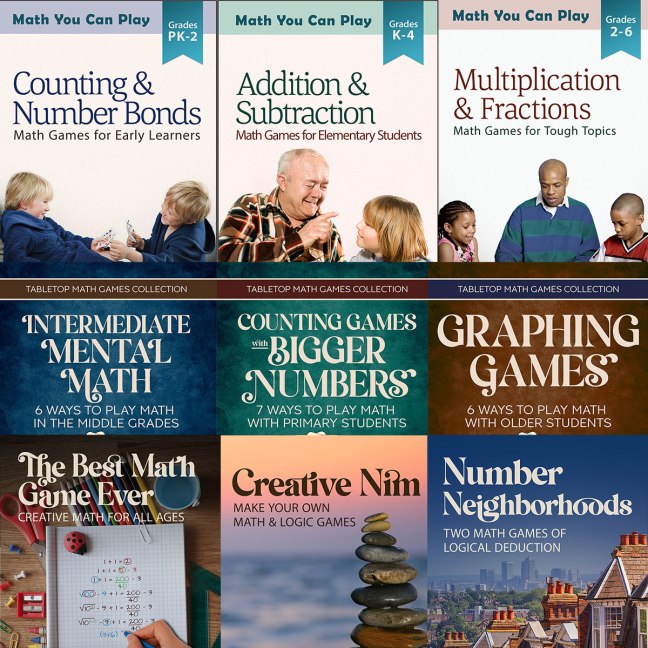
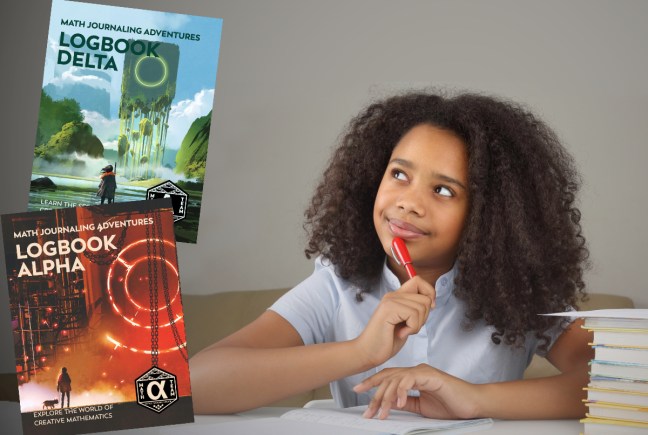
You may have heard me mention Sonya before. She created The Best Math Game Ever, and she teaches the math course I wish my kids and I could have taken:

And in fact, anyone who is taking one of her homeschool math courses (or signs up in the next few weeks) will get the Notice-Wonder-Discover Course included for free.

Sonya says:

“I don’t just build these resources — I use them. I’ve walked the road of frustration, math tears, and feeling lost about how to teach well. This course exists because I don’t want you to walk that road alone. This is the framework I wish I’d had years ago, and I can’t wait to share it with you.”

I really can’t praise Sonya’s work enough. If you’re struggling at all with your teaching or family life, she’ll turn you around and give you new perspective on how to move forward with grace.

Sign up now, before it’s too late:

Get the Notice–Wonder–Discover Course

 
* * *

Featured image above copyright © Sonya Post.

FAQ: How To Start a Homeschool Math Club

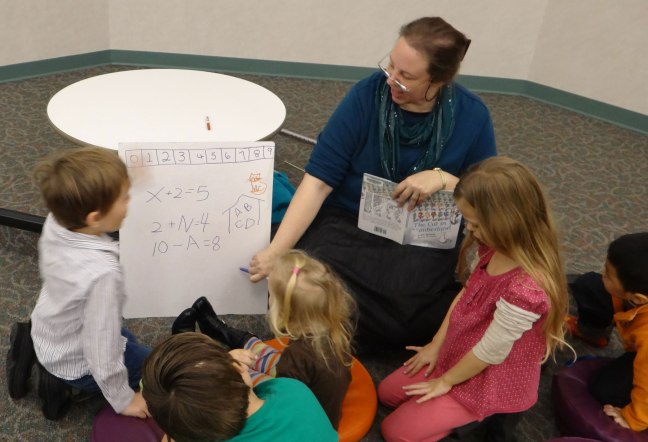
Denise Gaskins reading math with preschoolers

The question hits my inbox whenever parents start planning for a new school year:

“Hello! I am on the board of a homeschool co-op. We have had requests for a math club and wondered if you have any tips for starting one. We service children from K-10th and would need to try to meet the needs of as many ages as possible.”

There are several ways you might organize a homeschool math club, depending on the students you have and on your goals. I think you would have to split the students by age groups — it is very hard to keep that wide of a range of students interested. Then decide whether you want an activity-oriented club or a more academic focus.

When I started my first math club, I raided the math shelves in the children’s section at my library (510-519) for anything that interested me. I figured that if an activity didn’t interest me, I couldn’t make it fun for the kids. Over the years we have done a variety of games, puzzles, craft projects, and more — always looking for something that was NOT like whatever the kids would be doing in their textbooks at home.

Let’s look at the possibilities by grade level…

Continue reading FAQ: How To Start a Homeschool Math Club

New Membership Tiers: One-on-One Mentorship

Two women chatting over tea

Over the years, in my public writing and in personal correspondence, I’ve tried to help younger parents by sharing the things I wish someone would have told me forty years ago. Oftentimes, I will answer a question but never hear back what the person ended up doing or how their family got along.

It leaves me feeling as though I could have done more to encourage them along the way.

In the past few years, I’ve watched a professional writer I admire organize several more formal mentorships for younger indie authors to grow their writing and publishing careers. I think a similar program could be helpful for homeschooling families.

So now I’m offering two new Patreon membership tiers that give you a direct one-on-one connection with me through email or email-plus-video.

My goal is to help you think about math as a creative, playful investigation where you and your children explore concepts together using the math program or curriculum of your choice. This is not a tutoring arrangement. I will help you understand and teach math, but I will not do the teaching for you.

Here’s How It Works

(1) You email me every Sunday—or pick the day that works best for you, at least once every two weeks—to keep me up to date with what you are doing: good times, rough spots, progress or no progress, plans for the coming week. You can also ask any questions about math or education (or indie book publishing).

(2) I’ll write back with encouragement and tips, and I’ll answer questions to the best of my ability. Caveat: I’ve forgotten everything except the broad brushstrokes of calculus and beyond.

(3) If you signed up for a video mentorship, include in your first email a list of several dates and times when you would be available for our monthly one-on-one chat. I’ll compare that with my schedule to find a time we can meet.

Interested?

These new tiers are limited to a few members each—first paid, first in. Check out all the details on my Patreon home page.

Join me on Patreon

 
* * *

Thank you for reading!

“New Membership Tiers: One-on-One Mentorship” copyright © 2025 by Denise Gaskins. Image at the top of the post copyright © deagreez1 / Depositphotos.

Mental Math: Three Basic Principles

Doing mental math on the couch

“We know that algorithms are amazing human achievements, but they are not good teaching tools because mimicking step-by-step procedures can actually trap students into using less sophisticated reasoning than the problems are intended to develop.”

— Pam Harris, Math Is Figure-Out-Able Podcast

Whether you work with a math curriculum or take a less-traditional route to learning, do not be satisfied with mere pencil-and-paper competence. Instead, work on building your children’s mental math skills, because mental calculation forces a child to understand arithmetic at a much deeper level than is required by traditional pencil-and-paper methods.

Traditional algorithms (the math most of us learned in school) rely on memorizing and rigidly following the same set of rules for every problem, repeatedly applying the basic, single-digit math facts. Computers excel at this sort of step-by-step procedure, but children struggle with memory lapses and careless errors.

Mental math, on the other hand, relies on a child’s own creative mind to consider how numbers interact with each other in many ways. It teaches students the true 3R’s of math: to Recognize and Reason about the Relationships between numbers.

The techniques that let us work with numbers in our heads reflect the fundamental properties of arithmetic. These principles are also fundamental to algebra, which explains why flexibility and confidence in mental math is one of the best predictors of success in high school math and beyond.

Your textbook may explain these properties in technical terms, but don’t be intimidated by the jargon. These are just common-sense rules for playing with numbers.

Continue reading Mental Math: Three Basic Principles

Musings: Mental Math Is the Key to Algebra

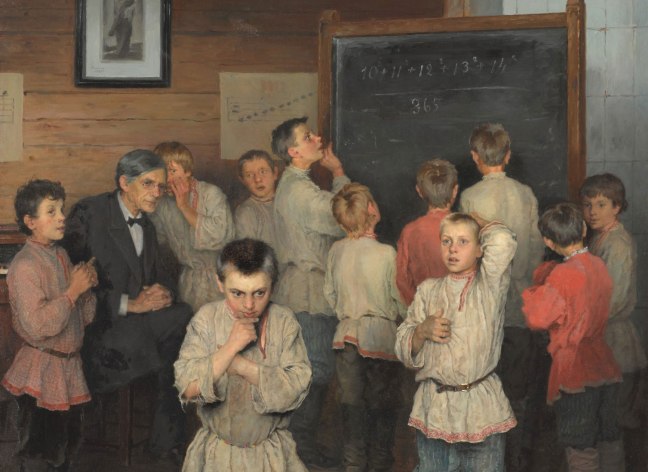
Painting by Nikolay Bogdanov-Belsky, public domain

“If you stay with meaningful mental arithmetic longer, you will find that your child, if she is average, can do problems much more advanced than the level listed for her grade. You will find that she likes arithmetic more.

    “And when she does get to abstractions, she will understand them better.

      “She will not need two or three years of work in primary grades to learn how to write out something like a subtraction problem with two-digit numbers. She can learn that in a few moments of time, if you just wait.”

      —Ruth Beechick, An Easy Start in Arithmetic

      What Do You Mean by Mental Math?

      Mental math is doing calculations in your head, with perhaps the aid of scratch paper or a whiteboard to jot down notes along the way.

      But you cannot simply transfer the standard pencil-and-paper calculations to a mental chalkboard. That’s far too complicated.

      Continue reading Musings: Mental Math Is the Key to Algebra

      Musings: Mathematical Beauty

      photo of child making footprints on the beach

      Memories…

      We were eclectic homeschoolers back in the Dark Ages before there was an internet. Our primary curriculum was the public library.

      As we went along, I noticed how many of our homeschooling friends felt uncomfortable with math, and even hated or feared the subject.

      Math anxiety runs rampant in Western culture. By one researcher’s estimate, more than 90% of adults experience some level of math anxiety — that is, discomfort, avoidance, and even emotional pain when faced with a math calculation.

      So I became a sort of “math evangelist” in the homeschooling community, spreading the news that we can find beauty and fun even in math.

      Continue reading Musings: Mathematical Beauty

      Skit: The Handshake Problem

      The handshake problem

      If seven people meet at a party, and each person shakes the hand of everyone else exactly once, how many handshakes are there in all?

      Our homeschool co-op held an end-of-semester assembly. Each class was supposed to demonstrate something they had learned.

      I threatened to hand out a ten question pop quiz on integer arithmetic, but instead my pre-algebra students presented this skit.

      Download a Printable Script

      Cast

      1-3 narrators (or more, if you have a large group)
      7 friends (non-speaking parts, adjust to fit your group)

      Props

      Each friend will need a sheet of paper with a number written on it big and bold enough to be read by the audience. The numbers needed are 0, 1, 2, 3, … up to one less than the number of friends. Each friend keeps his paper in a pocket until needed.

      Continue reading Skit: The Handshake Problem

      Charlotte Mason Math: Living Books

      “The Reading Lesson” painting by Jonathan Pratt, public domain

      [An addendum to my earlier Charlotte Mason Math series.]

      “Our business is to give [children] mind-stuff, and both quality and quantity are essential. Naturally, each of us possesses this mind-stuff only in limited measure, but we know where to procure it; for the best thought the world possesses is stored in books; we must open books to children, the best books; our own concern is abundant provision and orderly serving.”

      — Charlotte Mason, Toward A Philosophy of Education

      Most homeschool teachers, whatever our curriculum or schooling approach, understand the importance of teaching with living books. We read aloud biographies, historical fiction, or the classics of literature. We scour library shelves for the most creative presentations of scientific topics that interest our children, and encourage our high school students to go back to the original documents whenever possible.

      And we teach math with a textbook.

      Not that textbooks are inherently bad, because math is an abstract science. We need to meet the ideas  — the “mind-stuff” — of math on their own terms, and textbooks can help with that.

      But it’s not enough.

      Continue reading Charlotte Mason Math: Living Books

      Musings: Math Is a Social Game

      photo of three young girls talking about numbers

      Childhood Memories

      When I was in school, math was something each person did on their own for homework, quizzes or tests.

      Even when the teacher sent us to work on the chalkboard, each person did their own problem. We would never think to collaborate on math.

      To look at someone else’s answer was considered cheating.

      Continue reading Musings: Math Is a Social Game