What can you DO with a page full of dots?

Yesterday, I mentioned my new series of paperback dot grid notebooks, and I promised to share a few ideas for mathematical doodling.
But first, let me share my new dot-grid journals for kids. Aren’t they pretty?
Click Here for More Information
Doodling gives our minds a chance to relax, wander, and come back to our work refreshed. And though it goes against intuition, doodling can help us remember more of what we learn.
Math doodles let us experiment with geometric shapes and symmetries. We can feel our way into math ideas gradually, through informal play. Through doodles, our students will explore a wide range of mathematical structures and relationships.
Our own school experiences can make it hard for us to teach. What we never learned in school was the concept of playing around with math, allowing ideas to “percolate,” so to speak, before mastery occurs, and that process may take time.
—Julie Brennan
I like to doodle on dotty grid paper, like the pages in my math journals, but there’s No Purchase Necessary! You can design your own printable dot page at Incompetech’s PDF generator.
Patterns in Shape and Angle
To make a faceted mathematical gemstone, start with any shape you like. Then build other shapes around it. What do you notice? Does your pattern grow outward from its center? Or flow around the corner of your page? How is each layer similar, and how is it different?

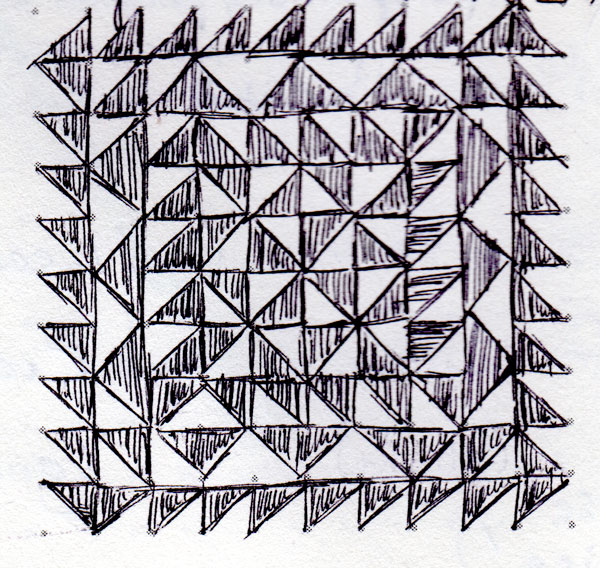
Arbitrary constraints can lead to mathematically interesting doodles. For instance, create a design out of 45-45-90 triangles by coloring exactly half of every grid square. How many variations can you find?
Symmetry Challenge
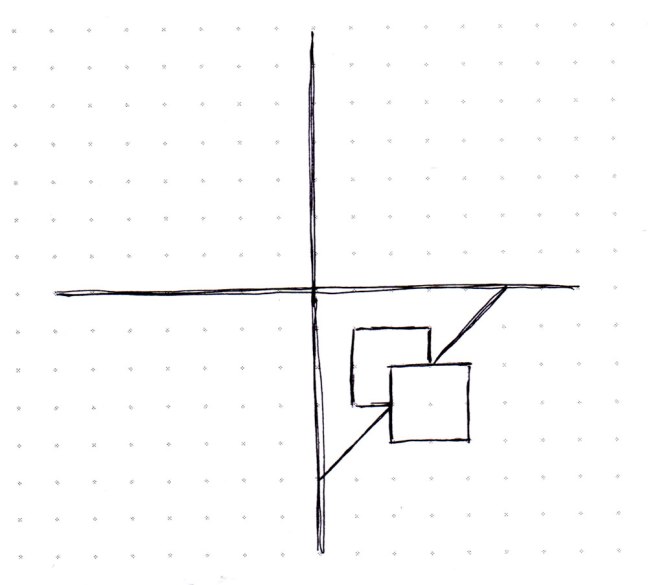
Play a symmetry puzzle game. Draw a line of symmetry and fill in part of the design. Then trade with a partner to finish each other’s doodles.

Make more complex symmetry puzzles with additional reflection lines.
Math Doodle Links
- Who can talk about mathematical doodling without mentioning Vi Hart? If you’ve never seen her “Doodling in Math Class” video series, you’re in for a treat!
- For more 45-45-90 triangle-tile designs, check out Dan’s “Doodling with Froebel”…
- …and the Math Munch blog post “Truchet, Truchet, Truchet!”
- Enjoy Cindy’s beautiful “Parallel & Perpendicular Art” and make some of your own.
- See if you can draw a rotational-symmetry design, like Don’s “Order 4” graphs.
- Play around with number-patterned doodles like Spirolaterals.
- Follow Michelle’s directions for “How to Draw a Celtic Knot Pattern.”
- Or experiment with the more flexible rules in John’s “Knot Fun” lesson.
- And my latest obsession: the “ultimate” tutorial series on Celtic Knotwork, which explores the link between knots and their underlying graphs.
- Finally, check out my Math Doodling board at Pinterest.




Before you start doodling: How to Break In Your New Math Journal.
Feature photo (top): Sommermorgen (Alte Holzbrücke in Pretzfeld) by Curt Herrmann, via Wikimedia Commons. [Public domain]


 Denise Gaskins' Let's Play Math
.jpg)