Do You Teach Math to Young Children?

Sue VanHattum is trying to convince the publishers that this excellent book would reach a wider audience if they made it available at a lower price. What do you think?

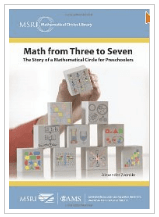
As anyone who has taught or raised young children knows, mathematical education for little kids is a real mystery. What are they capable of? What should they learn first? How hard should they work? Should they even “work” at all? Should we push them, or just let them be?

There are no correct answers to these questions, and Zvonkin deals with them in classic math-circle style: He doesn’t ask and then answer a question, but shows us a problem — be it mathematical or pedagogical — and describes to us what happened. His book is a narrative about what he did, what he tried, what worked, what failed, but most important, what the kids experienced.

This book is not a guidebook. It does not purport to show you how to create precocious high achievers. It is just one person’s story about things he tried with a half-dozen young children. On the other hand, if you are interested in running a math circle, or homeschooling children, you will find this book to be an invaluable, inspiring resource. It’s not a “how to” manual as much as a “this happened” journal. … Just about every page contains a really clever teaching idea, a cool math problem, and an inspiring and funny story.

— Paul Zeitz
Introduction to Math from Three to Seven

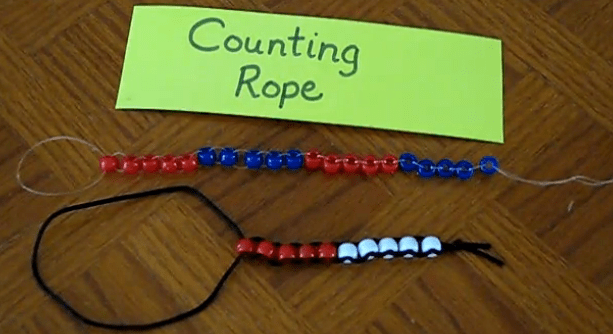
Easy-to-Make Counting Rope

This is wonderful! I am definitely not a crafts-person, but I can’t wait to make some of these. If I can just find my daughter’s pony beads….

From Cindy at love2learn2day, who got the idea from a math conference workshop by Kim Sutton.

Krista at the LivingMathForum wrote, “We’ve used these for several years. My son even made a bunch of them a few years ago and sold them at a homeschool resource fair. We always have one in most of our board games to help younger children add up their die rolls. I find them relaxing for some reason, just moving the beads along the cord, and my son will sometimes sit and listen to me reading, etc., and just manipulate the beads.”

Playful Math Lessons

You can use these math activities to play with your counting rope:

Arithmetic Village Books

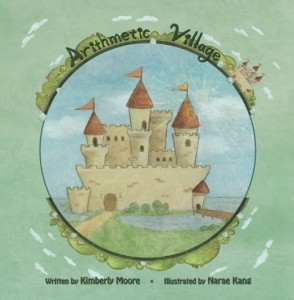
Thanks to the generosity of author Kimberly Moore, I am giving away a complete set of the beautiful Arithmetic Village picture books. You can read the first book free online.

When you think of math do you think of a light-hearted fairy tale?

No? Then come and meet some of the delightful characters who live in Arithmetic Village.

Polly Plus collects jewels slowly and methodically, Linus Minus is carefree and loses his. Tina Times and King David Divide… well you’ll see.

The first book offers the overview of the math concepts. These are then demonstrated through the lives of each character. The books are designed to be supported by a manipulative kit [homemade: see video below] with 100 jewels, 10 golden bags, and a treasure chest…

— Kimberly Moore
Proposal: Arithmetic Village

My fantasy-loving daughter Kitten would have been thrilled with this math program when she was little, just as this 6yo girl was. But it’s not just for girls — here is a thorough review by a homeschool mom of two boys.

Visit the Arithmetic Village website to read more about the books and explore the activity pages (links under each topic in the main page menu). Or check out Kim’s YouTube videos for activity ideas.

Continue reading Arithmetic Village Books

30+ Things to Do with a Hundred Chart

[Photo by geishaboy500 via Flickr (CC BY 2.0).]

Are you looking for creative ways to help your children study math? Even without a workbook or teacher’s manual, your kids can learn a lot about numbers. Just spend an afternoon playing around with a hundred chart (also called a hundred board or hundred grid).

My free 50-page PDF Hundred Charts Galore! printables file features 1–100 charts, 0–99 charts, bottom’s-up versions, multiple-chart pages, blank charts, game boards, and more. Everything you need to play the activities below and those in my new 70+ Things to Do with a Hundred Chart book.

Download Free “Hundred Charts Galore!” Printables

Shop for “70+ Things To Do with a Hundred Chart” Book

And now, let’s play…

Continue reading 30+ Things to Do with a Hundred Chart

How to Make Math Cards

Many of the games on this blog call for Math Cards. You do not need to look for these in stores or in your school supply catalog. Math cards are simply a modified deck of normal, poker-style playing cards. Remove all face cards and jokers from the deck, leaving the ace through ten of each suit. Or use a set of Rook cards, without the bird.

Using the ace as a one, this gives you four sets of numbers 1-10, and you will be ready to play your way to fluency in almost any arithmetical topic: addition, subtraction, multiplication, division, greater-than/less-than, fractions, negative numbers, and more.

Card Holder for Young Hands

Math card holder

Little hands often have trouble holding more than a few cards at a time. Your child may enjoy making and using a card holder.

Save the plastic lids from two large margarine tubs or similar containers. Place the lids together, top to top. Line up the edges, then staple them together, putting two or three staples near the center of the lids. Let your child decorate the card holder with stickers, if desired.

To use the card holder, slip playing cards between the two lids and fan them out. The lids will hold the cards upright, so the child can easily see them all.

 
* * *

This blog is reader-supported.

If you’d like to help fund the blog on an on-going basis, then please join me on Patreon for mathy inspiration, tips, and an ever-growing archive of printable activities.

If you liked this post, and want to show your one-time appreciation, the place to do that is PayPal: paypal.me/DeniseGaskinsMath. If you go that route, please include your email address in the notes section, so I can say thank you.

Which I am going to say right now. Thank you!

“How to Make Math Cards” copyright © 2007 by Denise Gaskins.

Elementary Problem Solving: The Early Years

[Rescued from my old blog. To read the entire series, click here: Elementary Problem Solving Series. Photo by Studio 757 via Flickr (CC BY 2.0).]

You can begin to teach your children algebraic thinking in preschool, if you treat algebra as a problem-solving game. Young children are masters at solving problems, at figuring things out. They constantly explore their world, piecing together the mystery of how things work. For preschool children, mathematical concepts are just part of life’s daily adventure. Their minds grapple with understanding the three-ness of three blocks or three fingers or one raisin plus two more raisins make three.

Wise homeschooling parents put those creative minds to work. They build a foundation for algebra with games that require the same problem-solving skills children need for abstract math: the ability to visualize a situation and to apply common sense.

Continue reading Elementary Problem Solving: The Early Years

Number Bonds = Better Understanding

[Rescued from my old blog.]

number bondsA number bond is a mental picture of the relationship between a number and the parts that combine to make it. The concept of number bonds is very basic, an important foundation for understanding how numbers work. A whole thing is made up of parts. If you know the parts, you can put them together (add) to find the whole. If you know the whole and one of the parts, you take away the part you know (subtract) to find the other part.

Number bonds let children see the inverse relationship between addition and subtraction. Subtraction is not a totally different thing from addition; they are mirror images. To subtract means to figure out how much more you would have to add to get the whole thing.

Continue reading Number Bonds = Better Understanding