[Photo by fdecomite.]
I stumbled across this cool project during a Creative Commons search at Flickr. Can you guess what it is?

[Photo by fdecomite.]
I stumbled across this cool project during a Creative Commons search at Flickr. Can you guess what it is?
Remember the Math Adventurer’s Rule: Figure it out for yourself! Whenever I give a problem in an Alexandria Jones story, I will try to post the answer soon afterward. But don’t peek! If I tell you the answer, you miss out on the fun of solving the puzzle. So if you haven’t worked these problems yet, go back to the original post. Figure them out for yourself — and then check the answers just to prove that you got them right.
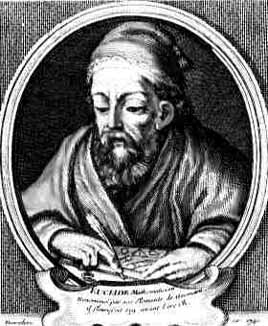
Picture from MacTutor Archives.
After the Pythagorean crisis with the square root of two, Greek mathematicians tried to avoid working with numbers. Instead, the Greeks used geometry to demonstrate mathematical concepts. A line can be drawn any length, so straight lines became a sort of non-algebraic variable.
You can see an example of this in The Pythagorean Proof, where Alexandria Jones represented the sides of her triangle by the letters a and b. These sides may be any length. The sizes of the squares will change with the triangle sides, but the relationship is always true for every right triangle.


Photo by peigianlong.
Here is a puzzle from Just a Substitute Teacher:
Lesson plan entry: “Hand out worksheet packets and have students staple before starting. They know what to do.”
Sounds simple enough! Four numbered sheets, eight total pages, printed front and back. What could go wrong?
Do you know how many possible combinations four pieces of paper can be arranged for stapling?
Continue reading Substitute Teacher Experiments with Combinatorics
Remember the Math Adventurer’s Rule: Figure it out for yourself! Whenever I give a problem in an Alexandria Jones story, I will try to post the answer soon afterward. But don’t peek! If I tell you the answer, you miss out on the fun of solving the puzzle. So if you haven’t worked these problems yet, go back to the original post. Figure them out for yourself — and then check the answers just to prove that you got them right.

Photo by frumbert.
Alexandria Jones‘s parents decided that the family needed to relax after the excitement of tracking Simon Skulk, so they spent the next day at a beach on the Mediterranean coast. Leon collected pebbles and tried to build up figurate numbers — numbers that make a figure, or shape — the way Dr. Theano had shown them.
Remember the Math Adventurer’s Rule: Figure it out for yourself! Whenever I give a problem in an Alexandria Jones story, I will try to post the answer soon afterward. But don’t peek! If I tell you the answer, you miss out on the fun of solving the puzzle. So if you haven’t worked these problems yet, go back to the original posts. Figure them out for yourself — and then check the answers just to prove that you got them right.
While checking out the book table after a homeschool group meeting, Maria Jones glanced up to see her children laughing with some kids she did not recognize. Driving home, she asked about the new family, but Alex and Leon had been too busy exchanging silly stories to even ask the strangers’ names.
“Well,” Leon said, “the boy told me he has twice as many sisters as brothers.”
No way!” said Alex. “The girl told me that she has the same number of brothers and sisters.”
How can that be?
Leonhard Jones is Alexandria Jones’s younger brother. He enjoys woodworking, and he cut a wooden cube into 8 smaller blocks to make himself a puzzle.
Leon painted the 8 blocks with his two favorite colors: red and forest green. When he was finished, Leon could put the blocks together into a red cube, or he could switch them around to make a green cube.
How did Leon paint his blocks?
Are you ready for a challenge? Join us for the 2008 Mathematics Game. Here are the rules:
Use the digits in the year 2008 and the operations +, -, x, ÷, sqrt (square root), ^ (raise to a power), and ! (factorial) — along with parentheses, brackets, or other grouping symbols — to write expressions for the counting numbers 1 through 100.
- All four digits must be used in each expression.
- Only the digits 2, 0, 0, 8 may be used.
- Multi-digit numbers such as 20, 208, or .02 MAY be used this year.
- The square function may NOT be used.
- The integer function may NOT be used.
By definition:
[See Dr. Math’s Why does 0 factorial equal 1?]
For this game we will accept the value:
[See the Dr. Math FAQ 0 to the 0 power.]