English mathematician and puzzle-meister Henry Ernest Dudeney once wrote:
“It may be said generally that a game is a contest of skill for two or more persons, into which we enter either for amusement or to win a prize. A puzzle is something to be done or solved by the individual.
“The example that I give here is apparently a game, but, as in every case one player may win if he only play correctly, it is in reality a puzzle. The interest, therefore, lies in attempting to discover the leading method of play.”
Below is the puzzle game as Dudeney explained it.
Play it for fun at first, then see if you can solve the puzzle.
Homeschooling families naturally build patterns and routines that help us keep our sanity as we go through our homeschooling day.
No matter what resources we choose or which curriculum packages we buy, we never end up following the book exactly as it is written. So don’t worry if you find yourself wandering away from the lesson plan. You’re not getting behind; you’re just discovering your family’s natural learning style.
If you and your children have fallen into the rut of traditional math lessons, have patience. Give yourself time to adjust to a more relaxed mindset about math.
And when you find the rhythm that fits your family, you’ll discover that math lessons flow so much more smoothly.
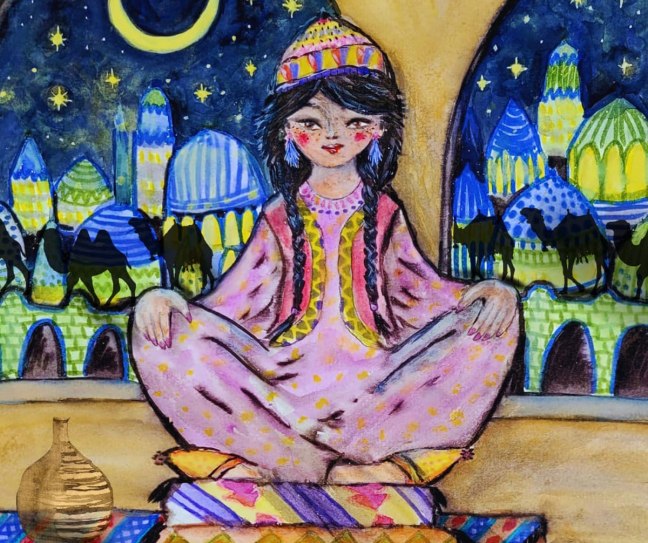
Farzanah and the 17 Camels celebrates the excitement and the rewards of solving a challenging and intriguing math problem. Set against the backdrop of the ancient Silk Road, with bustling markets, stunning carpets, fun characters, and camels, the story draws readers into the magic of Farzanah’s surroundings.
As Farzanah searches for an unusual approach, a way of solving the problem that no one else could think of, she follows the wise advice of her mother:
“My dear Farzanah, don’t be discouraged,” said Mama. “Sometimes, being stuck is exactly where you need to be. I find the best thing I can do is to step away. I free my mind to think about other things. It is in that space that the magic happens. I am able to look at things from a different perspective. With wait time and wishful thinking comes the solution.”
Farzanah embodies the joy of productive struggle in mathematical problem-solving. She is patient, persistent, and curious, using these qualities to tackle a perplexing dilemma that has troubled everyone.
For a bonus math puzzle you can play today, based on Farzanah’s life, download Farzanah’s Sheep Dilemma.
Looney’s earlier book, Ying and the Magic Turtle, is available on the Natural Math website. Or check out her Same But Different discussion prompts for all ages on her website.
Welcome to the 172nd edition of the Playful Math Blog Carnival, a buffet of delectable tidbits of mathy fun. It’s like a free online magazine devoted to learning, teaching, and playing around with math from preschool to high school.
The carnival went on hiatus for a couple of months due to unexpected life issues facing our volunteer hosts. But we’re back now, and ready to celebrate!
By tradition, we start the carnival with a puzzle in honor of our 172nd edition. But if you’d rather jump straight to our featured blog posts, click here for the Table of Contents.
Try This: Lazy Caterers and Clock-Binary Numbers
172 is a lazy caterer number: Imaging a caterer who brought a single large pie to serve the whole party. He needs to cut it into as many pieces as he can, using the fewest (straight) cuts he can get away with.
If each guest gets one piece of pie, what sizes of parties (numbers of people) can the lazy caterer serve?
Can you find a pattern in the lazy caterer sequence?
But for those of you who have followed the carnival for years, you may remember we played with the lazy caterer back in Playful Math 106. (That time, the caterer was serving pizza.) So here’s a bonus activity we’ve never done before…
The first several stages of a pattern are as follows:
What do you notice about this pattern of shapes?
What is the next shape in the sequence?
Can you figure out how the shape below fits into the pattern?
This pattern sequence was named clock binary by its creator, noelements-setempty.
Welcome to the 171st edition of the Playful Math Education Blog Carnival — a smorgasbord of delectable tidbits of mathy fun. It’s like a free online magazine devoted to learning, teaching, and playing around with math from preschool to high school.
Bookmark this post, so you can take your time browsing over the next week or so.
There’s so much playful math to enjoy!
By tradition, we start the carnival with a puzzle/activity in honor of our 171st edition. But if you’d rather jump straight to our featured blog posts, click here to see the Table of Contents.
Try This Puzzle/Activity
171 is a triangular number, the sum of all the numbers from 1 to 18:
1 + 2 + 3 + … + 17 + 18 = 171.
Can you think why a number like this is called “triangular”?
What other triangular numbers can you find?
Also, 171 is a palindrome number, with the same digits forward and backward. It’s also a palindrome of powers:
171 = 52 + 112 + 52
171 = 23 + 43 + 33 + 43 + 23
So in honor of our 171st Playful Math Carnival, here is a palindrome puzzle that leads to an unsolved question in math:
Does every number turn into a palindrome eventually?
Welcome to the 170th edition of the Playful Math Education Carnival — a smorgasbord of delectable tidbits of mathy fun. It’s like a free online magazine devoted to learning, teaching, and playing around with math from preschool to high school.
Bookmark this post, so you can take your time browsing.
There’s so much playful math to enjoy!
By tradition, we start the carnival with a puzzle/activity in honor of our 170th edition. But if you’d rather jump straight to our featured blog posts, click here to see the Table of Contents.
Puzzle: Prime Permutations
According to Tanya Khovanova’s Number Gossip, 170 is the smallest composite number where exactly four permutations of its digits make prime numbers.
To find permutations, think of all the different ways you can arrange the digits 1, 7, 0 into three-digit numbers. (When the zero comes first, those permutations actually make two-digit numbers, which DO also count.)
Can you figure out which permutations make prime numbers?
Hint: The permutation that makes the number “170” is not prime, but it is the product of three prime numbers. Which ones?
For Younger Children: The 170 Square
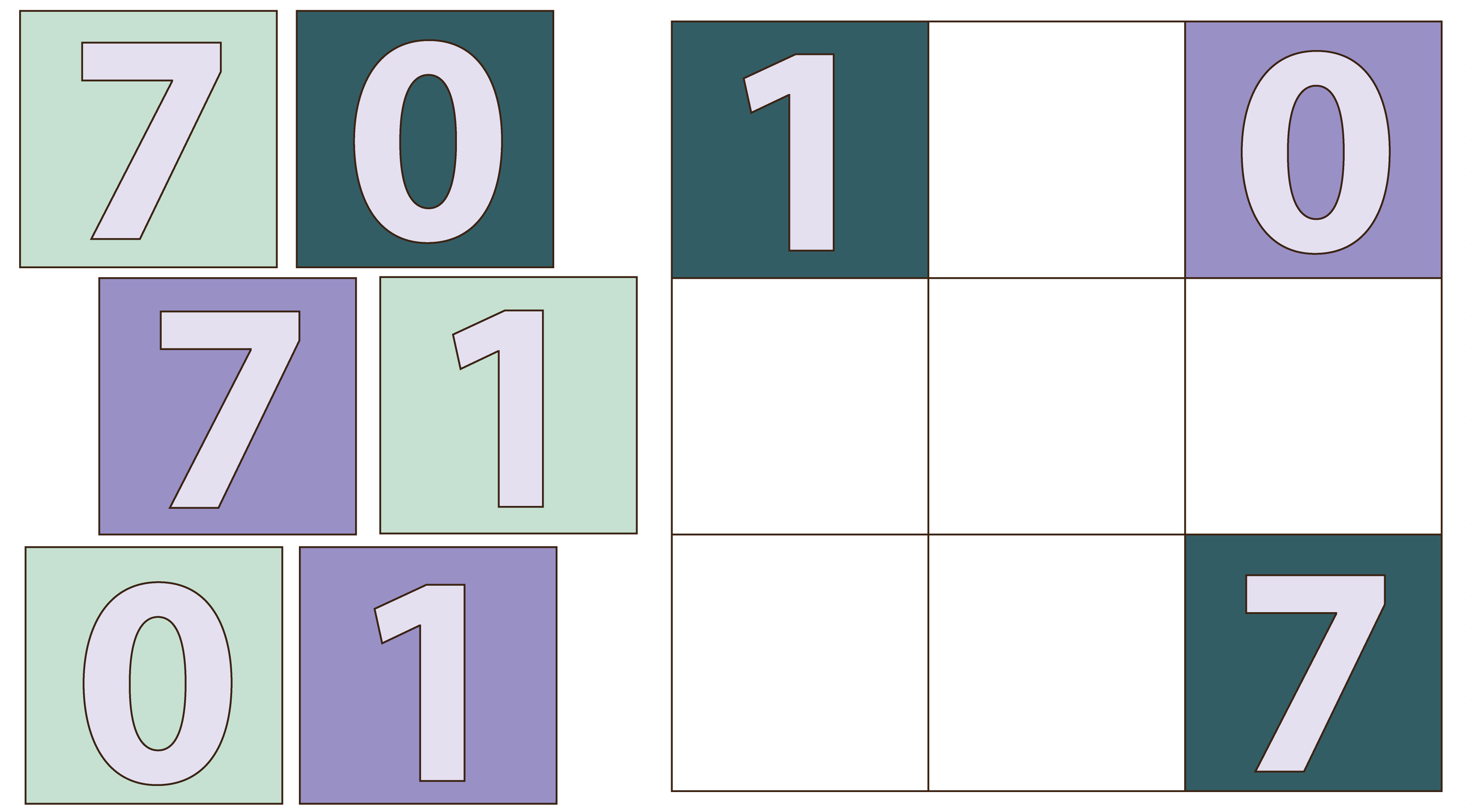
A Latin square is a grid filled with permutations: letters, numbers, or other symbols so that no row or column contains more than one of any character. You’ve probably seen the popular Latin-square puzzle called Sudoku. A Graeco-Latin square (also called an Euler square) is two independent Latin squares overlapping each other.
Can you complete this Euler square made by overlapping permutations of the digits of 170 with winter colors? Don’t repeat the same color OR the same number in any row or column.
Click the picture to get a larger image you can print.
English mathematician Henry Ernest Dudeney wrote logic puzzles and mathematical games for several newspapers and magazines, later collected into books. This poem is from Amusements in Mathematics, published by Thomas Nelson and Sons, 1917.
The numbers are simple enough that younger students can solve it by the guess-and-check method. Older students or adults may want to set up a quadratic equation.
Historical Note: In the British currency of the time, there were 12 pennies to a shilling and 20 shillings to a pound (which was also called a sovereign).
The Cyclists’ Feast
’Twas last Bank Holiday, so I’ve been told,
Some cyclists rode abroad in glorious weather.
Resting at noon within a tavern old,
They all agreed to have a feast together.
“Put it all in one bill, mine host,” they said,
“For everyone an equal share will pay.”
The bill was promptly on the table laid,
And four pounds was the reckoning that day.
But, sad to state, when they prepared to square,
’Twas found that two had sneaked outside and fled.
So, for two shillings more than his due share
Each honest friend who had remained was bled.
They settled later with those rogues, no doubt.
How many were they when they first set out?
Did You Solve It?
One fun thing about math is that you really don’t need the answer book. You can always check the math for yourself: Does your answer make sense? Does it fit the story?
Would you like to write a math poem puzzle of your own? I’d love to hear it!
If you’d like to help fund the blog on an on-going basis, then please join me on Patreon for mathy inspiration, tips, and an ever-growing archive of printable activities.
If you liked this post, and want to show your one-time appreciation, the place to do that is PayPal: paypal.me/DeniseGaskinsMath. If you go that route, please include your email address in the notes section, so I can say thank you.
Are your students doing anything special for Pi Day?
Back when we were homeschooling, my kids and I always felt stir-crazy after two months with no significant break. We needed a day off — and what better way could we spend it than to play math all afternoon?
I love any excuse to celebrate math!
Pi Day is March 14. If you write dates in the month/date format, then 3/14 at 1:59 is about as close as the calendar can get to 3.14159etc.
(Otherwise, you can celebrate Pi Approximation Day on July 22, or 22/7.)
Unfortunately, most of the activities on teacher blogs and Pinterest focus on the pi/pie wordplay or on memorizing the digits. With a bit of digging, however, I found a few puzzles that let us sink our metaphorical teeth into real mathematical meat.
What’s the Big Deal? Why Pi?
In math, symmetry is beautiful, and the most completely symmetric object in the (Euclidean) mathematical plane is the circle. No matter how you turn it, expand it, or shrink it, the circle remains essentially the same.
Every circle you can imagine is the exact image of every other circle there is.
This is not true of other shapes. A rectangle may be short or tall. An ellipse may be fat or slim. A triangle may be squat, or stand upright, or lean off at a drunken angle. But circles are all the same, except for magnification. A circle three inches across is a perfect, point-for-point copy of a circle three miles across, or three millimeters.
What makes a circle so special and beautiful? Any child will tell you, what makes a circle is its roundness. Perfectly smooth and plump, but not too fat.
The definition of a circle is “all the points at a certain distance from the center.” Can you see why this definition forces absolute symmetry, with no pointy sides or bumped-out curves?
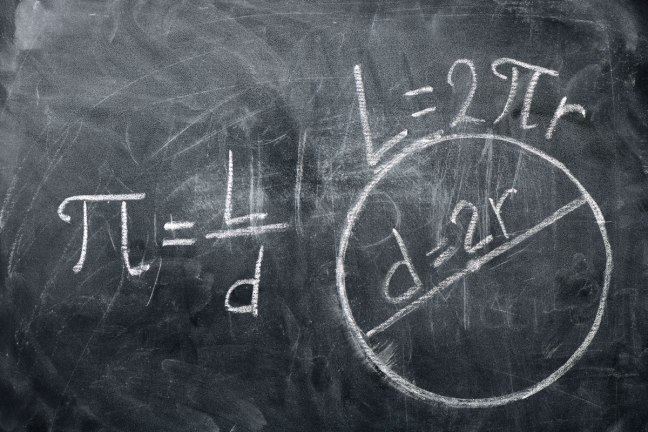
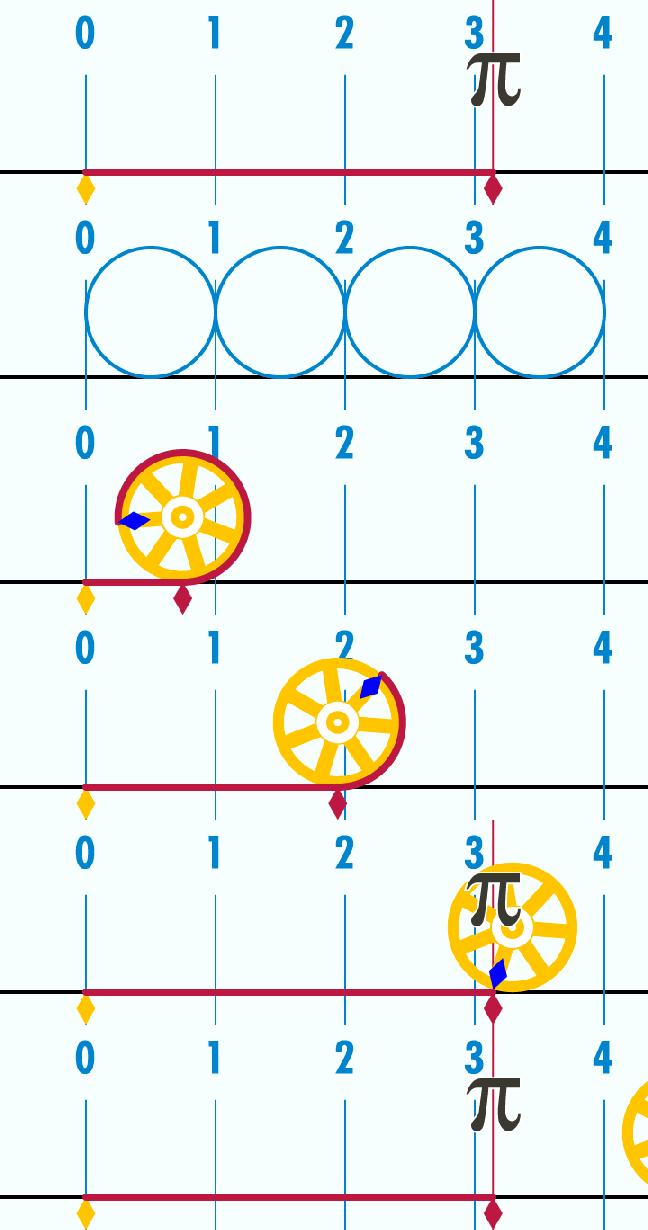
One way to express that perfect roundness in numbers is to compare it to the distance across. How many times would you have to walk back and forth across the middle of the circle to make the same distance as one trip around?
The ratio is the same for every circle, no matter which direction you walk.
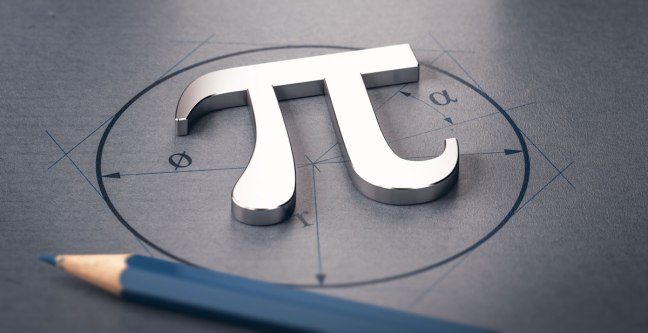
That’s pi!
Puzzles with Pi
For all ages:
Sarah Carter created this fun variation on the classic Four 4s puzzle for Pi Day:
Using only the digits 3, 1, 4 once in each calculation, how many numbers can you make?
You can use any math you know: add, subtract, multiply, square roots, factorials, etc. You can concatenate the digits, putting them together to make a two-digit or three-digit number.
1. Imagine the Earth as a perfect sphere with a long rope tightly wrapped around the equator. Then increase the length of the rope by 10 feet, and magically lift it off the Earth to float above the equator. Will an ant be able to squeeze under the rope without touching it? What about a cat? A person?
2. If you ride a bicycle over a puddle of water, the wheels will leave wet marks on the road. Obviously, each wheel leaves a periodic pattern. How the two patterns are related? Do they overlap? Does their relative position depend on the length of the puddle? The bicycle? The size of the wheels?
3. Draw a semicircle. Along its diameter draw smaller semicircles (not necessarily the same size) that touch each other. Because there are no spaces in between, the sum of the diameters of the small semicircles must equal the diameter of the large one. What about their perimeter, the sum of their arc lengths?
4. Choose any smallish number N. How can you cut a circular shape into N parts of equal area with lines of equal lengths, using only a straight-edge and compass? Hint: The lines don’t have to be straight.
Welcome to the 162nd edition of the Playful Math Education Blog Carnival — a smorgasbord of delectable tidbits of mathy fun. It’s like a free online magazine devoted to learning, teaching, and playing around with math from preschool to high school.
Bookmark this post, so you can take your time browsing.
There’s so much playful math to enjoy!
By tradition, we start the carnival with a puzzle/activity in honor of our 162nd edition. But if you’d rather jump straight to our featured blog posts, click here to see the Table of Contents.
Try This Puzzle/Activity
The number 162 is a palindromic product:
162 = 3 x 3 x 2 x 3 x 3
and 162 = 9 x 2 x 9
How would you define palindromic products?
What other numbers can you find that are palindromic products?
What do you notice about palindromic products?
What questions can you ask?
Make a conjecture about palindromic products. (A conjecture is a statement you think might be true.)
Make another conjecture. How many can you make? Can you think of a way to investigate whether your conjectures are true or false?








 Denise Gaskins' Let's Play Math