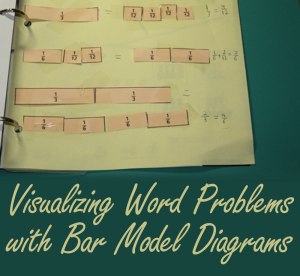
Visualizing Word Problems with Bar Model Diagrams

A friend emailed me, frustrated with her child’s math lesson on bar diagrams: “Why do they have to make it so complicated? Why can’t we just solve the blasted problem?”

I told her bar models themselves are not the goal. The real question for parents and teachers is:

  • What can you do when your child is stumped by a math word problem?

To solve word problems, students must be able to read and understand what is written. They need to visualize this information in a way that will help them translate it into a mathematical expression.

visualizing-word-problems

Bar model diagrams are one very useful tool to aid this visualization. These pictures model the word problem in a way that makes the solution appear almost like magic.

It is a trick well worth learning, no matter which math program you use.

Visualization

https://www.youtube.com/watch?v=HKsYDzQK8Zw

“Visualization is the brain’s ability to see beyond what the eyes can see, and we can develop visualization in many ways.”

The Bar Model Explained

https://www.youtube.com/watch?v=I6Ipio8JntU

“A bar model is a way to represent a situation in a word problem using diagrams — in particular, using rectangles.”

https://www.youtube.com/watch?v=i7LAHc1qvig

“This is one of the ideas that children learn in mathematics: the use of diagrams to represent quantities, especially quantities which are unknown.”

Word Problems from Literature

I’ve written a series of blog posts that explain bar model diagrams from the most basic through to solving multistep word problems. Check them out:

I’ve started working on a book about bar model diagrams, and I’d love to hear your input. Have you tried using them? Do they help your children? What questions do you have?

Update: My New Book

You can help prevent math anxiety by giving your children the mental tools they need to conquer the toughest story problems.

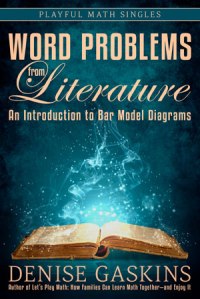
Check out Word Problems from Literature: An Introduction to Bar Model Diagrams—now available at all your favorite online bookstores!

And there’s a Student Workbook, too.

CREDITS: Videos and quotations from Dr. Yeap Ban Har’s YouTube channel. “Girl doing homework” photo (top) by ND Strupler and “math notebooking equal fractions” by Jimmie via Flickr (CC BY 2.0).

Quotable: Then and Now

“I used to think my job was to teach students to see what I see. I no longer believe this. My job is to teach students to see; and to recognize that no matter what the problem is, we don’t all see things the same way. But when we examine our different ways of seeing, and look for the relationships involved, everyone sees more clearly; everyone understands more deeply.”

Joe Schwartz
Then and Now

CREDITS: Feature photo (above) by jenn.davis via Flickr (CC BY 2.0).

Math Inspirations: Why Study Mathematics?

why-study-math

What teacher hasn’t heard a student complain, “When am I ever going to have to use this?” Didn’t most of us ask it ourselves, once upon a time?

And unless we choose a math-intensive career like engineering, the truth is that after we leave school, most of us will never again use most of the math we learned.

But if math beyond arithmetic isn’t all that useful, then what’s the point?

If you or your student is singing the “Higher Math Blues,” here are some quotations that may cheer you up — or at least give you the strength of vision to keep on slogging.

We Study Mathematics…

To Understand Creation

I don’t want to convince you that mathematics is useful. It is, but utility is not the only criterion for value to humanity. Above all, I want to convince you that mathematics is beautiful, surprising, enjoyable, and interesting. In fact, mathematics is the closest that we humans get to true magic. How else to describe the patterns in our heads that — by some mysterious agency — capture patterns of the universe around us? Mathematics connects ideas that otherwise seem totally unrelated, revealing deep similarities that subsequently show up in nature.

— Ian Stewart
The Magical Maze

That vast book which stands forever open before our eyes, the universe, cannot be read until we have learnt the language in which it is written. It is written in mathematical language, and the letters are triangles, circles, and other geometrical figures, without which means it is humanly impossible to comprehend a single word.

— Galileo Galilei
quoted by Clifford Pickover, A Passion for Mathematics

To Train Our Minds

The investigation of mathematical truths accustoms the mind to method and correctness in reasoning, and is an employment peculiarly worthy of rational beings.

— George Washington
quoted by William Dunham, The Mathematical Universe

I told myself, “Lincoln, you can never make a lawyer if you do not understand what demonstrate means.” So I left my situation in Springfield, went home to my father’s house, and stayed there till I could give any proposition in the six books of Euclid at sight. I then found out what “demonstrate” means, and went back to my law studies.

— Abraham Lincoln
quoted by William Dunham, The Mathematical Universe

To Understand History

In most sciences, one generation tears down what another has built, and what one has established another undoes. In mathematics alone, each generation adds a new story to the old structure.

— Herman Henkel
quoted by Noah benShea, Great Quotes to Inspire Great Teachers

Biographical history, as taught in our public schools, is still largely a history of boneheads: ridiculous kings and queens, paranoid political leaders, compulsive voyagers, ignorant generals — the flotsam and jetsam of historical currents. The men who radically altered history, the great scientists and mathematicians, are seldom mentioned, if at all.

— Martin Gardner
quoted by G. Simmons, Calculus Gems

I will not go so far as to say that constructing a history of thought without profound study of mathematical ideas is like omitting Hamlet from the play named after him. But it is certainly analogous to cutting out the part of Ophelia. For Ophelia is quite essential to the play, she is very charming. . . and a little mad.

— Alfred North Whitehead
quoted in The Viking Book of Aphorisms

To Appreciate the Beauty

The mathematician does not study pure mathematics because it is useful, he studies it because he delights in it, and he delights in it because it is beautiful.

— Henri Poincaré
quoted by Theoni Pappas, More Joy of Mathematics

A mathematician, like a painter or poet, is a maker of patterns. If his patterns are more permanent than theirs, it is because they are made with ideas. The mathematician’s patterns, like the painter’s or the poet’s, must be beautiful. The ideas, like the colors or the words, must fit together in a harmonious way. Beauty is the first test: there is no permanent place in this world for ugly mathematics.

— Godfrey H. Hardy
A Mathematician’s Apology

And Most of All, to Play

Mathematics is a world created by the mind of men, and mathematicians are people who devote their lives to what seems to me a wonderful kind of play!

Constance Reid

At age eleven, I began Euclid, with my brother as tutor. This was one of the great events of my life, as dazzling as first love. I had not imagined there was anything so delicious in the world.

— Bertrand Russell
The Autobiography of Bertrand Russell

I love mathematics … principally because it is beautiful, because man has breathed his spirit of play into it, and because it has given him his greatest game — the encompassing of the infinite.

Rózsa Péter
quoted by Rosemary Schmalz, Out of the Mouths of Mathematicians

Did you enjoy these? You can find plenty more on my Math & Education Quotations page.

  • I would LOVE to hear YOUR favorite mathematics, education, or inspirational quote. Please share in the Comments section below!

CREDITS: Never Ending Math Problem photo (above) by Danny (blog post title added) via Flickr (CC BY 2.0).
What Do We Mean by ‘Understanding’?

“You understand something if you have the ability to view it from different perspectives.

“Changing your perspective makes your mind more flexible, it makes you open to new things, and it makes you able to understand things.”

— Roger Antonsen
Math is the hidden secret to understanding the world

Check out the speaker’s footnotes for links and interesting tidbits about the images in the video.

Prof. Triangleman’s Abbreviated List of Standards for Mathematical Practice

How can we help children learn to think mathematically? Live by these four principles.

PTALSMP 1: Ask questions.

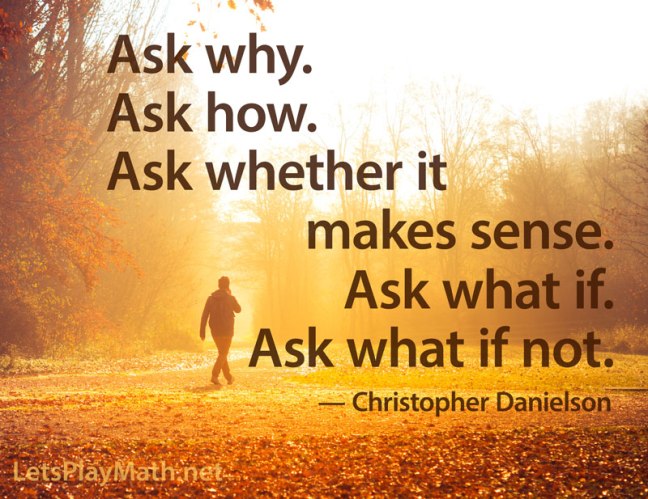
Ask why. Ask how. Ask whether your answer is right. Ask whether it makes sense. Ask what assumptions you have made, and whether an alternate set of assumptions might be warranted. Ask what if. Ask what if not.

PTALSMP 2: Play.

See what happens if you carry out the computation you have in mind, even if you are not sure it’s the right one. See what happens if you do it the other way around. Try to think like someone else would think. Tweak and see what happens.

PTALSMP 3: Argue.

Say why you think you are right. Say why you might be wrong. Try to understand how someone else sees things, and say why you think their perspective may be valid. Do not accept what others say is so, but listen carefully to it so that you can decide whether it is.

PTALSMP 4: Connect.

Ask how this thing is like other things. Try your ideas out on a new problem. Ask whether and how these ideas apply to other situations. Look for similarities and differences. Seek out the boundaries and limitations of your techniques.

— Christopher Danielson

And a Puzzle

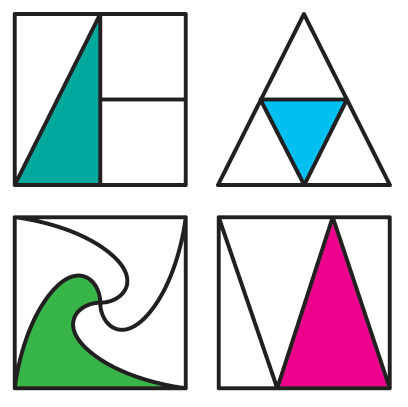
Practice applying Professor Triangleman’s Standards to the puzzle below. Which one doesn’t belong? Can you say why someone else might pick a different one?

wodb

multfrac-300CREDITS: An expanded version of the standards originally posted in Ginger ale (also abbreviated list of Standards for Mathematical Practice). Feature photo by Alexander Mueller via Flicker (CC-BY 2.0, text added). This post is an excerpt from my book Multiplication & Fractions: Math Games for Tough Topics, available now at your favorite online book dealer.

The Value of Math Games

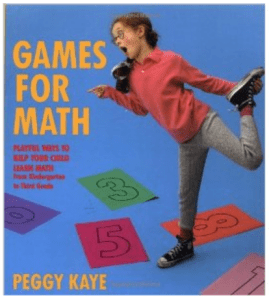
From Peggy Kaye’s classic book Games for Math:

Kaye-Games4Math

“Games put children in exactly the right frame of mind for learning difficult things.

“Children relax when they play — and they concentrate. They don’t mind repeating certain facts or procedures over and over, if repetition is part of the game.

“Children throw themselves into playing games the way they never throw themselves into filling out workbook pages.

“The games solidify the achievements of children who are already good at math, and they shore up children who need shoring up. They teach or reinforce many of the skills that a formal curriculum teaches, plus one skill that formal teaching sometimes leaves out — the skill of having fun with math, of thinking hard and enjoying it.

“If you play these games and your child learns only that hard mental effort can be fun, you will have taught something invaluable.”

Peggy Kaye
Games for Math

Sample Peggy’s Games for Math

 
* * *

This blog is reader-supported.

If you’d like to help fund the blog on an on-going basis, then please join me on Patreon for mathy inspiration, tips, and an ever-growing archive of printable activities.

If you liked this post, and want to show your one-time appreciation, the place to do that is PayPal: paypal.me/DeniseGaskinsMath. If you go that route, please include your email address in the notes section, so I can say thank you.

Which I am going to say right now. Thank you!

“The Value of Math Games” copyright © 2016 by Denise Gaskins.

Dreams for our Children

Don’t you love this quotation?

For our children, we dream that mathematics…

… makes sense
… is more than just arithmetic
… is joyous
… makes them strong
… is meaningful
… is creative
… is full of fascinating questions
… opens up many paths to solutions
… is friendly
… solves big problems and makes the world better
… is a powerful tool they can master
… is beautiful
… lets them learn in their own ways
… is connected to their lives
… asks “why” and not just “how”
… opens the world

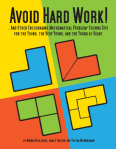
Avoid Hard WorkFrom the upcoming new book Avoid Hard Work by James Tanton and the Natural Math team.

Join the crowdfunding campaign and reserve your copy today!

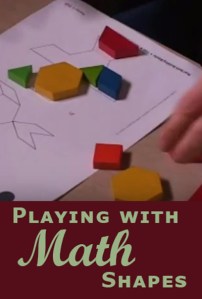
Playing with Math Shapes

Playing-with-shapesI love it when a plan — or rather, a series of math thoughts — comes together.

On Monday, Emily Grosvenor (author of the Tessalation! picture book) asked me how parents who are insecure in math could help their children learn through play, and I responded with this quote from my Let’s Play Math book:

If you are intimidated by numbers, you can look for patterns of shape and color. Pay attention to how they grow. Talk about what your children notice.

But I wasn’t entirely satisfied with that answer. So many adults have come away from their own school experience thinking math is only numbers. Even with shapes, isn’t it the numbers about them — how many sides, what size of angles, calculate the the area or perimeter — that are important? That’s what school math tends to focus on.

Those of us who are comfortable with math know that there are many more things to notice and think about than just numbers. We know that it’s this noticing, thinking, and wondering that is at the heart of math. And that just playing with shapes can build a powerful foundation for future math learning.

And then yesterday, Malke Rosenfeld posted a beautiful article about a paper manipulative created by Paula Krieg. Which included this video:

The ability to create, and maintain, and manipulate shapes mentally — that’s the goal. Just like kids who can put numbers together in their heads, kids who can rotate, flip, and think of how shapes fit together in their heads have a powerful tool to analyze not only simple shape puzzles, but dividing up an area that’s a more complex room shape … to look at a piece of artwork … or look at a building … For these kids, all the world around becomes a playground to use mathematical ideas.

— Doug Clements
Problem Solving Development: Composing Shapes

Of course, pattern blocks are good for much more than just filling in worksheet pictures. But I love this peek into how a child’s understanding grows, in bits and spurts — without any numbers at all — until the world itself becomes a playground for mathematical ideas.

Want more?

You know what? Children like mathematics. Children see the world mathematically … When we do a puzzle, when we count things, when we see who’s got more, or who’s taller … Play and mathematics are not on opposite sides of the stage.

— Doug Clements
Why Early Childhood is the Right Time to Start Learning Math

Did You Get Your Playful Math Snacks?

Circumferències de FordMy April “Let’s Play Math” newsletter went out early this morning to everyone who signed up for Tabletop Academy Press math updates. This month’s issue celebrated the 200th anniversary of the Farey Sequence.

The Farey Sequence was described in 1816 by English geologist John Farey, who was disparaged by the famous mathematical snob* G.H. Hardy as “at the best an indifferent mathematician.”

“I rather like the idea that the Farey Sequences are named after someone who noticed a pattern and asked a question — and not even the first person to notice the pattern, ask the question, or provide the answer. As math teachers, we teach plenty of indifferent mathematicians who wake up when they experience the joy of discovering something that is new to them, not necessarily new to the whole world.”

— Debra K. Borkovitz,
Farey Fraction Visual Patterns

If you’re a subscriber but didn’t see your newsletter, check your Updates or Promotions tab (in Gmail) or your Spam folder. And to make sure you get all the future newsletters, add “Denise at Tabletop Academy Press” [denise.gaskins @ tabletop academy press .com, without spaces] to your contacts or address book.

If you missed this month’s edition, no worries—‌there will be more playful math snacks coming soon. Click the link below to sign up today!

And remember: Newsletter subscribers are always the first to hear about new books, revisions, and sales or other promotions.


* See A Mathematician’s Apology Revisited by W.W. Sawyer.

Memorizing the Math Facts

Central City Times Tables[Photo by dsb nola via flickr. (CC BY 2.0)]

The most effective and powerful way I’ve found to commit math facts to memory is to try to understand why they’re true in as many ways as possible. It’s a very slow process, but the fact becomes permanently lodged, and I usually learn a lot of surrounding information as well that helps me use it more effectively.

Actually, a close friend of mine describes this same experience: he couldn’t learn his times tables in elementary school and used to think he was dumb. Meanwhile, he was forced to rely on actually thinking about number relationships and properties of operations in order to do his schoolwork. (E.g. I can’t remember 9×5, but I know 8×5 is half of 8×10, which is 80, so 8×5 must be 40, and 9×5 is one more 5, so 45. This is how he got through school.) Later, he figured out that all this hard work had actually given him a leg up because he understood numbers better than other folks. He majored in math in college and is now a cancer researcher who deals with a lot of statistics.

Ben Blum-Smith
Comment on Math Mama’s post What must be memorized?

The entire discussion (article and comments) is well worth reading:

You may also enjoy: