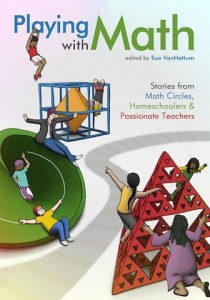
Playing With Math — the Book

body_Book_cover_for_upload

Update: The crowdfunding campaign is now closed and the book is in the final stages. It should be headed to the printer soon. Check the Playing With Math homepage for publication and ordering information.


There are only a few days left to reserve your copy of Playing With Math: Stories from Math Circles, Homeschoolers, and Passionate Teachers. I don’t have time to finish the review I hoped to write, so instead I’ll share some of my favorite quotes from the book:

What do mathematicians do? We play with math. What are little kids doing when they’re thinking about numbers, shapes, and patterns? They’re playing with math. You may not believe it yet, but you can have fun playing with math, too.

— Sue VanHattum, editor

We had a discussion at the end of the club on how we are all confused now, but pleasantly so, and how important it is to rejoice in confusion and to be comfortable with it. Adults often strive very hard to get rid of any and all possible traces of confusion for kids, making things dreadfully boring.

— Maria Droujkova, after a math circle exploration of infinity

All it talkes to do mathematics is opportunity, a frustrating problem, and a bit of stubbornness.

— Ellen Kaplan, math circle leader

Our own school experiences can make it hard for us to teach without being tempted to “help them master” a concept that they may or may not be ready to master. What we never learned in school was the concept of playing around with math, allowing ideas to “percolate,” so to speak, before mastery occurs, and that process may take time.

— Julie Brennan, homeschooler

Continue reading Playing With Math — the Book

Playing With Math: Stories from Math Circles, Homeschoolers, and Passionate Teachers

body_Book_cover_for_upload

Update: The crowdfunding campaign is now closed and the book is in the final stages. It should be headed to the printer soon. Check the Playing With Math homepage for publication and ordering information.


There’s a problem: Most people don’t like math. Why is that? Perhaps it has something to do with the way math is taught in school. As a teacher to my own kids and mentor to homeschooling parents, I’ve been fighting math anxiety for decades.

This book is one part of the solution.

Playing With Math: Stories from Math Circles, Homeschoolers, and Passionate Teachers features more than thirty authors who tell delightful stories of learning to appreciate math and of sharing their enthusiasm with their communities, families, or students. After every chapter is a puzzle, game, or activity to get you and your kids playing with math, too.

You can read a couple of excerpts at PlayingWithMath.org:

Continue reading Playing With Math: Stories from Math Circles, Homeschoolers, and Passionate Teachers

Reblog: In Honor of the Standardized Testing Season

TakingTest

[Feature photo above by Alberto G. Photo right by Renato Ganoza. Both (CC-BY-SA-2.0) via flickr.]

Quotations and comments about the perils of standardized testing, now part of my book Let’s Play Math.

I hope you enjoy this “Throw-back Thursday” blast from the Let’s Play Math! blog archives:


The school experience makes a tremendous difference in a child’s learning. Which of the following students would you rather be?

I continued to do arithmetic with my father, passing proudly through fractions to decimals. I eventually arrived at the point where so many cows ate so much grass, and tanks filled with water in so many hours. I found it quite enthralling.

— Agatha Christie
An Autobiography

…or…

“Can you do Addition?” the White Queen asked. “What’s one and one and one and one and one and one and one and one and one and one?”

“I don’t know,” said Alice. “I lost count.”

“She can’t do Addition,” the Red Queen interrupted. “Can you do Subtraction? Take nine from eight.”

“Nine from eight I can’t, you know,” Alice replied very readily: “but—”

“She can’t do Subtraction,” said the White Queen. “Can you do Division? Divide a loaf by a knife — what’s the answer to that?”

[Click here to go read In Honor of the Standardized Testing Season.]

Pi Day Roundup

WhyPi

[Feature photo above by Nicolo’ Canali De Rossi.]

Math holiday alert: March 14th is Pi Day. But why limit ourselves to a single day? Playing with math should be a year-round adventure! Here are some ideas to help you celebrate…

Pi Day Posts on Let’s Play Math! Blog

DragonOfPi

Continue reading Pi Day Roundup

Quotable: Math as a Second Language

Wenninger 94photo by fdecomite via flickr (CC BY 2.0)

I sat in class three days ago and thought to myself, “They need a class called ‘Math as a second language’ or MSL for short.”

It is easy to understand what a median is, or what attributes a kite has, or why is a rectangle a square but a square not a rectangle… for a minute or a day.

It is easy to temporarily memorize a fact. But without true understanding of the concept those “definitions” fade. If the foundation of truly understanding is not there to begin with then there is little hope for any true scaffolding and even less chance of any true learning.

Duncan
Comment on Christopher Danielson’s Geometry and language

Playing with Pinterest: New Math Boards

Do you like Pinterest? I’ve enjoyed exploring the site lately, so I set up a few boards where I can pin the goodies I find. It may take awhile before I get all the old games and posts from this blog loaded up, so save the links and come back often…

Playful Math Games & Activities

Middle-High School

As our children (and their parents!) play around with mathematical ideas and the relationships between them, we develop deep understanding that is strong enough to support future learning. Playful math links include math games, activities, and interesting lesson plans.

Math Doodling

Math Doodling

Making abstract math visual: Math doodles let us see and experiment with a wide range of mathematical structures — and even to feel them, if we include hands-on 3D doodles in clay or other media. Links include art projects, geometry constructions, and physical models to explore.

Math Teaching Tips & Resources

Math Teaching Tips

A variety of math teaching ideas for homeschool families or classroom teachers. Learning mathematics is more than just answer-getting: help your students make conceptual connections. These links are more “schooly” than on the other boards, and they include conceptual lessons that build your own understanding of mathematics as well as that of your students. And math notebooking resources, too.

MTaP Math Education Blog Carnival Archive

MTaP archive

Since early 2009, the Math Teachers at Play (MTaP) blog carnival has offered tips, tidbits, games, and activities for students and teachers of preschool through pre-college mathematics. Now published once a month, the carnival welcomes entries from parents, students, teachers, homeschoolers, and just plain folks. If you like to learn new things and play around with ideas, you are sure to find something of interest.

Math-Ed Quotes

Math-Ed Quotes

Inspiration for homeschooling parents and classroom teachers. This is where I’m posting my Wednesday Wisdom quotes.

And that’s the end of my Pinterest boards (so far).

What are some of your favorite Pinterest sites? Please share a link in the comments!

Math Teachers at Play #70

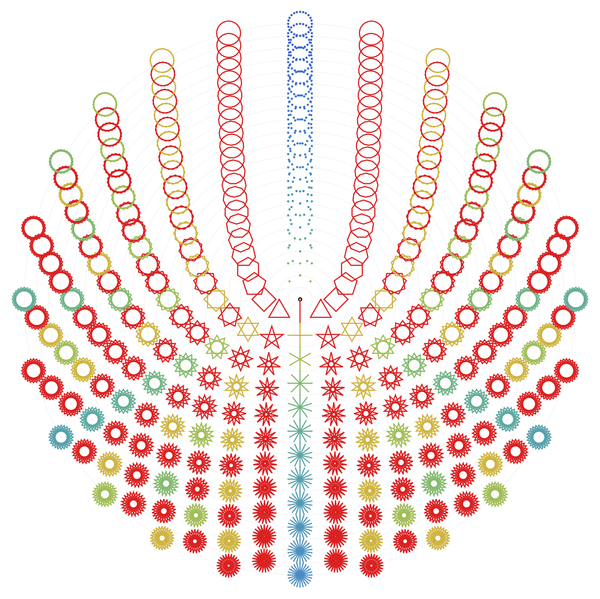
800px-Brauchtum_gesteck_70_1[Feature photo above by David Reimann via Bridges 2013 Gallery. Number 70 (right) from Wikimedia Commons (CC-BY-SA-3.0-2.5-2.0-1.0).]

Do you enjoy math? I hope so! If not, browsing this post just may change your mind.

Welcome to the 70th edition of the Math Teachers At Play math education blog carnival — a smorgasbord of 42+ links to bloggers all around the internet who have great ideas for learning, teaching, and playing around with math from preschool to pre-college. Let the mathematical fun begin!

By tradition, we start the carnival with a puzzle in honor of our 70th edition. But if you would like to jump straight to our featured blog posts, click here to see the Table of Contents.

Click here to continue reading.

Quotable: Focus on Being Silent

Children Reading Pratham Books and Akshara[Photo by Pratham Books via Flickr (CC BY 2.0).]

I discovered this gem in my blog reading today. One of the secrets of great teaching:

Audrey seemed, for once, at a loss for words. She was thinking about the question.

I try to stay focused on being silent after I ask young children questions, even semi-serious accidental ones. Unlike most adults, they actually take time to think about their answers and that often means waiting for a response, at least if you want an honest answer.

If you’re only looking for the “right” answer, it’s fairly easy to gently badger a child into it, but I’m not interested in doing that.

Thomas Hobson
Thank You For Teaching Me

Learn Math by Asking Questions

The best way for children to build mathematical fluency is through conversation. For more ideas on discussion-based math, check out these posts:

And be sure to follow Christopher Danielson’s Talking Math with Your Kids blog!

 
* * *

This blog is reader-supported.

If you’d like to help fund the blog on an on-going basis, then please join me on Patreon for mathy inspiration, tips, and an ever-growing archive of printable activities.

If you liked this post, and want to show your one-time appreciation, the place to do that is PayPal: paypal.me/DeniseGaskinsMath. If you go that route, please include your email address in the notes section, so I can say thank you.

Which I am going to say right now. Thank you!

“Quotable: Focus on Being Silent” copyright © 2013 by Denise Gaskins. Image at the top of the post copyright © Pratham Books via Flickr (CC BY 2.0).