“I’m so tired of being ignorant about math. I can memorize rules and do calculations, but if I miss a step the numbers make no sense at all, and I can’t spot what went wrong. Another struggle I have is keeping everything organized in my mind. When I learn a new concept or strategy, I easily forget it. My son is only a toddler now, but as he grows up, I don’t want to burden him with my own failures. Where should I start?”
As a first step, convince yourself that math is interesting enough to learn on its own merits, because parental guilt will only carry you so far. Start with Steven Strogatz’s “Elements of Math” series from The New York Times, or pick up his book The Joy of x.
Some Internet topics are evergreen. I noticed that my old Multiplication Is Not Repeated Addition post has been getting new traffic lately, so I read through the article again. And realized that, even after all those words, I still had more to say.
So I added the following update to clarify what seemed to me the most important point.
I’d love to hear your thoughts! The comment section is open down below . . .
Language Does Matter
Addition: addend + addend = sum. The addends are interchangeable. This is represented by the fact that they have the same name.
Multiplication: multiplier × multiplicand = product. The multiplier and multiplicand have different names, even though many of us have trouble remembering which is which.
multiplier = “how many or how much”
multiplicand = the size of the “unit” or “group”
Different names indicate a difference in function. The multiplier and the multiplicand are not conceptually interchangeable. It is true that multiplication is commutative, but (2 rows × 3 chairs/row) is not the same as (3 rows × 2 chairs/row), even though both sets contain 6 chairs.
A New Type of Number
In multiplication, we introduce a totally new type of number: the multiplicand. A strange, new concept sits at the heart of multiplication, something students have never seen before.
The multiplicand is a this-per-that ratio.
A ratio is a not a counting number, but something new, much more abstract than anything the students have seen up to this point.
A ratio is a relationship number.
In addition and subtraction, numbers count how much stuff you have. If you get more stuff, the numbers get bigger. If you lose some of the stuff, the numbers get smaller. Numbers measure the amount of cookies, horses, dollars, gasoline, or whatever.
The multiplicand doesn’t count the number of dollars or measure the volume of gasoline. It tells the relationship between them, the dollars per gallon, which stays the same whether you buy a lot or a little.
By telling our students that “multiplication is repeated addition,” we dismiss the importance of the multiplicand. But until our students wrestle with and come to understand the concept of ratio, they can never fully understand multiplication.
For Further Investigation
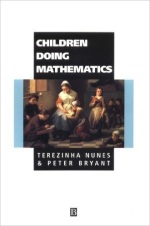
If you’re interested in digging deeper into how children learn addition and multiplication, I highly recommend Terezina Nunes and Peter Bryant’s book Children Doing Mathematics.
To learn about modeling multiplication problems with bar diagrams, check out the Mad Scientist’s Ray Gun model of multiplication:
I’ve started collecting quotes about teaching math for the chapter pages in my next Math You Can Play book. Here are a couple snippets that don’t fit the theme of “Multiplication & Fractions,” but they struck my fancy anyway:
If teachers would only encourage guessing. I remember so many of my math teachers telling me that if you guess, it shows that you don’t know. But in fact there is no way to really proceed in mathematics without guessing. You have to guess! You have to have intuitive judgment as to the way it might go. But then you must be willing to check your guess. You have to know that simply thinking it may be right doesn’t make it right.
One of the big misapprehensions about mathematics that we perpetrate in our classrooms is that the teacher always seems to know the answer to any problem that is discussed. This gives students the idea that there is a book somewhere with all the right answers to all of the interesting questions, and that teachers know those answers. And if one could get hold of the book, one would have everything settled. That’s so unlike the true nature of mathematics.
Earlier in this blog post series, I gave you three middle-school math rules. But by exploring the concept of rectangular area as a model of multiplication, we discovered that in a way they were all the same.
The rules are not arbitrary, handed down from a mathematical Mount Olympus. They are three expressions of a single basic question: what does it mean to measure area?
There was only one rule, one foundational pattern that tied all these topics together in a mathematical web.
What Is Your Worldview?
Many children want to learn math instrumentally, as a tool for getting answers. They prefer the simplicity of memorizing rules to the more difficult task of making sense of new ideas. Being young, they are by nature short-term thinkers. They beg, “Just tell me what to do.”
But if we want our children to truly understand mathematics, we need to resist such shortcuts. We must take time to explore mathematics as a world of ideas that connect and relate to each other in many ways. And we need to show children how to reason about these interconnected concepts, so they can use them to think their way through an ever-expanding variety of problems.
Our kids can only see the short term. If we adults hope to help them learn math, our primary challenge is to guard against viewing the mastery of facts and procedures as an end in itself. We must never fall into thinking that the point of studying something is just to get the right answers.
We understand this in other school subjects. Nobody imagines that the point of reading is to answer comprehension questions. We know that there is more to learning history than winning a game of Trivial Pursuit. But when it comes to math, too many parents (and far too many politicians) act as though the goal of our children’s education is to produce high scores on a standardized test.
What If I Don’t Understand Math?
If you grew up (as I did) thinking of math as a tool, the instrumental approach may feel natural to you. The idea of math as a cohesive system may feel intimidating. How can we parents help our children learn math, if we never understood it this way ourselves?
Don’t panic. Changing our worldview is never easy, yet even parents who suffer from math anxiety can learn to enjoy math with their children. All it takes is a bit of self-discipline and the willingness to try.
You don’t have to know all the answers. In fact, many people have found the same thing that Christopher Danielson described in his blog post “Let the children play” — the more we adults tell about a topic, the less our children learn. With the best of intentions we provide information, but we unwittingly kill their curiosity.
If you’re afraid of math, be careful to never let a discouraging word pass your lips. Try calling upon your acting skills to pretend that math is the most exciting topic in the world.
Encourage your children to notice the math all around them.
Search out opportunities to discuss numbers, shapes, symmetry, and patterns with your kids.
Patterns are so important that American mathematician Lynn Arthur Steen defined mathematics as the science of patterns.
As biology is the science of life and physics the science of energy and matter, so mathematics is the science of patterns. We live in an environment steeped in patterns — patterns of numbers and space, of science and art, of computation and imagination. Patterns permeate the learning of mathematics, beginning when children learn the rhythm of counting and continuing through times tables all the way to fractals and binomial coefficients.
If you are intimidated by numbers, you can look for patterns of shape and color. Pay attention to how they grow, and talk about what your children notice. For example, some patterns repeat exactly, while other patterns change as they go (small, smaller, smallest, or loud, louder, loudest).
Nature often forms fractal-like patterns: the puffy round-upon-roundness of cumulus clouds or broccoli, or the branch-upon-branchiness of a shrub or river delta. Children can learn to recognize these, not as a homework exercise but because they are interesting.
Math the Mathematician’s Way
Here is the secret solution to the crisis of math education: we adults need to learn how to think like mathematicians.
For more on what it means to think about math the mathematician’s way, check out my Homeschooling with Math Anxiety blog post series:
We’ve examined how our vision of mathematical success shapes our children’s learning. Do we think math is primarily a tool for solving problems? Or do we see math as a web of interrelated concepts?
Instrumental understanding views math as a tool. Relational understanding views math as an interconnected system of ideas. Our worldview influences the way we present math topics to our kids. And our children’s worldview determines what they remember.
In the past two posts, we looked at different ways to understand and teach rectangular area and fraction multiplication. But how about algebra? Many children (and adults) believe “math with letters” is a jumble of abstract nonsense, with too many formulas and rules that have to be memorized if you want to pass a test.
Which of the following sounds the most like your experience of school math? And which type of math are your children learning?
Instrumental Understanding: FOIL
Every mathematical procedure we learn is an instrument or tool for solving a certain kind of problem. To understand math means to know which tool we are supposed to use for each type of problem and how to use that tool — how to categorize the problem, remember the formula, plug in the numbers, and do the calculation.
When you need to multiply algebra expressions, remember to FOIL: multiply the First terms in each parenthesis, and then the Outer, Inner, and Last pairs, and finally add all those answers together.
The FOIL method for multiplying two binomials.
Relational Understanding: The Area Model
Each mathematical concept is part of a web of interrelated ideas. To understand mathematics means to see at least some of this web and to use the connections we see to make sense of new ideas.
The concept of rectangular area has helped us understand fractions. Let’s extend it even farther. In the connected system of mathematics, almost any type of multiplication can be imagined as a rectangular area. We don’t even have to know the size of our rectangle. It could be anything, such as subdividing a plot of land or designing a section of crisscrossed colors on plaid fabric.
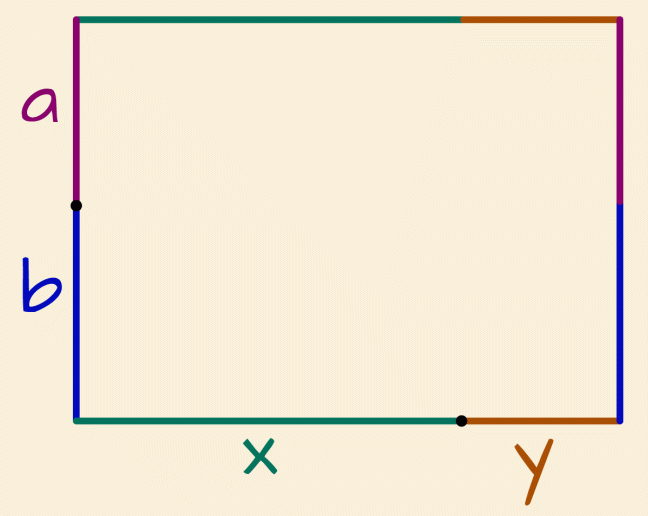
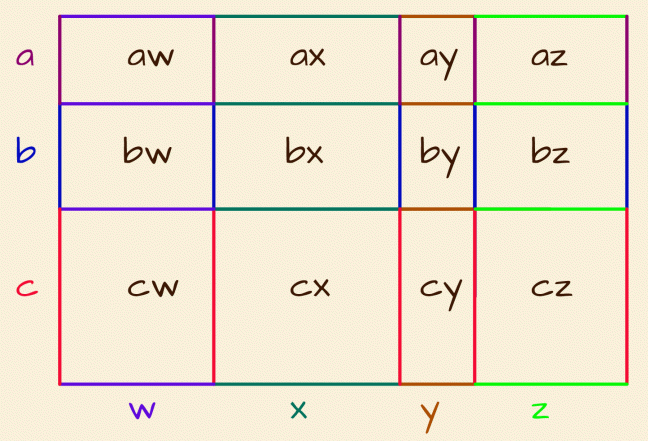
We can imagine a rectangle with each side made up of two unknown lengths. One side has some length a attached to another length b. The other side is x units long, with an extra amount y stuck to its end.
We don’t know which side is the “length” and which is the “width” because we don’t know which numbers the letters represent. But multiplication works in any order, so it doesn’t matter which side is longer. Using the rectangle model of multiplication, we can see that this whole shape represents the area .
An algebraic rectangle: each side is composed of two unknown lengths joined together.
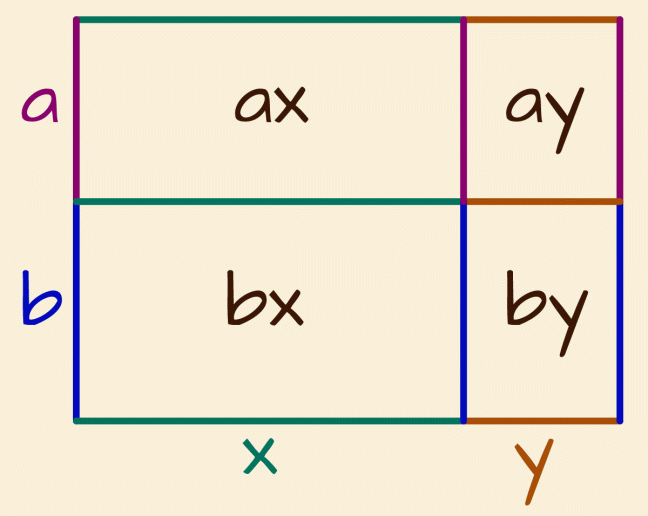
But since the sides are measured in pieces, we can also imagine cutting up the big rectangle. The large, original rectangle covers the same amount of area as the four smaller rectangular pieces added together, and thus we can show that .
Four algebraic rectangles: the whole thing is equal to the sum of its parts.
With the FOIL formula mentioned earlier, our students may get a correct answer quickly, but it’s a dead end. FOIL doesn’t connect to any other math concepts, not even other forms of algebraic multiplication. But the rectangular area model will help our kids multiply more complicated algebraic expressions such as .
The rectangle model of multiplication helps students keep track of all the pieces in a complex algebraic calculation.
Not only that, but the rectangle model gives students a tool for making sense of later topics such as polynomial division. And it is fundamental to understanding integral calculus.
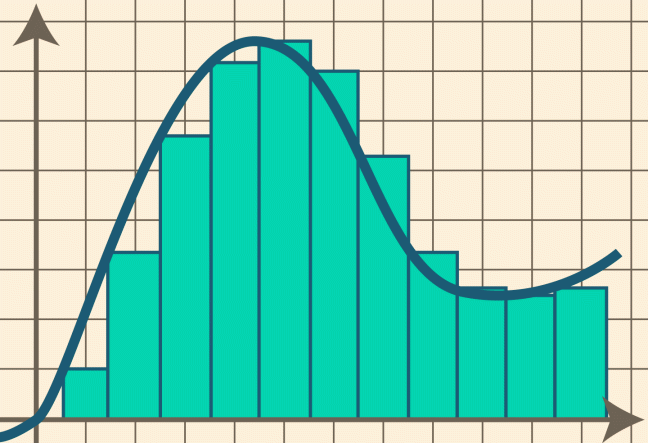
In calculus, students use the rectangle model of multiplication to find irregular areas. The narrower the rectangles, the more accurate the calculation, so we imagine shrinking the widths until they are infinitely thin.
In this post, we consider the second of three math rules that most of us learned in middle school.
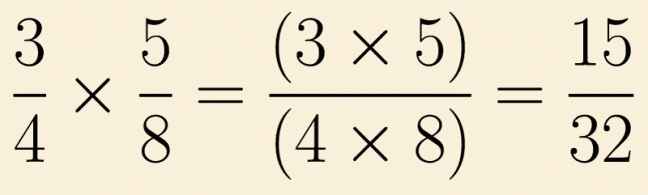
To multiply fractions, multiply the tops (numerators) to make the top of your answer, and multiply the bottoms (denominators) to make the bottom of your answer.
Instrumental Understanding: Math as a Tool
Fractions confuse almost everybody. In fact, fractions probably cause more math phobia among children (and adults) than any other topic before algebra.
Children begin learning fractions by coloring or cutting up paper shapes, and their intuition is shaped by experiences with food like sandwiches or pizza. But before long, the abstraction of written calculations looms up to swallow intuitive understanding.
Upper elementary and middle school classrooms devote many hours to working with fractions, and still students flounder. In desperation, parents and teachers resort to nonsensical mnemonic rhymes that just might stick in a child’s mind long enough to pass the test.
The CrissCross Applesauce family is just one of the many fraction mnemonic tricks you can find online. For more information, check out NixTheTricks.com.
Relational Understanding: Math as a Connected System
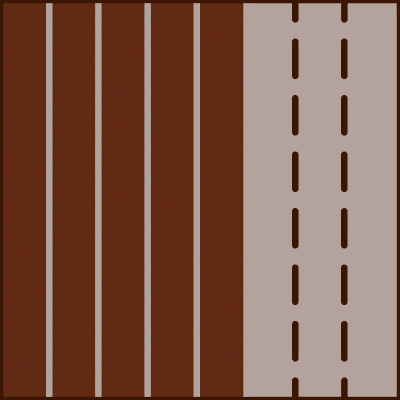
Now let’s zoom in on our rectangle. Imagine magnifying our virtual grid to show a close-up of a single square unit, such as the pan of brownies on our table. And we can imagine subdividing this square into smaller, fractional pieces. In this way, we can see that five-eighths of a square unit looks something like a pan of brownies cut into strips, with a few strips missing:
One batch of brownies is one square unit, but part of the batch has been eaten. Now we have fractional brownies: five-eighths of the pan.
But what if we don’t even have that whole five-eighths of the pan? What if the kids came through the kitchen and snatched a few pieces, and now all we have is three-fourths of the five-eighths?
3/4 of 5/8: We can make a fraction of a fraction by cutting the other direction. We cut the strips into fourths, and the kids ate one part of each strip.
How much of the original pan of brownies do we have now? There are three rows with five pieces in each row, for a total of 3 × 5 = 15 pieces left — which is the numerator of our answer. And with pieces that size, it would take four rows with eight in each row (4 × 8 = 32) to fill the whole pan — which is our denominator, the number of pieces in the whole batch of brownies. So three-fourths of five-eighths is a small rectangle of single-serving pieces.
Compare the pieces we have left to the original batch. Each of the numbers in the fraction calculation has meaning. Can you find them all in the picture?
Notice that there was nothing special about the fractions 3/4 and 5/8, except that the numbers were small enough for easy illustration. We could imagine a similar pan-of-brownies approach to any fraction multiplication problem, though the final pieces might turn out to be crumbs.
Of course, children will not draw brownie-pan pictures for every fraction multiplication problem the rest of their lives. But they need to spend plenty of time thinking about what it means to take a fraction of a fraction and how that meaning controls the numbers in their calculation. They need to ask questions and to put things in their own words and wrestle with the concept until it makes sense to them. Only then will their understanding be strong enough to support future learning.
In this post, we consider the first of three math rules that most of us learned in middle school.
Area of a rectangle = length × width
Instrumental Understanding: Math as a Tool
The instrumental approach to explaining such rules is for the adult to work through a few sample problems and then give the students several more for practice.
In a traditional lecture-and-workbook style curriculum, students apply the formula to drawings on paper. Under a more progressive reform-style program, the students may try to invent their own methods before the teacher provides the standard rule, or they may measure and calculate real-world areas such as the surface of their desks or the floor of their room.
Either way, the ultimate goal is to define terms and master the formula as a tool to calculate answers.
Richard Skemp describes a typical lesson:
Suppose that a teacher reminds a class that the area of a rectangle is given by A=L×B. A pupil who has been away says he does not understand, so the teacher gives him an explanation along these lines. “The formula tells you that to get the area of a rectangle, you multiply the length by the breadth.”
“Oh, I see,” says the child, and gets on with the exercise.
If we were now to say to him (in effect) “You may think you understand, but you don’t really,” he would not agree. “Of course I do. Look; I’ve got all these answers right.”
Nor would he be pleased at our devaluing of his achievement. And with his meaning of the word, he does understand.
As the lesson moves along, students will learn additional rules.
For instance, if a rectangle’s length is given in meters and the width in centimeters, we must convert them both to the same units before we calculate the area. Also, our answer will not have the same units as our original lengths, but that unit with a little, floating “2” after it, which we call “squared.”
Each lesson may be followed by a section on word problems, so the students can apply their newly learned rules to real-life situations.
Relational Understanding: Math as a Connected System
In contrast, a relational approach to area must begin long before the lesson on rectangles.
Again, this can happen in a traditional, teacher-focused classroom or in a progressive, student-oriented, hands-on environment. Either way, the emphasis is on uncovering and investigating the conceptual connections that lie under the surface and support the rules.
We start by exploring the concept of measurement: our children measure a path along the floor, sidewalk, or anywhere we could imagine moving in a straight line. We learn to add and subtract such distances. Even if our path turns a corner or if we first walk forward and then double back, it’s easy to figure out how far we have gone.
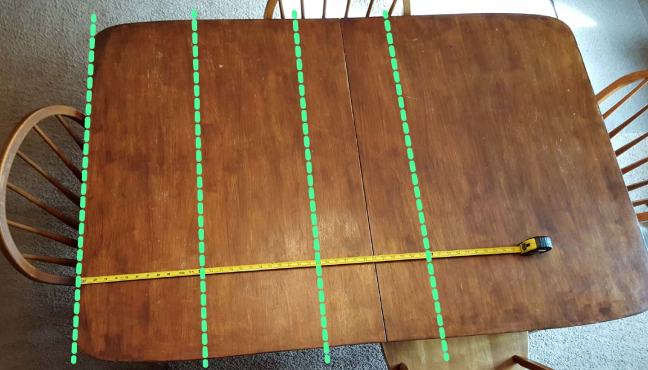
But something strange happens when we consider distances in two different directions at the same time — measuring the length and width of the dining table automatically creates an invisible grid.
In measuring the length of a rectangular table, we do not find just one point at any given distance. There is a whole line of points that are one foot, two feet, or three feet from the left side of the table.
Measuring the distance from one edge of a table. Apologies to my metric-speaking readers, but the old-fashioned foot is the most convenient unit for this demonstration.
And measuring the width shows us all the points that are one, two, or three feet from the near edge. Now our rectangular table is covered by virtual graph paper with squares the size of our measuring unit.
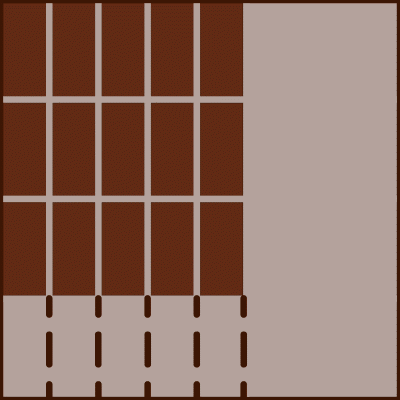
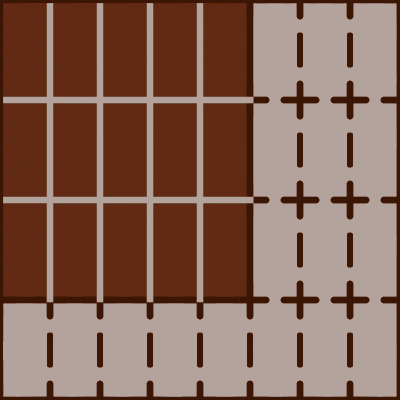
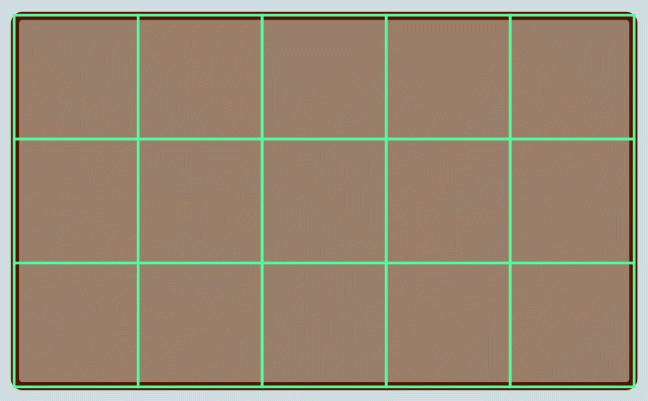
The rectangular tabletop with an imaginary grid that shows the length and width measurements: three feet wide by five feet long.
The length of the rectangle tells us how many squares we have in each row, and the width tells us how many rows there are. As we imagine this invisible grid, we can see why multiplying those two numbers will tell us how many squares there are in all.
That is what the word area means: the area of a tabletop is the number of virtual-graph-paper squares it takes to cover it up, which is why our answer will be measured in square units.
Making Sense of Mixed Units
What if we measured the length in meters and the width in centimeters?
With a relational understanding of area, even a strange combination of units can make sense. Our invisible grid would no longer consist of squares but of long, thin, rectangular centimeter-meters. But we could still find the area of the tabletop by counting how many of these units it takes to cover it.
How many rectangles will we need to cover a table that is 2 m long by 90 cm wide?
2 × 90 = 180 centimeter-meters.
Square units aren’t magic — they’re just easier, that’s all.
From the outside, it’s impossible to tell how a person is thinking. A boy with the instrumental perspective and a girl who reasons relationally may both get the same answers on a test. Yet under the surface, in their thoughts and how they view the world, they could not be more different.
“Mathematical thinking is more than being able to do arithmetic or solve algebra problems,” says Stanford University mathematician and popular author Keith Devlin. “Mathematical thinking is a whole way of looking at things, of stripping them down to their numerical, structural, or logical essentials, and of analyzing the underlying patterns.”
And our own mathematical worldview will influence the way we present math topics to our kids. Consider, for example, the following three rules that most of us learned in middle school.
Area of a rectangle = length × width.
To multiply fractions, multiply the tops (numerators) to make the top of your answer, and multiply the bottoms (denominators) to make the bottom of your answer.
When you need to multiply algebra expressions, remember to FOIL: multiply the First terms in each parenthesis, and then the Outer, Inner, and Last pairs, and finally add all those answers together.
While the times symbol or the word multiply is used in each of these situations, the procedures are completely different. How can we help our children understand and remember these rules?
Over the next three posts in this series, we’ll dig deeper into each of these math rules as we examine what it means to develop relational understanding.
Many people misunderstand the distinction between Instrumental and Relational Understanding as having to do with surface-level, visible differences in instructional approach, but it’s not that at all. It has nothing to do with our parenting or teaching style, or whether our kids are learning with a traditional textbook or through hands-on projects. It’s not about using “real world” problems, except to the degree that the world around us feeds our imagination and gives us the ability to think about math concepts.
This dichotomy is all about the vision we have for our children — what we imagine mathematical success to look like. That vision may sit below the level of conscious thought, yet it shapes everything we do with math. And our children’s vision for themselves shapes what they pay attention to, care about, and remember.
Educational psychologist Richard Skemp popularized the terms instrumental understanding and relational understanding to describe these two ways of looking at mathematics. It is almost as if there were two unrelated subjects, both called “math” but as different from each other as American football is from the game the rest of the world calls football.
Which of the following sounds the most like your experience of school math? And which type of math are your children learning?
Instrumental Understanding: Math as a Tool
Every mathematical procedure we learn is an instrument or tool for solving a certain kind of problem. To understand math means to know which tool we are supposed to use for each type of problem and how to use that tool — how to categorize the problem, remember the formula, plug in the numbers, and do the calculation. To be fluent in math means we can produce correct answers with minimal effort.
Primary goal: to get the right answer. In math, answers are either right or wrong, and wrong answers are useless. Key question: “What?” What do we know? What can we do? What is the answer? Values: speed and accuracy. Method: memorization. Memorize math facts. Memorize definitions and rules. Memorize procedures and when to use them. Use manipulatives and mnemonics to aid memorization. Benefit: testability.
Instrumental instruction focuses on the standard algorithms (the pencil-and-paper steps for doing a calculation) or other step-by-step procedures. This produces quick results because students can follow the teacher’s directions and crank out a page of correct answers. Students like completing their assignments with minimal struggle, parents are pleased by their children’s high grades, and the teacher is happy to make steady progress through the curriculum.
Unfortunately, the focus on rules can lead children to conclude that math is arbitrary and authoritarian. Also, rote knowledge tends to be fragile, and the steps are easy to confuse or forget. Thus those who see math instrumentally must include continual review of old topics and provide frequent, repetitive practice.
Relational Understanding: Math as a Connected System
Each mathematical concept is part of a web of interrelated ideas. To understand mathematics means to see at least some of this web and to use the connections we see to make sense of new ideas. Giving a correct answer without justification (explaining how we know it is right) is mere accounting, not mathematics. To be fluent in math means we can think of more than one way to solve a problem.
Primary goal: to see the building blocks of each topic and how that topic relates to other concepts. Key questions: “How?” and “Why?” How can we figure that out? Why do we think this is true? Values: logic and justification. Method: conversation. Talk about the links between ideas, definitions, and rules. Explain why you used a certain procedure, and explore alternative approaches. Use manipulatives to investigate the logic behind a technique. Benefit: flexibility.
Relational instruction focuses on children’s thinking and expands on their ideas. This builds the students’ ability to reason logically and to approach new problems with confidence. Mistakes are not a mark of failure, but a sign that points out something we haven’t yet mastered, a chance to reexamine the mathematical web. Students look forward to the “Aha!” feeling when they figure out a new concept. Such an attitude establishes a secure foundation for future learning.
Unfortunately, this approach takes time and requires extensive personal interaction: discussing problems, comparing thoughts, searching for alternate solutions, and hashing out ideas. Those who see math relationally must plan on covering fewer new topics each year, so they can spend the necessary time to draw out and explore these connections. Relational understanding is also much more difficult to assess with a standardized test.
What constitutes mathematics is not the subject matter, but a particular kind of knowledge about it.
The subject matter of relational and instrumental mathematics may be the same: cars travelling at uniform speeds between two towns, towers whose heights are to be found, bodies falling freely under gravity, etc. etc.
But the two kinds of knowledge are so different that I think that there is a strong case for regarding them as different kinds of mathematics.
Welcome to the 92nd edition of the Math Teachers At Play math education blog carnival—a monthly smorgasbord of links to bloggers all around the internet who have great ideas for learning, teaching, and playing around with math from preschool to pre-college.
Let the mathematical fun begin!
By tradition, we start the carnival with a couple of puzzles in honor of our 92nd edition…
Puzzle #1
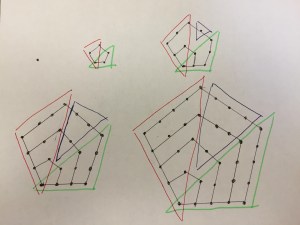
92 is a pentagonal number, so I was delighted when Lisa Winer‘s (@Lisaqt314) carnival submission came in. Her class spent some time playing around with figurate number puzzles—including pentagonal numbers—and collaborated on a blog post about their discoveries.
What is the maximum number of queens that can be placed on an chessboard such that no two attack one another?
Spoiler: Don’t peek! But the answer is here—and the cool thing is that there are 92 different ways to do it.
Table Of Contents
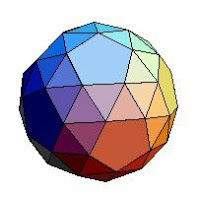
The snub dodecahedron is an Archimedean solid with 92 faces.
And now, on to the main attraction: the blog posts. Many articles were submitted by their authors; others were drawn from the immense backlog in my rss reader. If you’d like to skip directly to your area of interest, click one of these links.
Kids can enjoy making up math problems, but sometimes they can get a bit carried away. Just ask A. O. Fradkin (@aofradkin) about her daughter’s Gruesome Math.
Sarah Dees (@FrugalFun4Boys) comes up with a way to do Sorting, Counting, and Graphing for Preschoolers. “We were able to get in lots of counting practice and conversations about more and less and which group was the greatest. And, it kept him busy for quite awhile, which is always a good thing.”
Nancy Smith (@nancyqsmith) notices her students struggling with the equal sign in Equality. Strong opinions, and even a few tears. It will be interesting to hear what tomorrow brings…
Joshua Greene (@JoshuaGreene19) offers some great ways to tweak an already-wonderful multiplication game in Times square variations. “It was really interesting to see the different strategies that the students took to determining what would go on their boards.”
How often have you found that students are taught “tricks” to remember math rules—but they still make mistakes, because the rules don’t make sense? Ellie Nix (Bloglovin’)explains Why I’m Not Teaching Decimal Operations “Rules”.
Tina Cardone (@crstn85) experiments with Bar Models in Algebra to help her students think about linear equations. “I did not require students to draw a model, but I refused to discuss an incorrect equation with them until they had a model. Kids would tell me ‘I don’t know how to do fractions or percents’ but when I told them to draw a bar, and then draw 4/5, they could do that without assistance…”
Pradeep Mutalik challenges readers to “infer the simple rule behind a number sequence that spikes up and down like the beating of a heart” in Be Still My Pulsating Sequence.
How can we get a peek at how our children are thinking? Kristin Gray (@mathminds) starts with a typical set of 1st Grade Story Problems and tweaks them into a lively Notice/Wonder Lesson. “When I told them they would get to choose how many students were at each stop, they were so excited! I gave them a paper with the sentence at the top, let them choose a partner and sent them on their way…”
Tracy Zager (@tracyzager) talks about her own mathematical journey in The Steep Part of the Learning Curve: “The more math I learn, the better math teacher I am. I keep growing as a learner; I know more about where my kids are headed; and I understand more about what building is going on top of the foundation we construct in elementary school.”
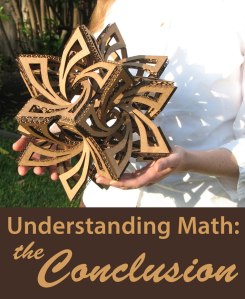
And finally, you may be interested in my new blog post series exploring what it means to understand math. Check out the first post Understanding Math: A Cultural Problem. More to come soon…
And that rounds up this edition of the Math Teachers at Play carnival. I hope you enjoyed the ride.
The December 2015 installment of our carnival will open sometime during the week of December 21-25 at Math Misery? blog. If you would like to contribute, please use this handy submission form. Posts must be relevant to students or teachers of preK-12 mathematics. Old posts are welcome, as long as they haven’t been published in past editions of this carnival.
We need more volunteers. Classroom teachers, homeschoolers, unschoolers, or anyone who likes to play around with math (even if the only person you “teach” is yourself)—if you would like to take a turn hosting the Math Teachers at Play blog carnival, please speak up!

 We know that there is more to learning history than winning a game of Trivial Pursuit. But when it comes to math, too many parents (and far too many politicians) act as though the goal of our children’s education is to produce high scores on a standardized test.

 We’ve examined how our vision of mathematical success shapes our children’s learning. Do we think math is primarily a tool for solving problems? Or do we see math as a web of interrelated concepts?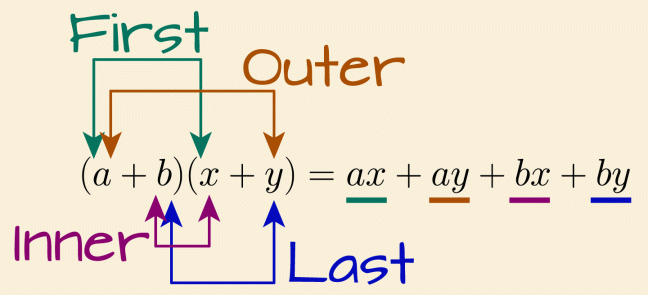
 .
.
 .
.
 .
.

 Fractions confuse almost everybody. In fact, fractions probably cause more math phobia among children (and adults) than any other topic before algebra.


 Every mathematical procedure we learn is an instrument or tool for solving a certain kind of problem. To understand math means to know which tool we are supposed to use for each type of problem and how to use that tool — how to categorize the problem, remember the formula, plug in the numbers, and do the calculation. To be fluent in math means we can produce correct answers with minimal effort.