Vi Hart: Snowflakes, Starflakes, and Swirlflakes
Vi Hart is back with some wintery fun!
Have a Mathy Thanksgiving Dinner
Professional Mathemusician Vi Hart is back with more mathematical holiday fun. Enjoy!
Optimal Potatoes
Green Bean Matherole
Borromean Onion Rings
Thanksgiving Turduckenen-duckenen
HexaFlexaParty This Weekend!
Sunday, October 21, is the worldwide hexaflexagon party in honor of Martin Gardner’s birthday. Gardner’s article about hexaflexagons launched his career as a recreational math guru who inspired people all around the world to love math.
Here’s how to join in the fun:
Hexaflexagon History
What Is a Proof?
I’ve been enjoying the Introduction to Mathematical Thinking course by Keith Devlin. For the first few weeks, we mostly talked about language, especially the language of logical thinking. This week, we started working on proofs.
For a bit of fun, the professor emailed a link to this video. My daughter Kitten enjoyed it, and I hope you do, too.
Who Killed Professor X?
What a Fun Book!
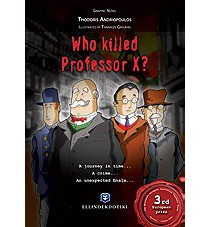
Who Killed Professor X? is a work of fiction based on actual incidents, and its heroes are real people who left their mark on the history of mathematics. The murder takes place in Paris in 1900, and the suspects are the greatest mathematicians of all time. Each suspect’s statement to the police leads to a mathematical problem, the solution of which requires some knowledge of secondary-school mathematics. But you don’t have to solve the puzzles in order to enjoy the book.
Fourteen pages of endnote biographies explain which parts of the mystery are true, which details are fictional, and which are both (true incidents slightly modified for the sake of the story).
My daughter Kitten, voracious as always, devoured it in one sitting — and even though she hasn’t studied high school geometry yet, she was able to work a couple of the problems.
The World of Mathematical Reality
I wanted to include this video last week when I mentioned Paul Lockhart’s new book, but I couldn’t figure out how to copy it from Amazon. So today I read Shecky’s review of Measurement, which included the YouTube video. Thanks, Shecky!
Rate × Time = Distance Problems
I love how Richard Rusczyk explains math problems. It’s a new school year, and that means it’s time for new MathCounts Mini videos. Woohoo!
- Download the activity sheet with warm-up and follow-up problems.
Sample from the Introduction to Mathematical Thinking Class
I’m really looking forward to Keith Devlin’s free Introduction to Mathematical Thinking class, which starts in mid-September. There are more than 30,000 nearly 40,000 students signed up already. Will you join us?
These days, mathematics books tend to be awash with symbols, but mathematical notation no more is mathematics than musical notation is music.
A page of sheet music represents a piece of music: the music itself is what you get when the notes on the page are sung or performed on a musical instrument. It is in its performance that the music comes alive and becomes part of our experience. The music exists not on the printed page but in our minds.
The same is true for mathematics. The symbols on a page are just a representation of the mathematics. When read by a competent performer (in this case, someone trained in mathematics), the symbols on the printed page come alive — the mathematics lives and breathes in the mind of the reader like some abstract symphony.
— Keith Devlin
Introduction to Mathematical Thinking
How to Think like a Mathematician
Would you like to learn how to think like a mathematician? Stanford professor (and NPR “Math Guy”) Keith Devlin is teaching a free online course through Coursera. It starts in just a few weeks. I’ve signed up. Will you join us?
The prerequisite is to be taking or have finished high school math. If (like me) you took it so long ago that you can’t quite remember, don’t worry: The focus of the course is not on long-forgotten mathematical procedures, but on “learning to think in a certain (very powerful) way.”
Mathematical thinking is not the same as doing mathematics — at least not as mathematics is typically presented in our school system. School math typically focuses on learning procedures to solve highly stereotyped problems. Professional mathematicians think a certain way to solve real problems, problems that can arise from the everyday world, or from science, or from within mathematics itself.
The key to success in school math is to learn to think inside-the-box. In contrast, a key feature of mathematical thinking is thinking outside-the-box — a valuable ability in today’s world. This course helps to develop that crucial way of thinking.
— Keith Devlin
Introduction to Mathematical Thinking

