Playful Math Education Carnival 97

Did you know 97 is an emirp?
Did you know 97 is an emirp? It’s prime both forward and backward! What other emirps can you find?

Welcome to the 97th edition of the Math Teachers At Play math education blog carnival: a monthly smorgasbord of links to bloggers all around the internet who have great ideas for learning, teaching, and playing around with math from preschool to pre-college.

A few articles were submitted by their authors, but most were drawn from the immense backlog in my rss reader. If you’d like to see your blog post featured next month, be sure to send it in yourself. Our hosts are busy parents and teachers who have limited time to scour the Internet for goodies.

To add a bit of color, I’ve thrown in several favorites from my newly updated Math with Living Books pages. Some (affiliate) links go to Amazon.com, where you can read descriptions and reviews — but there’s no need to buy. Most of these books should be available through your local library.

Table of Contents

If you’d like to skip directly to your area of interest, click here:

Please: If you enjoy the carnival, would you consider volunteering to host sometime this year? Classroom teachers, homeschoolers, unschoolers, or anyone who likes to play around with math (even if the only person you “teach” is yourself) — if you would like to take a turn, please speak up!

And now, let the mathematical fun begin!
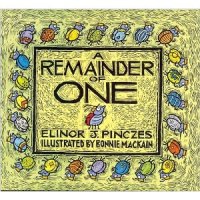

Pinczes-A Remainder of One

When the queen of her bugs demands that her army march in even lines, Private Joe divides the marchers into more and more lines so that he will not be left out of the parade.

Talking Math with Kids

  • Crystal Wagner (@Tri_Learning) shares several Math Games to Play in the Car: “Or maybe you are waiting in line at the grocery store or doctor’s appointment. Turn these times of waiting into learning opportunities.”
  • Christopher Danielson (@Trianglemancsd) shows how The sequence machine can launch math conversations with older students: “Now you can generate number sequences, without being distracted by the multiplication facts.”
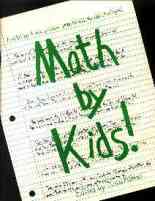
richman-bykids

Help inspire your kids to try writing their own unique problems. Includes a wide range of math topics and concepts: money and time, fractions, percentages, geometry, logic, and multi-step problem solving.
[Back to top.]
[Back to Table of Contents.]

Continue reading Playful Math Education Carnival 97

FAQ: Lifelong Learning for Parents

“I’m so tired of being ignorant about math. I can memorize rules and do calculations, but if I miss a step the numbers make no sense at all, and I can’t spot what went wrong. Another struggle I have is keeping everything organized in my mind. When I learn a new concept or strategy, I easily forget it. My son is only a toddler now, but as he grows up, I don’t want to burden him with my own failures. Where should I start?”

As a first step, convince yourself that math is interesting enough to learn on its own merits, because parental guilt will only carry you so far. Start with Steven Strogatz’s “Elements of Math” series from The New York Times, or pick up his book The Joy of x.

Continue reading FAQ: Lifelong Learning for Parents

Multiplication Is Not Repeated Addition: Update

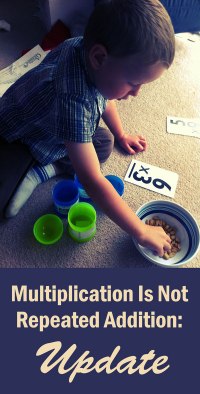
Multiplication Is Not Repeated Addition: Update[Photo “Micah and Multiplication” by notnef via Flickr (CC BY 2.0, text added).]

Some Internet topics are evergreen. I noticed that my old Multiplication Is Not Repeated Addition post has been getting new traffic lately, so I read through the article again. And realized that, even after all those words, I still had more to say.

So I added the following update to clarify what seemed to me the most important point.

I’d love to hear your thoughts! The comment section is open down below . . .


Language Does Matter

Addition: addend + addend = sum. The addends are interchangeable. This is represented by the fact that they have the same name.

Multiplication: multiplier × multiplicand = product. The multiplier and multiplicand have different names, even though many of us have trouble remembering which is which.

  • multiplier = “how many or how much”
  • multiplicand = the size of the “unit” or “group”

Different names indicate a difference in function. The multiplier and the multiplicand are not conceptually interchangeable. It is true that multiplication is commutative, but (2 rows × 3 chairs/row) is not the same as (3 rows × 2 chairs/row), even though both sets contain 6 chairs.

A New Type of Number

In multiplication, we introduce a totally new type of number: the multiplicand. A strange, new concept sits at the heart of multiplication, something students have never seen before.

The multiplicand is a this-per-that ratio.

A ratio is a not a counting number, but something new, much more abstract than anything the students have seen up to this point.

A ratio is a relationship number.

In addition and subtraction, numbers count how much stuff you have. If you get more stuff, the numbers get bigger. If you lose some of the stuff, the numbers get smaller. Numbers measure the amount of cookies, horses, dollars, gasoline, or whatever.

The multiplicand doesn’t count the number of dollars or measure the volume of gasoline. It tells the relationship between them, the dollars per gallon, which stays the same whether you buy a lot or a little.

By telling our students that “multiplication is repeated addition,” we dismiss the importance of the multiplicand. But until our students wrestle with and come to understand the concept of ratio, they can never fully understand multiplication.

For Further Investigation

nunes-doingmathIf you’re interested in digging deeper into how children learn addition and multiplication, I highly recommend Terezina Nunes and Peter Bryant’s book Children Doing Mathematics.

To learn about modeling multiplication problems with bar diagrams, check out the Mad Scientist’s Ray Gun model of multiplication:

And here is an example of the multiplication bar diagram in action:

Amazon Bestseller Today

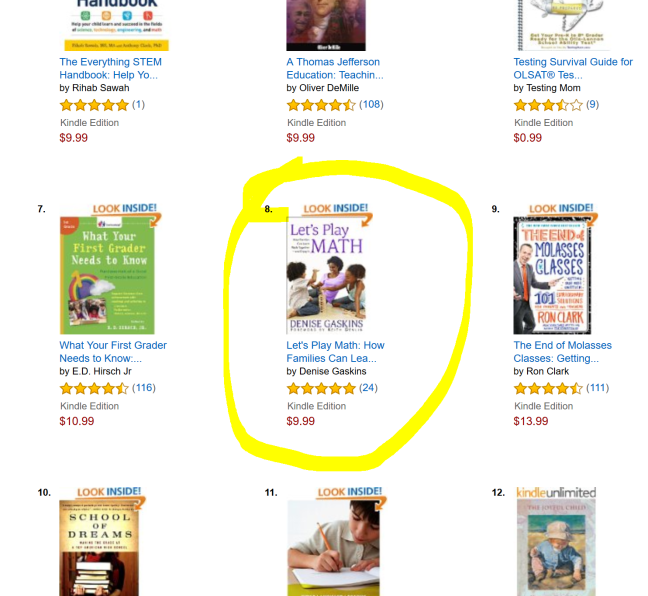
Bookselling stats rise and fall like a roller-coaster, but the top of the curve is always fun. Today Let’s Play Math hit the Top Ten in homeschooling (“parent participation in education”) at Amazon.com:

LPMtop10-2016-04-14highlight

Update: Top 25 in STEM Resources

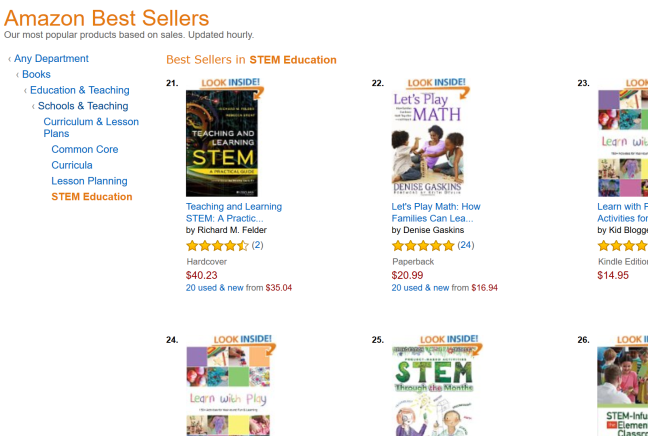
I noticed the “STEM Education” category at Amazon, so I updated my book’s keywords. And the Let’s Play Math paperback zipped into the Top 25!

LPMtop25-STEM-2016-04-16

Let’s Play Math FAQs: Introduction

I’ll let you in on a secret about teaching: there is no place in the world where it rolls along smoothly without problems. Only in articles and books can that happen.

—Dr. Ruth Beechick
You Can Teach Your Child Successfully

Learning math is an adventure into the unknown. The ideas we adults take for granted are a wild, unexplored country to our children. Like any traveler in a strange land, they will stumble over rocky places and meet with unexpected detours.

Whenever I visit a parenting forum, I feel compassion for the families who are struggling with math. No other school subject elicits such depths of frustration and despair.

Continue reading Let’s Play Math FAQs: Introduction

Did You Get Your Playful Math Snacks?

Circumferències de FordMy April “Let’s Play Math” newsletter went out early this morning to everyone who signed up for Tabletop Academy Press math updates. This month’s issue celebrated the 200th anniversary of the Farey Sequence.

The Farey Sequence was described in 1816 by English geologist John Farey, who was disparaged by the famous mathematical snob* G.H. Hardy as “at the best an indifferent mathematician.”

“I rather like the idea that the Farey Sequences are named after someone who noticed a pattern and asked a question — and not even the first person to notice the pattern, ask the question, or provide the answer. As math teachers, we teach plenty of indifferent mathematicians who wake up when they experience the joy of discovering something that is new to them, not necessarily new to the whole world.”

— Debra K. Borkovitz,
Farey Fraction Visual Patterns

If you’re a subscriber but didn’t see your newsletter, check your Updates or Promotions tab (in Gmail) or your Spam folder. And to make sure you get all the future newsletters, add “Denise at Tabletop Academy Press” [denise.gaskins @ tabletop academy press .com, without spaces] to your contacts or address book.

If you missed this month’s edition, no worries—‌there will be more playful math snacks coming soon. Click the link below to sign up today!

And remember: Newsletter subscribers are always the first to hear about new books, revisions, and sales or other promotions.


* See A Mathematician’s Apology Revisited by W.W. Sawyer.

Playful Math Carnival 96 via The Usual Mayhem

Check out the new playful math education carnival at The Usual Mayhem. Puzzles, primes, patterns, and more playful mathy fun:

MTAP96

I am delighted to be hosting March’s MTaP Carnival! It’s late because I had the flu for 10 days – sorry for the delay, I know that we all look forward to reading the contributors’ posts each month. Without further delay, then, here are the great reads you won’t want to miss….

Click here to go read the carnival post.

Memorizing the Math Facts

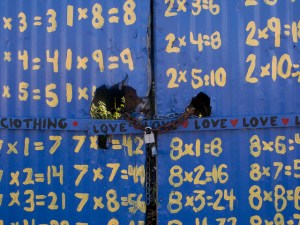
Central City Times Tables[Photo by dsb nola via flickr. (CC BY 2.0)]

The most effective and powerful way I’ve found to commit math facts to memory is to try to understand why they’re true in as many ways as possible. It’s a very slow process, but the fact becomes permanently lodged, and I usually learn a lot of surrounding information as well that helps me use it more effectively.

Actually, a close friend of mine describes this same experience: he couldn’t learn his times tables in elementary school and used to think he was dumb. Meanwhile, he was forced to rely on actually thinking about number relationships and properties of operations in order to do his schoolwork. (E.g. I can’t remember 9×5, but I know 8×5 is half of 8×10, which is 80, so 8×5 must be 40, and 9×5 is one more 5, so 45. This is how he got through school.) Later, he figured out that all this hard work had actually given him a leg up because he understood numbers better than other folks. He majored in math in college and is now a cancer researcher who deals with a lot of statistics.

Ben Blum-Smith
Comment on Math Mama’s post What must be memorized?

The entire discussion (article and comments) is well worth reading:

You may also enjoy: