Free Number Sense Resources from Steve Wyborney

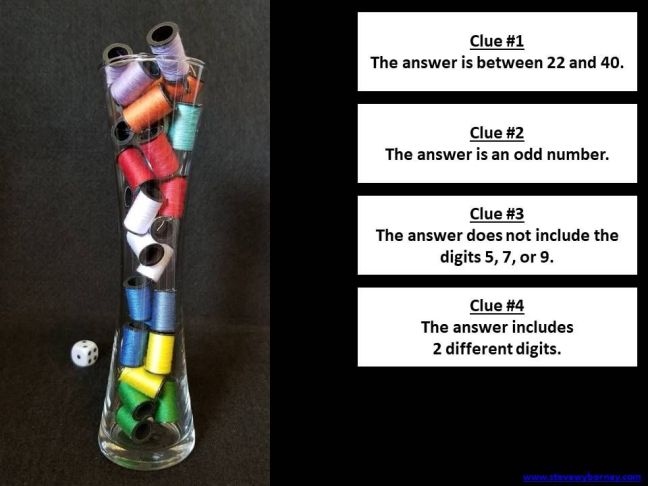
If you teach children in the primary grades, you’ll enjoy this new series from the wonderful Steve Wyborney. Every day for the rest of the school year, Steve will post a new estimation or number sense resource for grades K–8 (or any age!) at his blog:

“This is my way of providing support and encouragement – as well as bringing math joy to your classroom… I’m going to stick with you all year long.”

—Steve Wyborney

Click to visit Steve’s blog

Did You Get Your Books?

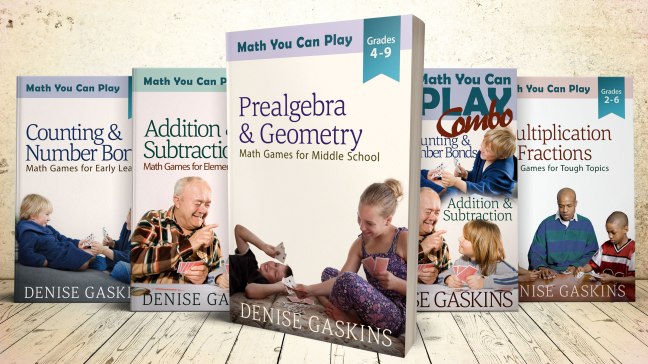
Math You Can Play series by Denise Gaskins

One more time, because I’m still finding people who didn’t get their Kickstarter rewards…

To Everyone Who Supported the Math You Can Play Kickstarter

Thank you so much! I’m amazed and awed by how many people from all around the world showed interest in my books. You’re the greatest!

ALL the pledge rewards have now been sent, both digital and physical books.

Everyone should have received two emails:

  • Stretch Goals, four printable pdf math activity books.
  • Your digital (ebook) rewards and printable gameboard files.

Even if you ordered paperbacks, you should have gotten the digital book email.

But we’ve had trouble with things getting lost in the tangles of the internet. If you don’t see these emails, check your Spam folder — or if you use Gmail, look in the Promotions or Updates tab.

If you did NOT receive the emails mentioned above, please let me know!!

You can contact me through Kickstarter or use the About/Contact page on this blog to send me a message.

P.S.: There are still two people who ordered (and paid for) paperbacks but haven’t filled out the Kickstarter survey. I can’t mail out your book package until I get an address. If you can’t find the survey email, feel free to message me directly.

Don’t Panic

As I mentioned last Saturday, I decided to try my hand at rewriting the Standards for Mathematical Practice into student-friendly language.

Here’s the second installment…

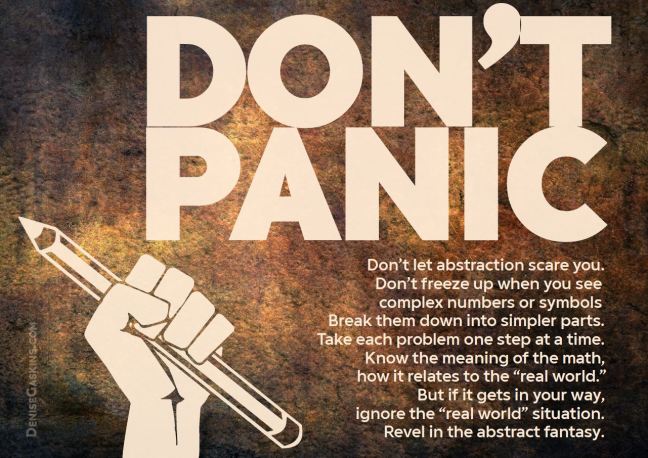
Math Tip # 2: Don’t Panic.

  • Don’t let abstraction scare you.
  • Don’t freeze up when you see complex numbers or symbols.
  • Break them down into simpler parts.
  • Take each problem one step at a time.
  • Know the meaning of the math, how it relates to the “real world.”
  • But if it gets in your way, ignore the “real world” situation. Revel in the abstract fantasy.

Continue reading Don’t Panic

Magical Mathematics

In fact, mathematics is the closest that we humans get to true magic. How else to describe the patterns in our heads that — by some mysterious agency — capture patterns of the universe around us?

Ian Stewart
The Magical Maze

CREDITS: Photo by Greg Rakozy via Unsplash.com. I am an Amazon affiliate. If you follow the book link and buy something, I’ll earn a small commission (at no cost to you).

Never Give Up

Have you read the Standards for Mathematical Practice? Good idea in theory, but horribly dull and stilted. Like math standards in general, the SMPs sound as if they were written by committee. (Duh!)

I’ve seen several attempts to rewrite the SMPs into student-friendly language. Many of those seem too over-simplified, almost babyish.

Probably I’m just too critical.

Anyway, I decided to try my hand at the project. Here’s the first installment…

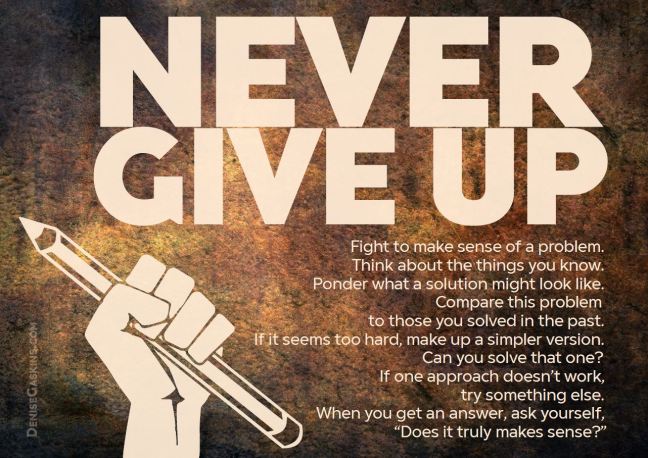
Math Tip # 1: Never Give Up.

  • Fight to make sense of a problem.
  • Think about the things you know.
  • Ponder what a solution might look like.
  • Compare this problem to those you solved in the past.
  • If it seems too hard, make up a simpler version. Can you solve that one?
  • If one approach doesn’t work, try something else.
  • When you get an answer, ask yourself, “Does it truly makes sense?”

Download the poster, if you like:

What do you think? Would this resonate with your students?

What changes do you suggest?

You can find the whole SMP series (eventually) under the tag: Posters.

Update: I Made a Thing
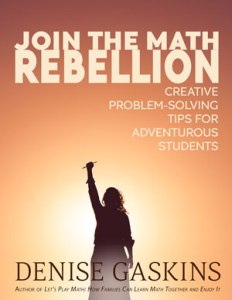
I had so much fun making these posters that I decided to put them into a printable activity guide. It includes the full-color poster shown above and a text-only version, with both also in black-and-white if you need to conserve printer ink.

Here’s the product description…

Join the Math Rebellion: Creative Problem-Solving Tips for Adventurous Students

Take your stand against boring, routine homework.

Fight for truth, justice, and the unexpected answer.

Join the Math Rebellion will show you how to turn any math worksheet into a celebration of intellectual freedom and creative problem-solving.

This 42-page printable activity guide features a series of Math Tips Posters (in color or ink-saving black-and-white) that transform the Standards for Mathematical Practice to resonate with upper-elementary and older students.

Available with 8 1/2 x 11 (letter size) or A4 pages.

Check It Out
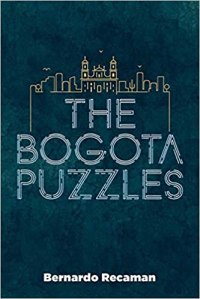
Free Sample: The Bogotá Puzzles

“Mathematics, besides being beautiful and useful, is fun. I hope [my book] brings mathematical joy to many.”

—Bernardo Recamán, The Bogotá Puzzles


Dover Publications occasionally posts free samples from some of their wonderful collection of books. This month’s sampler includes several puzzles from The Bogotá Puzzles by Bernardo Recamán.

Inspired by such illustrious collections as The Canterbury Puzzles, The Moscow Puzzles, and The Tokyo Puzzles. Colombian mathematician and professor Bernardo Recamán assembled these 80 brainteasers, word problems, sudoku-style challenges, and other math-based diversions while living and working in Bogotá.

Enjoy!

If you’d like to receive future Dover Sampler emails, you can sign up here.

THE FINE PRINT: I am an Amazon affiliate. If you follow the book link above and buy something, I’ll earn a small commission (at no cost to you).

Boxes for the Postman

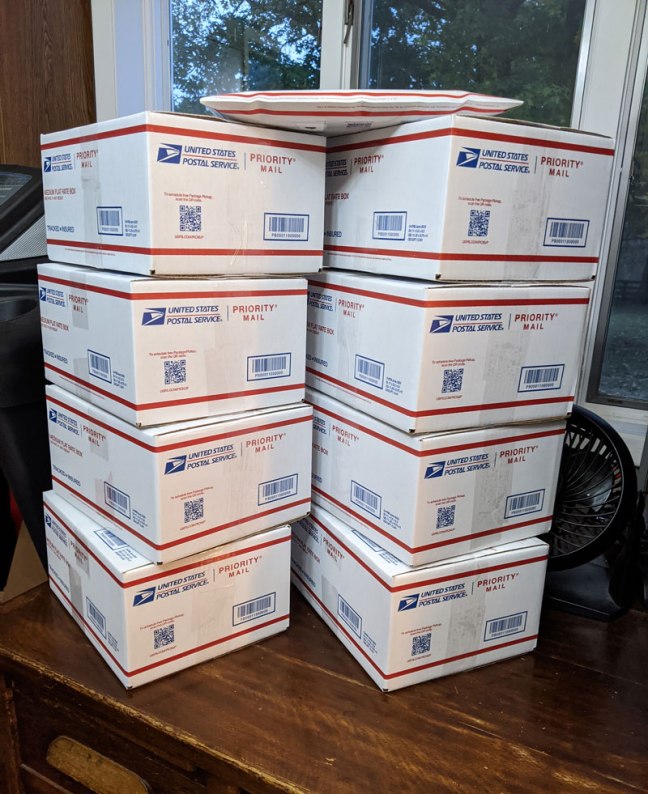
Here’s another round of books for the Math You Can Play Kickstarter. Almost finished.

If you backed the Kickstarter, thank you!

You should have already received the following:

  • An email with links to your Stretch Goals, four printable pdf math activity books.
  • A second email with links to your digital (ebook) rewards and printable gameboard files.
  • A survey asking for your address, if you ordered paperback books.

And most of you should have already received your paperbacks in the mail. The packages above are for those who ordered the 9-book paperback set. Hopefully, they’ll get to you sometime next week.

If you did NOT receive the emails mentioned above, please let me know!!

We’ve had some trouble with things getting lost in the tangles of the internet. You can contact me through Kickstarter or use the About/Contact page on this blog to send me a message.

And if you are one of the two people who bought paperbacks but still haven’t filled out the survey, please do that soon. I can’t mail out your book package until I get an address.

Playing with a Hundred Chart #36: Cover 100 Squares

Patrick Vennebush shared this puzzle from his new book, One-Hundred Problems Involving the Number 100:

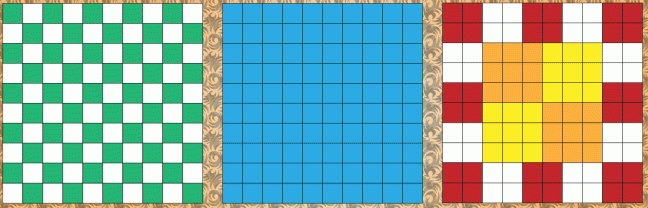
It’s easy to cover a hundred chart with 100 small squares: 10 rows of 10 squares = 100.

It’s easy to cover a hundred chart with one big square: one 10×10 square = 100.

But can you cover the chart with 20 squares? Or with 57 squares? The squares do NOT have to be all the same size.

If we only consider squares with whole-number sides, so they exactly fit on the grid, then:

  • What numbers of squares work to cover the chart?
  • What numbers don’t work — and can you prove it?

Click to read the original puzzle along with some teaching tips at Patrick’s blog:

Covering 100 Squares

If you’d like some printable hundred charts for coloring in squares, download my free Hundred Charts Galore! file.

And discover more ways to play with these printables in my classic blog post: 30+ Things to Do with a Hundred Chart.