Playful Math Carnival 127 at Find the Factors

Check out the latest carnival of playful math for all ages:

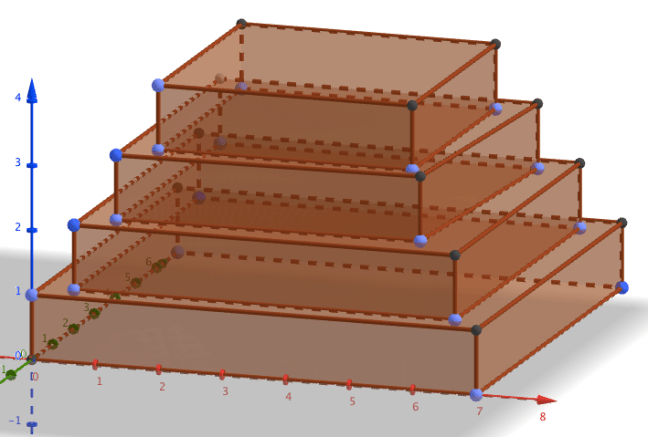
Iva put together this carnival of mathematical fun with numbers and shapes, math art and creative writing, games, Desmos activities, books to read with your kids, history, optical illusions, fractions, exponents, statistics, linear equations, and more — even an egg hunt.

Each monthly Playful Math Education Blog Carnival brings you a great new collection of puzzles, math conversations, crafts, teaching tips, and all sorts of mathy fun.

It’s like a free online magazine of mathematical adventures, helpful and inspiring no matter when you read them. Enjoy!

Click Here to Read the Carnival Blog

Want to Join in the Fun?

Do you have a favorite blog post about math activities, games, lessons, or hands-on fun? The Playful Math Blog Carnival would love to feature your article!

We welcome math topics from preschool through the first year of calculus. Old posts are welcome, as long as they haven’t been published in past editions of this carnival.

To submit a blog article for consideration, fill out this form:

Click Here to Share Your Post

Have you noticed a new math blogger on your block that you’d like to introduce to the rest of us? Feel free to submit another blogger’s post in addition to your own. Beginning bloggers are often shy about sharing, but like all of us, they love finding new readers.

CREDITS: “Fireworks” photo (top) by Ray Hennessy and “Adulting done right” (treats) photo by Toa Heftiba on Unsplash.

Math Game: Six Hundred

Today I’m working on the next book in my Math You Can Play series, culling the games that don’t fit. Six Hundred is a fine game, but I can’t figure out how it landed in the prealgebra manuscript…

Math Concepts: addition, multiplication, parity (odd or even).
Players: any number.
Equipment: six regular 6-sided dice (my math club kids love this set), free printable score sheet, pen or pencil.

Click Here for the Score Sheet

Set-Up

A full game consists of eighteen rounds of play. Players may share the dice and score sheet, taking turns around the table. But for a large group you may want to have extras, so that two or more people can be rolling their dice at the same time.

How to Play

On your turn, roll all six dice up to three times. After each roll, you may set aside one or more dice to keep for scoring, if you wish. Once a die has been set aside, you may not change your mind and roll it again.

After the third roll, choose an unused category on your score sheet. Count the dice according to the rules for that section, and write down your score. If your dice do not fit anywhere, then you must take a zero in the category of your choice.

When all players have filled their score sheet and recorded any appropriate bonuses (or penalties), whoever has the highest score wins.

Scoring

Dice are scored in eighteen categories, in four sections, as follows. The maximum possible score is 600 points.

Numbers

Record the sum of only the dice showing that number. For example, if you rolled 1, 1, 3, 4, 4, 4, you could score 2 in the Ones category. Or you could score 12 in the Fours category, or zero in the Fives.

Bonus: If the combined Numbers score is 80 or more, add 35 points to your total.

Rungs (1–4)

Score the total of all six dice. Like a ladder, the score in each rung must be greater than the one before it. Rung 1 gets the lowest number, and Rung 4 the highest.

You may fill in the rungs in any order. But if you write 18 in Rung 2, then the score in Rung 1 must be 17 or less, and the score in Rung 3 must be at least 19.

Penalty: If the Rung scores don’t fit the ascending value rule, this category is worth zero.

Clusters

Score the total of all six dice, if they fit the rules for that category.

  • Four of a Kind: at least four dice show the same number.
  • Five of a Kind: at least five dice show the same number.
  • Odds: all six dice show odd numbers.
  • Evens: all six dice show even numbers.
Patterns

Score the amount shown for each pattern.

  • Series: 30 points you roll 1, 2, 3, 4, 5, 6.
  • Pairs: 30 points if you roll three pairs of matching numbers. Four dice showing the same number may be counted as two pairs.
  • Triplets: 30 points if you roll two sets of three dice with the same numbers, such as three 2s and three 5s.
  • Sextet: 36 points when all six dice show the same number.
Game Bonus

If you score at least one point in all eighteen categories, or if the only zero you take is for the sextet, then award yourself an additional 36 points.

History

Players around the world have played poker-style dice games for ages. I grew up with Yahtzee, but you may know the game by Yatzy, Yacht, Generala, or another name.

Reiner Knizia included this mathematical version in his book Dice Games Properly Explained. And I found it online at Michael Ayers’s Stick Insect blog.

John Golden posted a simpler “Mathzee” game played with five dice on his Math Hombre blog — and while you’re there, be sure to check out his amazing Math Games page.

 
* * *

This blog is reader-supported.

If you’d like to help fund the blog on an on-going basis, then please join me on Patreon for mathy inspiration, tips, and an ever-growing archive of printable activities.

If you liked this post, and want to show your one-time appreciation, the place to do that is PayPal: paypal.me/DeniseGaskinsMath. If you go that route, please include your email address in the notes section, so I can say thank you.

Which I am going to say right now. Thank you!

“Math Game: Six Hundred” copyright © 2019 by Denise Gaskins. Image at the top of the post copyright © rekre89 via Flickr (CC BY 2.0).

Playful Math Carnival 126 at Math Mama Writes

Check out the new playful math blog carnival at Math Mama Writes blog. Sue put together a great collection of geometry constructions, story problem ideas, teaching tips, and more:

It’s like a free online magazine of mathematical adventures. Enjoy!

Click here to go read the carnival blog

And if you’re a blogger, be sure to submit your blog post for next month’s carnival!

Do You Want More Ways to Play with Math?

Past carnivals are still full of mathy treasure. See them all on Pinterest:

The Final Books from a Homeschooled Teen Author

Teen author Teresa Gaskins
Do you enjoy binge reading tales of epic fantasy?

Love exploring magical worlds wracked by the struggle of good against evil?

Then don’t miss Teresa Gaskins’s four-book serial adventure, The Riddled Stone.

Those of us who read her earlier books have waited eagerly to hear how the story ends. Two years longer than we hoped, since she had to squeeze in her writing between calculus exams and college essays.

But finally, it’s done!

Now a homeschool graduate, she wrote the last few scenes right at the tail end of her nineteenth year — which means these will be Teresa’s final books as a teen author.

Check them out…

The Riddled Stone: Omnibus Edition, Four Books in One

How can a knight fight magic?

Christopher Fredrico loved the quiet life of a scholar-in-training. Plenty of spare time to spend with his friends. But the night Crown Prince Tyler came to dinner, everything changed.

Falsely accused of stealing a magical artifact and banished under threat of death, Chris leaves the only home he knows.

But as he and his three friends travel towards the coast, they find a riddle that may save a kingdom — or cost them their lives.

Discover the full story of The Riddled Stone, complete in one volume.

Free Online Preview

Buy now at:
Amazon-Kindle-logo the_book_depository_logo Barnes-Noble-logo kobo-logo ibookstore-badg
and other online retailers, or by special request at your favorite local bookshop.

Or for those who already read the earlier books…

Revealed: The Riddled Stone, Book Four

A gift she never wanted. A curse she can’t escape.

Alone in the dark, Nora of Yorc feels the dungeon walls pressing in. Even worse, the duke’s sorcery weaves itself around her, unseen and deadly. But as the spell tightens, shy, fragile Nora breaks — and something new takes her place.

Or something old beyond memory.

Nora joined this quest to help her friends. But can she stop herself before the wildness within destroys them all?

Find out in Revealed, the exciting conclusion of Teresa Gaskins’s four-book serial fantasy adventure, The Riddled Stone.

Free Online Preview

Buy now at:
Amazon-Kindle-logo the_book_depository_logo Barnes-Noble-logo kobo-logo ibookstore-badg
and other online retailers, or by special request at your favorite local bookshop.

Praise for The Riddled Stone

“A captivating fantasy story with a well-thought-out plot…”

— Wayne S. Walker, Home School Book Review

“There are some obvious protagonists and some obvious villains, but Gaskins creates a nice ambiguity around several of the key characters. The plot itself is interesting and engaging with multiple levels of motivation that drive it along.”

— Phanwadee, online reader review

“I enjoyed the book and I am absolutely amazed at how such a young author can write so well. I definitely see her going far in her writing career, and I can’t wait to see what stories she publishes next.”

— Tia, Homeschool Literature.com

CREDITS: Feature image of Neuschwanstein Castle, Schwangau, Germany, (top) by William West via Unsplash. Author photo by Christina Vernon, MelliRu.com.

Getting Started with Playful Family Math

One of the most common questions I get from parents who want to help their children enjoy math is, “Where do we start?”

My favorite answer: “Play games!”

Math games meet children each at their own level. The child who sits at the head of the class can solidify skills. The child who lags behind grade level can build fluency and gain confidence.

And (as Peggy Kaye pointed out in her book Games for Math) both will learn something even more important — that hard mental effort can be fun.

Now I’ve put together a short, inexpensive book to help families begin playing with math.

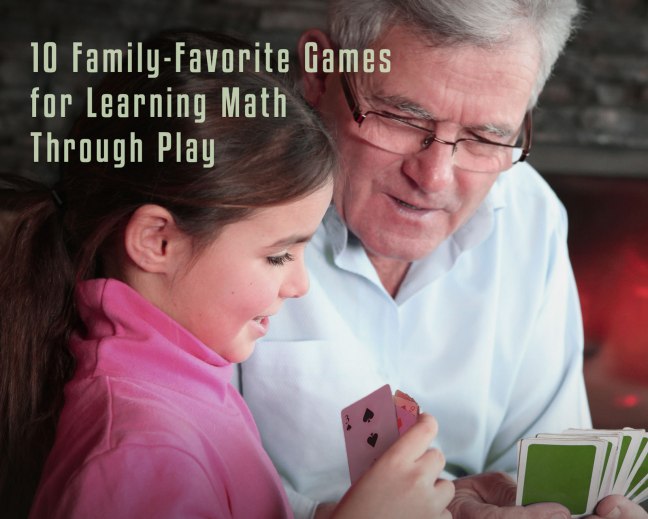
Let’s Play Math Sampler: 10 Family-Favorite Games for Learning Math Through Play contains short excerpts from my most popular books, including a preview of two games from my work-in-progress Prealgebra & Geometry Games.

Don’t miss it: Order your copy today.

“Denise Gaskins is that sound voice of reason that comes into my head when I get agitated teaching. This isn’t performance — this is play. My kids aren’t on trial, they are learning to learn.”

—Sonya Post

“By exploring math in a playful way, your kids will be happy to learn and will discover an enjoyment of math in the process. You might even have fun, too! ”

—Olisia Yeend

Playful Math Carnival 125 at Singapore Maths Tuition

Check out the latest carnival of playful math for all ages:
Each monthly Playful Math Education Blog Carnival brings you a great new collection of puzzles, math conversations, crafts, teaching tips, and all sorts of mathy fun.

It’s like a free online magazine of mathematical adventures. Enjoy!

William put together this carnival of 10 evergreen links — helpful and inspiring no matter when you read them — featuring chess statistics, a horse riddle, fish that count, and more.

Click Here to Read the Carnival Blog

Want to Join in the Fun?

Do you have a favorite blog post about math activities, games, lessons, or hands-on fun? The Playful Math Blog Carnival would love to feature your article!

We welcome math topics from preschool through the first year of calculus. Old posts are welcome, as long as they haven’t been published in past editions of this carnival.

To submit a blog article for consideration, fill out this form:

Yes! Please Share My Post

Have you noticed a new math blogger on your block that you’d like to introduce to the rest of us? Feel free to submit another blogger’s post in addition to your own. Beginning bloggers are often shy about sharing, but like all of us, they love finding new readers.

CREDITS: Carnival photo (top) by Scott Trento on Unsplash.

Playful Math Carnival 124 at Life Through A Mathematician’s Eyes

Check out the new playful math blog carnival at Life Through A Mathematician’s Eyes blog. Ioana put together a great collection of math games, activities, and teaching tips:

Click here to go read the carnival blog

And if you’re a blogger, be sure to submit your blog post for next month’s carnival!

Do You Want More Ways to Play with Math?

Past carnivals are still full of mathy treasure. See them all on Pinterest:

Public Domain Day

In honor of Public Domain Day

Stopping By Woods On A Snowy Evening

Whose woods these are I think I know.
His house is in the village, though;
He will not see me stopping here
To watch his woods fill up with snow.

My little horse must think it queer
To stop without a farmhouse near
Between the woods and frozen lake
The darkest evening of the year.

He gives his harness bells a shake
To ask if there is some mistake.
The only other sound’s the sweep
Of easy wind and downy flake.

The woods are lovely, dark and deep,
But I have promises to keep,
And miles to go before I sleep,
And miles to go before I sleep.

—Robert Frost

[And Why the Public Domain Matters.]

CREDITS: “Snow falling in a forest” photo (top) by Photo by Annie Spratt on Unsplash.

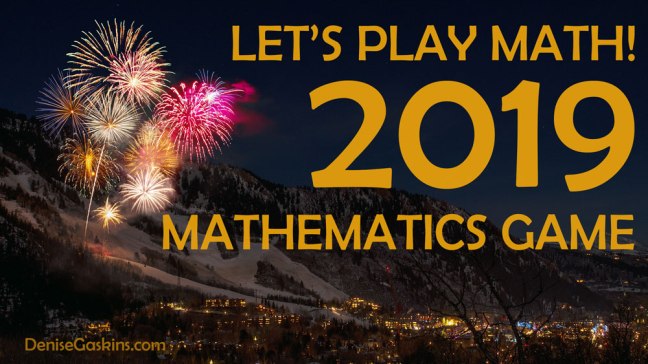
2019 Mathematics Game: Playful Math for All Ages

Happy 2019! Have you set any goals for the year?

My goals are to continue playing with math (1) in my homeschool coop classes and (2) on this blog — and (3) hopefully to publish a couple of new books as well.

My favorite way to celebrate any new year is by playing the Year Game. It’s a prime opportunity for players of all ages to fulfill the two most popular New Year’s Resolutions: spending more time with family and friends, and getting more exercise.

So grab a partner, slip into your workout clothes, and pump up those mental muscles!

Rules of the Game

Use the digits in the year 2019 to write mathematical expressions for the counting numbers 1 through 100. The goal is adjustable: Young children can start with looking for 1-10, middle grades with 1-25.

  • You must use all four digits. You may not use any other numbers.
  • Solutions that keep the year digits in 2-0-1-9 order are preferred, but not required.
  • You may use a decimal point to create numbers such as .2, .02, etc., but you cannot write 0.02 because we only have one zero in this year’s number.
  • You may create multi-digit numbers such as 10 or 201 or .01, but we prefer solutions that avoid them.

My Special Variations on the Rules

  • You MAY use the overhead-bar (vinculum), dots, or brackets to mark a repeating decimal. But students and teachers beware: you can’t submit answers with repeating decimals to Math Forum.
  • You may NOT use a double factorial, n!! = the product of all integers from 1 to n that have the same parity (odd or even) as n. The Math Forum allows them, but I feel much more creative when I can wrangle a solution without invoking them.

For many years mathematicians, scientists, engineers and others interested in mathematics have played “year games” via e-mail and in newsgroups. We don’t always know whether it is possible to write expressions for all the numbers from 1 to 100 using only the digits in the current year, but it is fun to try to see how many you can find.

Math Forum Year Game Site

Click here to continue reading.

Holiday Math Puzzles and Activities for Christmas, Winter Break

Hapollonian Holidays from my Math Circle kids, and best wishes for a grace-filled holiday season.
Hapollonian Holiday Greetings from my co-op class kids, and best wishes for a grace-filled holiday season.

Do you know of any great math-related seasonal games, crafts, or activities I missed? Please add them to the comments section below.

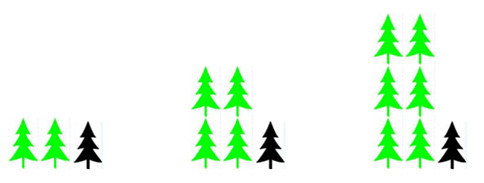
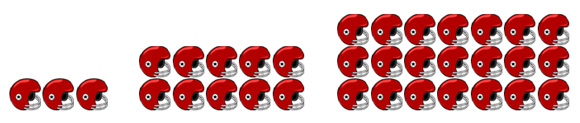
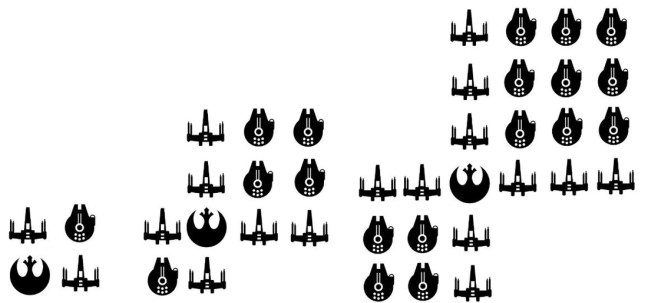
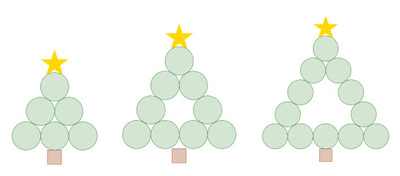
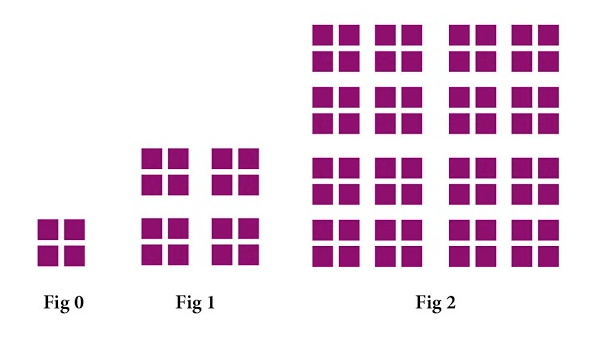
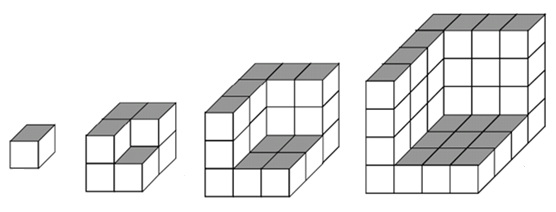
As you scroll through the links below, you find several puzzle graphics from the wonderful Visual Patterns website.

Use them as conversation-starters with your kids: What do you notice? How does each pattern grow?

For older students: Can you write a formula to describe how each pattern? What will it look at stage 43?

Pattern #7, Trees

A Bit of Fun

Setting the mood: Enjoy this bit of seasonal fidgeting from Vi Hart. If you don’t understand some of the references, that’s normal! Pick a phrase, Google it, and enjoy the fun of learning something new.

Advent Math Activity Calendars

Every year, some of my favorite websites offer a seasonal selection of activities to encourage your children’s (and your own!) mathematical creativity, one for each day in the run-up to Christmas.

Colleen Young updates the list every year, so check out her pages:

Pattern #9, Snowflakes

Let It Snow! Let It Snow! Let It Snow!

  • Clarissa (@c0mplexnumber) demonstrates how to make beautiful, challenging origami snowflakes. She recommends beginners try the first few folds — which create a pretty cool design on their own. Let it Snow…
Pattern #20, Helmets

Happy Hanukkah

Pattern #30, from John Golden, Squares

Hands-on Holidays

Pattern #197, from Stephanie Bowyer, Symbols

Following Yonder Star

Pattern #132, from Math Curmudgeon, Diagonals

Mathy Christmas Cards

Pattern #98, Centers are collinear, Fraction of the original circle shaded

Santa Claus Is Coming

Pattern #8, Penguins

Rockin’ Around the Christmas Tree

Pattern #152, from John Golden, Circles

Puzzles Under the Tree

  • Unfortunately, the holidays come smack in the middle of flu season. Did you come down with The Grinch Bug?
Pattern #52, Cubes
  • Speaking of Christmas carols, the Christmas Price Index shows the current cost for one set of each of the gifts given in the song “The Twelve Days of Christmas.” I wonder what’s the cumulative cost of all the gifts, when you count each repetition in the song?

Christmas Adventures with Alexandria Jones

Alexandria Jones and her family are fictional characters from my old Mathematical Adventures newsletter. Their stories appear sporadically as I find time to transcribe them from the back-issues. You can find them all on this blog page.

Here are all the Alexandria Jones stories Christmas stories, with activity and craft ideas…

Pattern #174, from Katie Gates, Squares

What About Worksheets?

Do you need to keep your kids busy and work in a bit of math practice? Try these Christmas word problems:

Or visit the sites below for worksheets to cover all ages:
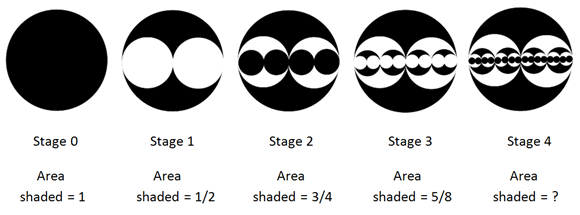
Pattern #28, Surface area

CREDITS: “Circle Packing” feature graphic (top) by fdecomite via Flickr (CC BY 2.0). Picture pattern puzzles from Visual Patterns website.