Blog

Another Egyptian Math Puzzle

Pyramids clip artI have one last puzzle for those of you who are following my Alexandria Jones series on hieroglyphic math and the Egyptian scribe’s method of multiplication by doubling. Here is the “teaser” problem from the cover of the Sept./Oct.1998 issue of my newsletter:

One more Egyptian math puzzle (pdf, 53KB)

Continue reading Another Egyptian Math Puzzle

Elementary Problem Solving: The Tools

[This article begins a series rescued from my old blog. Moving has been a long process, but I’m finally unpacking the last cardboard box! To read the entire series, click here: elementary problem solving series.]

Most young students solve story problems by the flash of insight method: When they read the problem, they know almost instinctively how to solve it. This is fine for problems like:

There are 7 children. 2 of them are girls. How many boys are there?

As problems get more difficult, however, that flash of insight becomes less reliable, so we find our students staring blankly at their paper or out the window. They complain, “I don’t know what to do. It’s too hard!”

We need to give our students a tool that will help them when insight fails.

Continue reading Elementary Problem Solving: The Tools

Back-to-School at the Carnivals

Blog carnival graphic 5The Carnival of Homeschooling #85: School Stuff Edition at Dewey’s Trehouse is stocking up for back-to-school season. From comfy couches to high-tech gadgets, they have a bit of everything. Be sure to check it out.

And the 132nd Carnival of Education comes to my neighborhood—well, to Illinois at any rate—hosted at Education Matters. Plenty of great reading to browse, think about, and post comments on. Enjoy!

7 Things to Do with a Hundred Chart


This post has been revised to incorporate all the suggestions in the comments below, plus many more activities. Please update your bookmarks:

Or continue reading the original article…


Continue reading 7 Things to Do with a Hundred Chart

Egyptian Math Puzzles

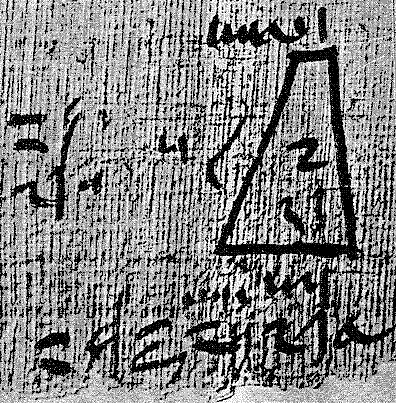
What we know about ancient Egyptian mathematics comes primarily from two papyri, the first one written around 1850 BC. Moscow papyrus problem 14This is called the Moscow papyrus, because it now belongs to Moscow’s Pushkin Museum of Fine Arts. The scroll contains 25 problems, mostly practical examples of various calculations. Problem 14, which finds the volume of a frustrum (a pyramid with its top cut off), is often cited by mathematicians as the most impressive Egyptian pyramid of all.

Continue reading Egyptian Math Puzzles

Quotations XIV: The Joy of Mathematics

Someone asked me if I was ever sorry I had chosen mathematics. I said, “I didn’t choose! Mathematics is an addiction with me!”

Marguerite Lehr

If we are to teach mathematics at all, real success is not possible unless we know that the subject is beautiful as well as useful. Mere utility of the moment without any feeling of beauty becomes a hopeless bit of drudgery, a condition which leads to stagnation.

…What would mathematics have amounted to without the imagination of its devotees—its giants and their followers? There never was a discovery made without the urge of imagination—of imagination which broke the roadway through the forest in order that cold logic might follow.

David Eugene Smith

Continue reading Quotations XIV: The Joy of Mathematics

Are You Smarter than a 3rd-6th Grader?

Here are a few challenging word problems from Singapore:

I did fine on the 3rd-grade problems, but I stumbled a bit on the 4/5th-grade “How much sugar…” problem. The toy cars were tricky, but manageable. I misread the problem with the chocolate and sweets at first — I think of chocolates as a sub-category of sweets, but in this problem they are totally different. (Perhaps “sweets” are what I would call “hard candy”?) Finally, I had to resort to algebra for the last two Grade 6 questions.

How many can you solve?

Alex’s Puzzling Papyrus

(In the last episode, Dr. Fibonacci Jones discovered a torn scrap of papyrus, covered with hieroglyphic numbers. He promised to teach his daughter, Alexandria, how the ancient Egyptian scribes worked multiplication problems using only the times-two table.)

Back at their tent, Dr. Jones handed the papyrus scrap to Alexandria. “What do you see?” he asked.

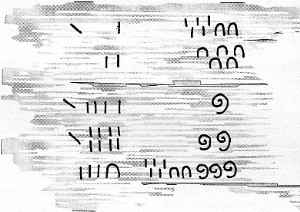
“Well, there are two columns of numbers,” Alex said. “Let me write them down.” She got a piece of notebook paper and translated the hieroglyphs. Papyrus fragment

Click on the image for a larger view. Translate the numbers for yourself before reading on. If you need help, read Egyptian Math in Hieroglyphs.

Continue reading Alex’s Puzzling Papyrus