Remember the Math Adventurer’s Rule: Figure it out for yourself! Whenever I give a problem in an Alexandria Jones story, I will try to post the answer soon afterward. But don’t peek! If I tell you the answer, you miss out on the fun of solving the puzzle. So if you haven’t worked these problems yet, go back to the original posts. Figure them out for yourself—and then check the answers just to prove that you got them right.
Blog
High School Math Challenge
The USA Mathematical Talent Search (USAMTS) has posted its current set of challenge problems, the first of four rounds scheduled for the 2007-2008 school year. USAMTS is a free competition open to all United States middle school and high school students. Young mathematicians have a little over a month (until October 9) to write and send in solutions for the five questions.
According to the USAMTS website:
Student solutions to the USAMTS problems are graded by mathematicians and comments are returned to the students. Our goal is to help all students develop their problem solving skills, improve their technical writing abilities, and mature mathematically while having fun. We wish to foster not only insight, ingenuity and creativity, but also the virtue of perseverance, which is equally essential in scientific endeavors.
A mere five questions. How hard can it be? (Ha!)
A Very Short History of Mathematics
This paper was read to the Adams Society (St. John’s College Mathematical Society) at their 25th anniversary dinner, Michaelmas Term, 1948. [Warning: Do not attempt to read this while drinking coffee or other spittable beverage!]
Hat tip: I found this through the math carnival at a mispelt bog.
Update: The original page has disappeared from the internet, or at least I cannot find it any more, but the Internet Archive Wayback Machine came to the rescue. After my plea for help, James Clare pointed me to the article’s new home.
Carnival of Mathematics XV
 Aaargh—I missed it again! I suppose I should know better by now, but I sent in my entries (on time at least) via the blog carnival submission form. I have lost more carnival entries that way, but I still let myself be lured in by the ease of using a form, rather than writing a simple email by hand. Silly, lazy me.
Anyway, the latest Carnival of Mathematics is now open at a mispelt bog, with plenty of fun graphics and interesting things to read about.
Egyptian Geometry and Other Challenges
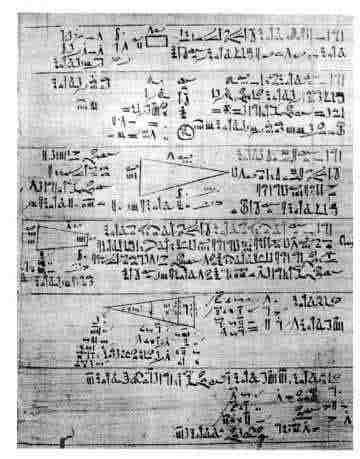
Would you like to study “the knowledge of all existing things and all obscure secrets”? That is how Scribe Ahmose (also translated Ahmes) described his mathematical papyrus. Ahmose’s masterpiece is now called the Rhind Papyrus, after Alexander Henry Rhind, a Scotsman who was one of the first archaeologists to make meticulous records of his excavations (rather than simply hunting for treasures). Rhind purchased the papyrus from an antiquities dealer in Luxor, Egypt, in 1858.
Ahmose’s writing included a huge table of fractions as well as story problems, geometry, algebra, and accounting. Can you solve any of Scribe Ahmose’s problems?
How to “Teach to the Test”
Excellent post (quoting Rafe Esquith, author of Teach Like Your Hair’s On Fire) over at Mindless Math Mutterings.
Writing to Learn Math

Have you considered experimenting with writing in your math class this year? It seems that math journals are a growing fad, and for good reason:
Writing is how we think our way into a subject and make it our own.
Math journal entries can be as simple as class notes, or they can be research projects that take hours of experimentation and pondering. Students may use the journal to store their thoughts as they work several days to solve a challenge problem of the week, or they might jot down quick reflections about what they learned in today’s math class.
Another Egyptian Math Puzzle
 I have one last puzzle for those of you who are following my Alexandria Jones series on hieroglyphic math and the Egyptian scribe’s method of multiplication by doubling. Here is the “teaser” problem from the cover of the Sept./Oct.1998 issue of my newsletter:
One more Egyptian math puzzle (pdf, 53KB)
Elementary Problem Solving: The Tools
[This article begins a series rescued from my old blog. Moving has been a long process, but I’m finally unpacking the last cardboard box! To read the entire series, click here: elementary problem solving series.]
Most young students solve story problems by the flash of insight method: When they read the problem, they know almost instinctively how to solve it. This is fine for problems like:
There are 7 children. 2 of them are girls. How many boys are there?
As problems get more difficult, however, that flash of insight becomes less reliable, so we find our students staring blankly at their paper or out the window. They complain, “I don’t know what to do. It’s too hard!”
We need to give our students a tool that will help them when insight fails.
I Could Sit Here Forever…
…with Princess Kitten‘s baby sitting on my lap, sucking her thumb paw. Of course, it is difficult to get any typing done, and the laundry that is beeping at me from the other room will just have to wait its turn. Peace is a purring kitten.

