Blog

Can You Help Me?

I’m finishing up my plans for the Tabletop Math Games Collection project and pledge levels. The Kickstarter launches in two weeks. Where did the time go?!

But I need help. Could you please take a few minutes to look over the project page and give me some feedback?

  • Preview & Comments Page
    (NO account required to see the preview, but you may need to log in if you want to leave a comment.)

It’s so hard to edit myself because I miss too many mistakes. So having new eyes on the page would be a great help in catching typos and making sure the descriptions make sense and are as clear as possible.

Here’s a screenshot of what you’ll see:

There’s a place to enter comments on the right. Or you can email me directly with anything you want to share.

There’s also a Notification link at the top left corner of the page, for anyone who hasn’t yet signed up for Kickstarter to tell you when the project launches.

Thank you so much for the feedback!

Yes, I’d Love To Help. Let’s Go!

New Project: The Tabletop Math Games Collection

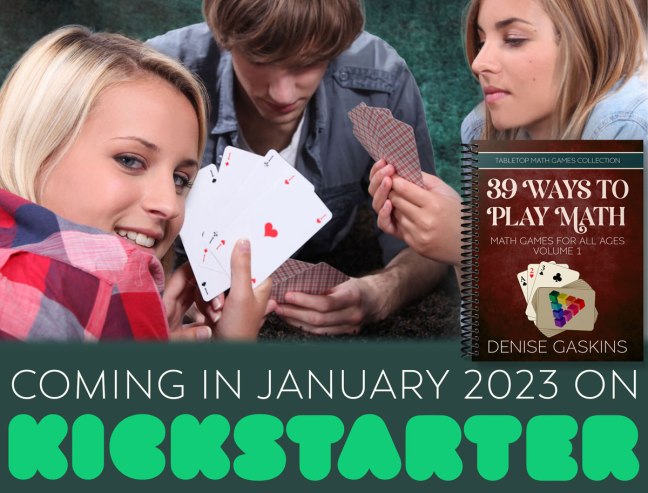
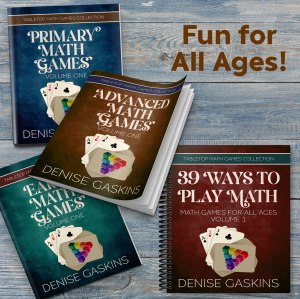
Coming Soon! On January 30th, I’ll be launching a brand new book series, the Tabletop Math Games Collection.

And the Kickstarter prelaunch page is now live. That means you can sign up to get an email from Kickstarter as soon as the campaign launches:

Visit the Prelaunch Page ❯
(free Kickstarter account required)

Test Out 4 Free Sample Games

Math games build mental flexibility and strategic reasoning in players of all ages. And even people who hated math in school can enjoy the friendly challenge of a game.

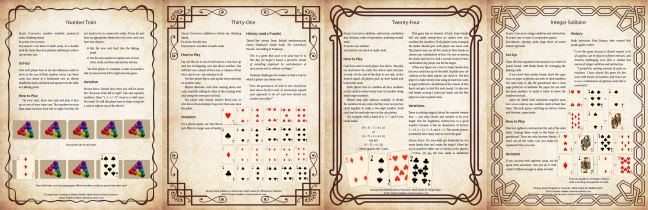
I’ve put together a free printable sampler file, with four ready-to-play card games you can enjoy today.

I think you’ll love it!

Download the Sample File ❯

Help Your Kids Learn Math the Playful Way

  • Are you a parent trying to help your child learn math?
  • Or a teacher looking for ways to encourage creative thinking?
  • Or a gamer ready to try something new with your friends?

Then the Tabletop Math Games Collection is perfect for you.

These are NOT the typical memory-and-speed-based math games you’ve probably seen online, but true battles of wit and skill (plus a bit of luck). Even the preschool games can be fun for adults, too.

Most of the games take only seconds to learn and less than 15 minutes to play, making them perfect ice-breakers for family gatherings, classroom warmups, or for launching a group game night.

Don’t miss the fun!

Hit the button to visit the prelaunch page and sign up for notifications:

Get Notified ❯

Playful Math Carnival #161 via Nature Study Australia

If you’re into math education — or just curious about how learning math could possibly be fun — you’ll definitely want to check out the latest edition of the Playful Math Education Blog Carnival. It’s a collection of awesome blog posts curated by Johanna Buijs and published on the Nature Study Australia website:

The whole point of the carnival is to show that math doesn’t have to be tedious or repetitive. Through a bunch of fun and engaging posts, we celebrate math that’s playful, creative, and totally relevant to everyday life. Because what could be more relevant that having fun while we learn?

In this edition, you’ll find everything from creative math art and music to incorporating nature and the outdoors into your lessons — and even a few racing turtles!

So if you want to mix up your math teaching and make it more enjoyable for your students (and for you!), definitely check out the Playful Math Education Blog Carnival. Happy reading!

Go Visit the Carnival

Wanted: Hosts for 2023

The Playful Math Blog Carnival is a joint effort. We depend on our volunteer hosts to collect blog posts and write the carnival each month.

Putting together a blog carnival can be a lot of work, but it’s a great opportunity to share the work of bloggers you admire and to discover new math-friends online. I love that part of being a host!

Classroom teachers, homeschoolers, college professors, unschoolers, or anyone who likes to play around with math — if you would like to take a turn hosting the carnival, please speak up.

Check the details on the carnival’s home page, and then leave a comment here or email me directly to let me know which month fits your schedule.

Playful Math Carnival Instructions

Playful Math at a Nice Discount: Cyber Monday in Advance

Are you looking for new math activities to play with your kids?

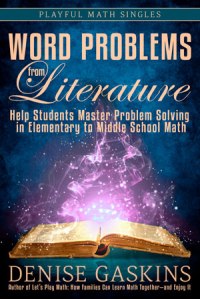
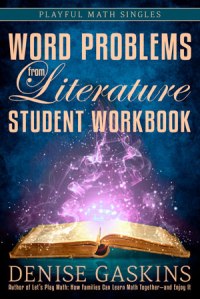
I just added several new ebooks to my publisher’s online store, including the exclusive pre-publication edition of my new book Word Problems from Literature: Help Students Master Problem Solving in Elementary to Middle School Math. You can preorder the book through your favorite online bookshop — or you can get it today at our store, in all digital formats.

And through the end of November, you can get 20% off anything in our store by using the coupon code SALE2022 at checkout.

While you’re there, be sure to check out our new collections!

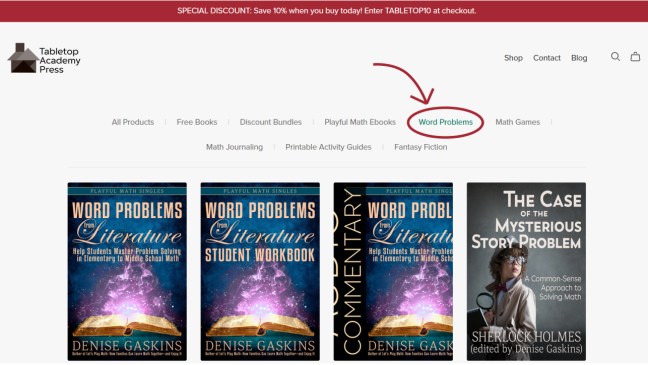
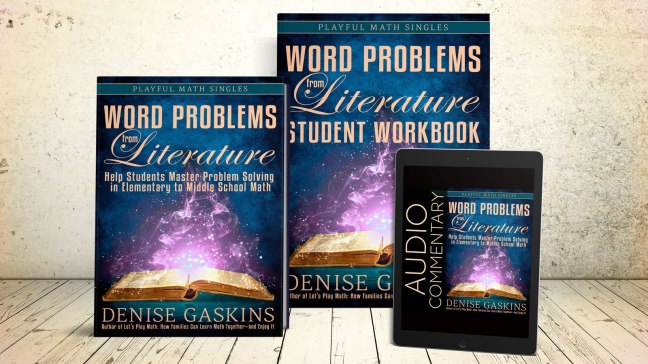
You can buy resources for problem-solving in the Word Problems collection, including the 97-minute audio commentary with special behind-the-scenes tips and tidbits:

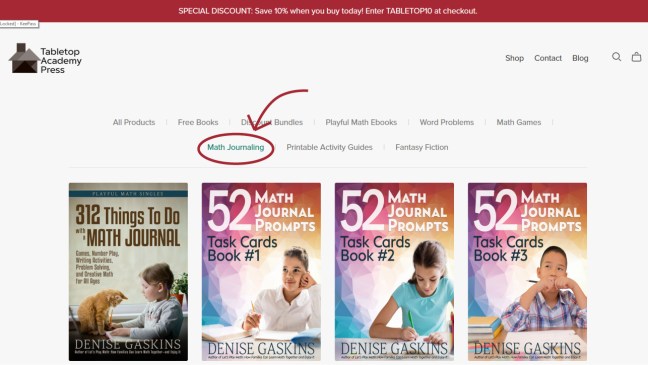
Or explore the wealth of resources for creative mathematical investigations in our Math Journaling collection:

And of course, be sure to check out the free books and discount bundles. You can even pick up my daughter’s epic fantasy adventure, The Riddled Stone.

But don’t delay! The special discount code SALE2022 expires at the end of November.

The Colors-of-Fall Carnival: Playful Math #160

Welcome to the 160th edition of the Playful Math Education Blog Carnival — a smorgasbord of delectable tidbits of mathy fun. It’s like a free online magazine devoted to learning, teaching, and playing around with math from preschool to high school.

Bookmark this post, so you can take your time browsing.

There’s so much playful math to enjoy!

By tradition, we start the carnival with a puzzle/activity in honor of our 160th edition. But if you’d rather jump straight to our featured blog posts, click here to see the Table of Contents.

Try This Puzzle/Activity

Appropriately for an October carnival, 160 is an evil number.

A number is evil if it has an even number of ones in binary form. Can you find the binary version of 160? (Hint: Exploding Dots.)

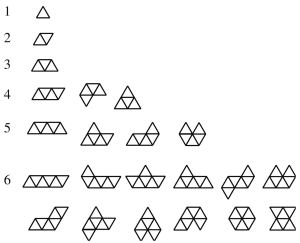
160 is also a polyiamond number. If you connect 9 equilateral triangles side-to-side, a complete set of 9-iamond shapes would have 160 pieces.

But sets that large can be overwhelming. Try playing with smaller sets of polyiamonds. Download some triangle-dot graph paper and see how many different polyiamond shapes you can make.

What do you notice? Does it make you wonder?

What designs can you create with your polyiamonds?


Photo by Daiga Ellaby on Unsplash

Click here for all the mathy goodness!

Don’t Miss Playful Math Carnivals #158 and #159!

Here is SOOOOO MUCH GREAT MATH!

Each monthly carnival brings you a new collection of ideas for playing math from preschool to high school. It’s like a free online magazine of mathematical adventures, helpful and inspiring no matter when you read them.

Explore with your kids or on your own:

Alexa Kapor-Mater put together an awesome carnival, with fun facts, activity ideas, puzzles, videos, problem-solving tips, and interesting stuff you should know. Wow!

John Golden found a delightful assortment of playful tidbits from around the internet, fun songs, games, activities, puzzles, math art, and the #Mathober challenge prompts. Love it!

Help Us Keep the Carnival Going

The Playful Math Blog Carnival is a joint effort. We depend on our volunteer hosts to collect blog posts and write the carnival each month.

Putting together a blog carnival can be a lot of work, but it’s a great opportunity to share the work of bloggers you admire and to discover new math-friends online. Classroom teachers, homeschoolers, college professors, unschoolers, or anyone who likes to play around with math — if you would like to take a turn hosting the carnival, please speak up.

Check the details on the carnival’s home page, and then leave a comment here on the blog or email me directly to let me know when you want to host.

Playful Math Carnival Instructions

CREDITS: Feature photo (top) by Count Chris on Unsplash.com.

Get a Weekly Dose of Playful Math

Our leaves haven’t started to turn yet, but summer’s on the wane, farmers are busy with harvest, and the back-to-school rush has calmed down into a daily routine.

But if you’re like me, you keep tweaking that routine, constantly looking for the perfect balance for your family or classroom. I especially love to discover easy ways to add more playful math to our schedule.

So here’s a collection of sites that offer fresh math resources on a weekly or monthly basis throughout the school year.

Which one will you try?

KenKen Classroom

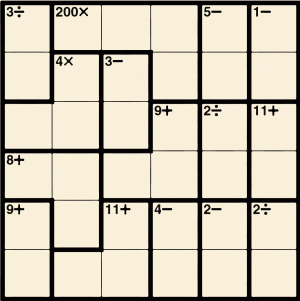
Every week, they’ll email you a set of free KenKen arithmetic puzzles for all ages. As the challenge level subtly shifts week to week, students develop their math and logical thinking skills without even knowing it.

Subscribe ❯

#MathStratChat

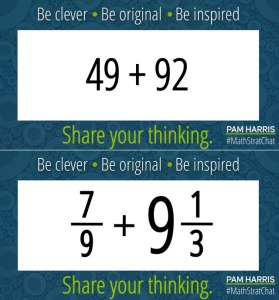
Pose an interesting math problem. How can you figure it out? What else could you do? How many different ways can you find? Which strategy do you like best for this problem?

Follow Pam Harris on your favorite social media site to get a new problem every Wednesday.

Choose a Problem ❯

The Parallel Universe

Dr Simon Singh, author of the No. 1 bestseller Fermat’s Last Theorem and The Simpsons and Their Mathematical Secrets has created a set of weekly maths challenges – just 15-30 minutes of interesting, fun and challenging tidbits of mystery and history, activities and oddities, puzzles and problems.

Help students expand their mathematical horizons beyond the school curriculum and build strong mathematical thinking skills. Stretch your brain every week!

Learn More ❯

Limited Time Book Deals

Do you want to help your children master problem-solving skills?

Check out my temporary online store for anyone who missed the Kickstarter.

Through the end of September, you can place a preorder for the early-release edition of Word Problems from Literature, along with the Word Problems Student Workbook and exclusive Audio Commentary (or any of my other books or printable math activity guides).

I’ll lock down the preorder store when I’m ready to send the Kickstarter order to my printer.

Books will be delivered with the Kickstarter orders: Digital items in October, physical books by the end of December.

Shop Now ❯

Final Countdown for Word Problems from Literature

There’s just over 24 hours left to get Word Problems from Literature and the Word Problems Student Workbook on Kickstarter.

Don’t miss out!

Get It Now

The Kickstarter campaign is roaring along. We hit our funding goal and plenty more, paying for two extra chapters (one on decimals and the other on percents, rates, and proportional reasoning) plus a special section on making the transition to algebra.

That means Word Problems from Literature will truly be a thorough guide to mastering problem-solving in elementary and middle school math.

And we’ve got plenty of goodies besides the book:

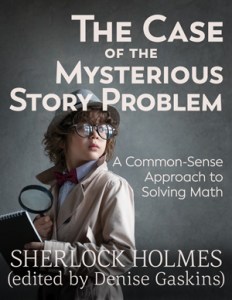
  • The Case of the Mysterious Story Problem: A short treatise on how to solve math problems, written directly to the student by the master of deduction, Sherlock Holmes. Includes the printable poster, “Be a Math Detective” in full color and ink-saving black & white.
  • Audio Commentary (and annotated pdf): An exclusive mp3 recording to play on your phone or other device, with additional math tips and behind-the-scenes tidbits.
  • Make Your Child (or Yourself) a Character: Your child can be a character in a prealgebra story problem. Only 3 slots remaining: captive prince/princess (or the dragon), fantasy warrior king/queen, or a starship captain (or the ship’s engineer).
  • Math You Can Play: All my math games, journaling resources, and other playful math books are available as add-on purchases in ebook or paperback format.

So many great ways to play math with your kids!

Get Yours Before Time Runs Out

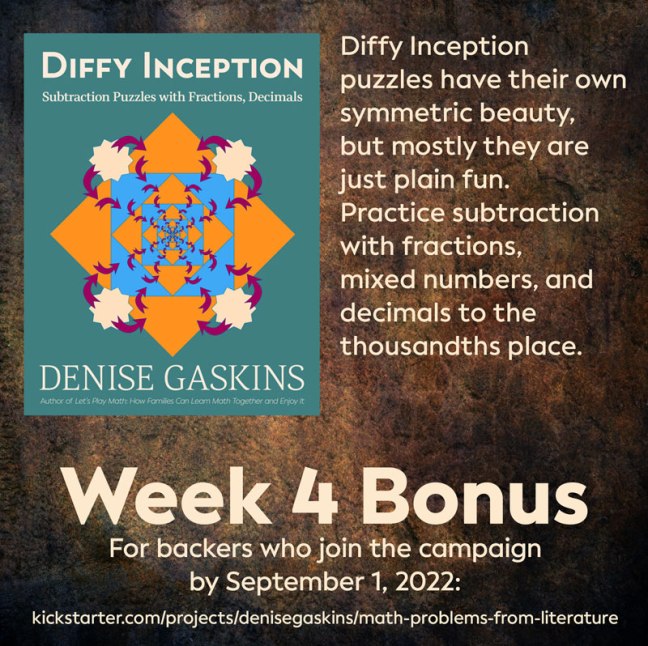
And as a bonus, anyone who pledges in these final days will get an extra printable activity guide: Diffy Inception. It’s a great way to get kids playing with fractions, mixed numbers, and decimals.

Playful Math: Getting Students To Write Their Own

To wrap up our week of exploring the resources from Word Problems from Literature, let’s talk about getting students to write their own math.

Check in on the Kickstarter

First up, I’m sharing an excerpt from the Word Problems Student Workbook. The “Story Problem Challenge” is one of my favorite math club activities.

Following that, you’ll find an amazing online mathemagical adventure for middle school: The Arithmetiquities. It’s great fun, and a great inspiration for students to create their own math stories.

Have fun writing math with your kids!

The Story Problem Challenge

What do you get when you cross a library book or favorite movie with a math worksheet? A great alternative to math homework!

The rules are simple:

(1) Choose a worksheet calculation to be the basis for your word problem.

(2) Solve the calculation.

(3) Consider where these numbers could make sense in your book or movie universe. How might the characters use math? What sort of things would they count or measure? Do they use money? Do they build things, or cook meals, or make crafts? Do they need to keep track of how far they have traveled? Or how long it takes to get there?

(4) Write your story problem.

To make the game easier, you may change the numbers to make a more realistic problem. But you must keep the same type of calculation. For example, if your worksheet problem was 18÷3, you could change it to 18÷6 or 24÷3 or even 119÷17 to fit your story, but you can’t make it something like 18−3.

Remember that some quantities are discrete and countable, such as hobbits and fireworks. Other quantities are continuous, such as a barrel of wine or a length of fabric. Be sure to consider both types when you are deciding what to use in your problem.

Then share your problem with friends, and you try their problems. Can you stump each other?

A Note about Copyright and Trademarks

Old books are in the public domain, so you can always use characters like Robin Hood, Sherlock Holmes, or Winnie-the-Pooh (but not the newer Disney version with the red jacket). But most books and movies are the protected intellectual property of their authors or estates, or of the company who bought those rights.

When you write problems for your own private use, feel free to use your favorite characters from any story. That’s like fan fiction, secret, just for your own pleasure.

But if you decide to share your creation beyond your own home or classroom, then be sure to “genericize” it first. Change or remove the proper names, using general descriptions instead.

For example, if you love the Harry Potter series, you might want to use Harry or Hermione in your story problems. Instead, write about “the boy wizard destined to fight an evil sorcerer.” Or “the bright young witch who can master any spell.”

Or if you like the Star Wars movies, you might write about “an interstellar justice warrior with an energy sword.” Or “an alien master of martial arts training a cocky but inexperienced apprentice.”

The Arithmetiquities
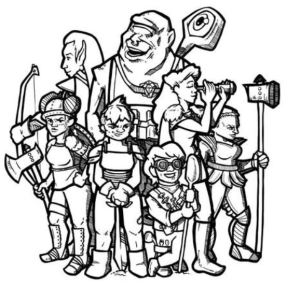
When the world of Sfera is threatened by the machinations of a malevolent sorcerer, it will be up to a band of unlikely heroes to become the brightest light in the darkness.

The adventurers fan out across the land to find and retrieve the Arithmetiquities, a set of ancient mathemagical artifacts.

The Arithmetiquities is a fantasy adventure story told through a sequence of 36 mathematical puzzles.

Join the Adventure

“Though it is still before sunrise, Lumparland Harbor is already bustling. Sailing ships moor at the misty docks, bringing travelers and goods to the seaside town. Three dwarves disembark from different ships, each adventurer returning home from some faraway locale. The three women gather at the end of the pier.

    “The strangers discover that they all live along the main road that leads from the harbor, so they decide to split the cost of a wagon. Egga lives 10 miles away, Floora lives 20 miles away, and Greeta lives 30 miles away. The wagon ride costs $1.50 per mile regardless of the number of passengers.

      “How much should each of the adventurers pay so that each one has a fair fare?”

      —Jason Ermer, “Lumparland Harbor,” The Arithmetiquities Chapter I

       
      * * *

      Are you looking for more creative ways to play math with your kids? Check out all my books, printable activities, and cool mathy merch at Denise Gaskins’ Playful Math Store. Or join my email newsletter.

      This blog is reader-supported. If you’d like to help fund the blog on an ongoing basis, then please join me on Patreon (or choose the paid level on Substack) for mathy inspiration, tips, and an ever-growing archive of printable activities.

      “Playful Math: Getting Students To Write Their Own” copyright © 2022 by Denise Gaskins. Image at the top of the post copyright © Hannah Olinger via Unsplash.com.