Blog

Math Conversation Starter

(Click for larger image.)

What do you see?

Does it make you wonder?

How is perspective art similar to the isometric drawing in yesterday’s post? How is it different?

You may also enjoy:

CREDITS: William Hogarth – “The importance of knowing perspective” (Absurd perspectives), Engraving on paper. From Wikimedia Commons.

How to Draw Minecraft Blocks

Running out of time on my Math You Can Play Kickstarter, so I better get to work on that Kickstarter Special Edition math-art book I promised to all the backers as a bonus reward.

Today I’m working on the Isometric Drawing and Impossible Figures section, because my co-op math classes had so much fun learning how to draw those.

Here’s a starter image on how to draw Minecraft blocks. At first I called them “isometric blocks” — but changing the name to “Minecraft” made the students really excited to learn. I’m not sure whether I like the pencil sketch, or if I should remake the illustrations on the computer…

Key steps:

  1. Make a Y.
  2. Turn it into an M.
  3. Slant down for the bottom.
  4. Slant up for the top.
Student drawings from my co-op classes.

The most common problem for beginners is that they try to make the base straight. They know a block can sit on a table, so the bottom has to be flat, right? But once students get a feel for how it goes, they can really take off and have fun.

UPDATE: The Kickstarter deals have ended, but my playful math books are still available through your favorite online store or by special order at your local bookshop. (Except for the Prealgebra & Geometry Games book, scheduled for publication in early 2021. Sign up for my email list to get the latest news.)

Morning Coffee – 17 August 2020

Morning Coffee image

One of the best ways we can help our children learn mathematics (or anything else) is to always be learning ourselves.

Here are a few stories to read with your morning coffee this week:

“A strategy is how you mess with the numbers, how you use relationships and connections between numbers to solve a problem. A model is a representation of your strategy, the way the strategy looks visibly. Modeling your strategy makes your thinking more clear to others because they can see the thinking and the relationships that went into your process.”

—Pam Harris
Strategies vs. Models

  • Do you have preschool or elementary students? Michael Minas has a great collection of games on his blog. Easy to learn and full of mathematical thinking.

“Doing mathematics like this deprives students of, well, let’s be honest, mathematics itself. We need to get to the answer faster. We need to move on. No time to stumble around rabbit holes. There is a curriculum to cover.”

—Sunil Singh
Our Fear of Being Lost Devalues The Beauty of Mathematics

CREDITS: Feature photo (top) by Kira auf der Heide via Unsplash. “Morning Coffee” post format inspired by Nate Hoffelder at The Digital Reader.

Behind the Scenes with the Index Edit

Gel pens are wonderful for editing because they show up so well against the manuscript text. Each pass gets a new color. The picture above is the 5th cycle through my Prealgebra & Geometry Games index, this time with purple ink.

When I printed the output from cycle #4, everything looked so neat in three columns with alphabet headers in place. I thought, “This is almost done!”

Moral: Don’t judge an index by how nice it looks.

Still, it’s also not as bad as the marked-up pages make it seem. Only a few of those will be major tweaks. (Like, how did we not notice that the Jack Lyon quote got left out of the reference section?!)

Plenty of work to go, but the end is in sight…

Prealgebra & Geometry: Math Games for Middle School is scheduled for publication in early 2021. Sign up for my newsletter to get updates.

That’s Mathematics

Here’s a bit of fun I found on YouTube. Happy Friday!

Mathematicians and maths educators in order of appearance:

Eddie Woo @misterwootube
Hannah Fry @FryRSquared
James Tanton @jamestanton
Chris Smith @aap03102
Bobby Seagull @Bobby_Seagull
Jo Morgan @mathsjem
David Wees @DavidWees
Matt Parker @standupmaths
Michael Stevens @tweetsauce
Lieven Schiere @lievenscheire
Ben Sparks @SparksMaths
Rob Eastaway @robeastaway
Nira Chamberlain @ch_nira
Ed Southall @edsouthall
Steven Strogatz @stevenstrogatz
Simon Pampena @mathemaniac
Rachel Riley @RachelRileyRR
Alex Bellos @alexbellos
Simon Singh @SLSingh
Katie Steckles @stecks
Craig Barton @mrbartonmaths
Kyle Evans @kyledevans

Still Working on the Index

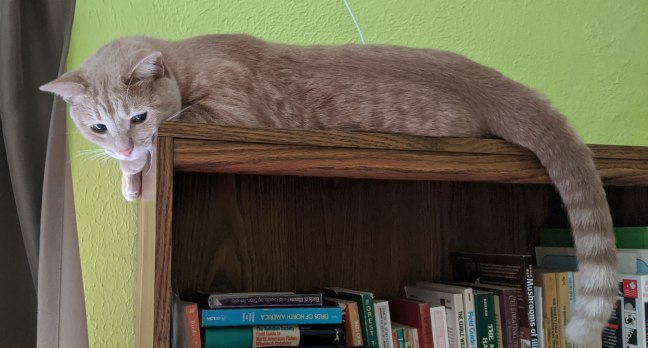
With the less-than-help of my daughter’s cat, I’ve made it through several cycles of editing my Prealgebra & Geometry index. If you’re curious about the process, you may enjoy my behind-the-scenes peek at How to DIY a Nonfiction Index.

There’s yet a ways to go, but it’s starting to look like what I want. The index includes game listings by category: card games, pencil and paper games, cooperative games, solitaires, etc.

One of the entries is “Games, Complete List of.”

So I counted…

Officially, the book features 41 games that help prepare students for high school math by playing with number properties, mixed operations, integers, algebraic functions, coordinate geometry, and more.

But when I counted all the official game listings plus all the game variations that were different enough to have their own names — 62 games.

Wow!

Prealgebra & Geometry: Math Games for Middle School is scheduled for publication in early 2021. Sign up for my newsletter to get updates.

Only by Thinking

The full quote, as it appears in my new book:

When we give students a rule, we give them permission not to think. All they need to do is remember our instructions.

But it is only by thinking — by struggling their way through mental difficulties — that our students can build a foundation of mathematical knowledge strong enough to support future learning.

—Denise Gaskins
Prealgebra & Geometry: Math Games for Middle School

 
* * *

Excerpted from my upcoming book, Prealgebra & Geometry: Math Games for Middle School, scheduled for publication in early 2021. Sign up for my newsletter to get updates.

This blog is reader-supported.

If you’d like to help fund the blog on an on-going basis, then please join me on Patreon for mathy inspiration, tips, and an ever-growing archive of printable activities.

If you liked this post, and want to show your one-time appreciation, the place to do that is PayPal: paypal.me/DeniseGaskinsMath. If you go that route, please include your email address in the notes section, so I can say thank you.

Which I am going to say right now. Thank you!

“Only by Thinking” copyright © 2020 by Denise Gaskins. Image at the top of the post copyright © Sean Kong on Unsplash.

Math Game: Hit Me

I believe this was the first math game I ever invented. Of course, ideas are common currency, so I’m sure other math teachers thought of it before I did. But to me, it was original.

I’ve blogged about the game before, but here’s the updated version as it appears in my new book Prealgebra & Geometry: Math Games for Middle School — scheduled for publication in early 2021. Sign up for my newsletter to get updates.

Hit Me

Math Concepts: integer addition, absolute value.

Players: two or more.

Equipment: playing cards (two decks may be needed for a large group).

Continue reading Math Game: Hit Me

Morning Coffee – 10 August 2020

Morning Coffee image

One of the best ways we can help our children learn mathematics (or anything else) is to always be learning ourselves.

Here are a few stories to read with your morning coffee this week:

“The happy truth about doing math with your kids is that it’s way more fun than you’re expecting it to be. It’s not about right answers, and it’s not about speed. It’s about playing, counting, building, sorting, and studying the wonderful, colorful world around us.”

—Dan Finkel and Katherine Cook
How to help your kids fall in love with math: a guide for grown-ups

Continue reading Morning Coffee – 10 August 2020