Blog

Playful Math Education Carnival 115—Women of Mathematics

Welcome to the 115th edition of the Playful Math Education Blog Carnival — a smorgasbord of links to bloggers all around the internet who have great ideas for learning, teaching, and playing around with math from preschool to pre-college.

In honor of Women’s History Month, this carnival features quotes from fifteen women mathematicians.

If you would like to jump straight to our featured blog posts, click here to see the Table of Contents.

Let the mathematical fun begin!

The Women of Mathematics

They came from many countries and followed a variety of interests.

They conquered new topics in mathematics and expanded the world’s understanding of old ones.

They wrestled with theorems, raised children, published articles, won awards, faced discrimination, led professional organizations, and kept going through both success and failure.

Some gained international renown, but most enjoyed quiet lives.

They studied, learned, and lived (and some still live) as most of us do — loving their families and friends, joking with colleagues, hoping to influence students.

I think you’ll find their words inspiring.

“What I really am is a mathematician. Rather than being remembered as the first woman this or that, I would prefer to be remembered, as a mathematician should, simply for the theorems I have proved and the problems I have solved.”
Julia Robinson (1919–1985)


“All in all, I have found great delight and pleasure in the pursuit of mathematics. Along the way I have made great friends and worked with a number of creative and interesting people. I have been saved from boredom, dourness, and self-absorption. One cannot ask for more.”
Karen Uhlenbeck (b. 1942)

Continue reading Playful Math Education Carnival 115—Women of Mathematics
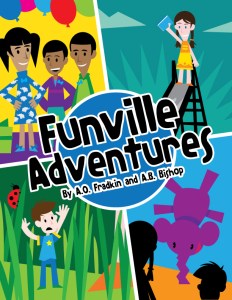
Funville Adventures: Blake’s Story

Today we have a guest post — an exclusive tale by Sasha Fradkin and Allison Bishop, authors of the new math storybook Funville Adventures. Enjoy!

Funville Adventures is a math-inspired fantasy that introduces children to the concept of functions, which are personified as magical beings with powers.

Each power corresponds to a transformation such as doubling in size, rotating, copying, or changing color. Some Funvillians have siblings with opposite powers that can reverse the effects and return an object to its original state, but other powers cannot be reversed.

In this way, kids are introduced to the mathematical concepts of invertible and non-invertible functions, domains, ranges, and even functionals, all without mathematical terminology.

We know about Funville because two siblings, Emmy and Leo, were magically transported there after they went down an abandoned slide.

When they came back, Emmy and Leo shared their adventures with their friends and also brought back the following manuscript written by their new friend Blake.

Continue reading Funville Adventures: Blake’s Story

Cultivate Mathematical Curiosity

“Cultivating thinking skills is the main reason for teaching math. It is the mind’s perfect playground for shaping up.

To begin developing thinking, you must first have a child who is curious. For without curiosity, there is only forced thinking.

The problem with traditional math is it jumps to the punchline.

Absolutely no mystery or suspense is developed in traditional math books. Why? Apparently, someone thought math was without mystery. That math is a definitive subject of rules and algorithms that all have been discovered.

We must persuade children that math is a worthy pursuit through interesting stories, examining quirky math properties, and asking good questions.”

— Lacy Coker
5 Tips to Cultivate Math Curiosity

The Mind’s Perfect Playground

My K-2nd-grade homeschool co-op math class will be following many of the tips in Lacy’s article.

Our topic is “Math Storytime,” so we’ll be starting with picture books, exploring the ideas they bring up, and finding things to notice and wonder about.

I’m looking forward to it.

But picture books aren’t just for little kids. They can be great discussion-starters at any age. Have you enjoyed math books with your students?

I’d love to hear your suggestions!

CREDITS: Background photo courtesy of Bekah Russom on Unsplash.

Learning Mathematics Is a Deep Mystery

Of all the myths about mathematics, the one I find most blatantly wrong is the idea that some people are just born knowing the answers. In my experience, when you confront a genuine puzzle, you start out not knowing, no matter who you are.

Moreover, “knowing” the answers can be a trap; learning mathematics is about looking at what you thought you understood and seeing that there’s deeper mystery there than you realised.

— Dan Finkel
A Mathematician at Play Puzzle #1

Puzzles for Learning Mathematics

If you’d like to practice learning mathematics by confronting genuine puzzles, Dan’s “A Mathematician at Play” series looks like a wonderful place to start.

Some of these puzzles are classics, others are original. All of them involve some kind of thinking or insight that strikes me as pretty, or surprising, or delightful.

— Dan Finkel
A Mathematician at Play Puzzle #1

Dan plans to post new puzzles on the Math 4 Love blog every Monday for the next few months. And sharing spoilers on each following Friday, if you want to verify your answers.

Check it out!

CREDITS: Background photo courtesy of Amy on Unsplash.

Learning Math Requires Imagination

“Teach mathematics the way we learn any other subject: Make it visual, make it concrete, not dependent on meaningless, abstract symbols, employ all the senses!

If math is such an important subject (and it is) why teach it in a way that is dependent on a child’s weakest mental ability: memory, rather than her strongest mental ability: imagination?”

— Geoff White
The Grade 10 Math Crunch, or Hitting the Wall at Grade 10

Mathematics and Imagination

How can we stir up our students’ imagination?

Teachers have struggled with this question for years — perhaps since the beginning of the profession.

Consider these comments by W. W. Sawyer in Mathematician’s Delight:

“Earlier we considered the argument, ‘Twice two must be four, because we cannot imagine it otherwise.’ This argument brings out clearly the connexion between reason and imagination: reason is in fact neither more nor less than an experiment carried out in the imagination.

“People often make mistakes when they reason about things they have never seen. Imagination does not always give us the correct answer. We can only argue correctly about things of which we have experience or which are reasonably like the things we know well. If our reasoning leads us to an untrue conclusion, we must revise the picture in our minds, and learn to imagine things as they are.

“When we find ourselves unable to reason (as one often does when presented with, say, a problem in algebra) it is because our imagination is not touched. One can begin to reason only when a clear picture has been formed in the imagination.

“Bad teaching is teaching which presents an endless procession of meaningless signs, words and rules, and fails to arouse the imagination.”

CREDITS: Background photo by Mehmet Kürşat Değer on Unsplash.

2018 Mathematics Game — Join the Fun!

Let’s resolve to have fun with math this year. Ben has posted a preview of 2018’s mathematical holidays. Iva offers plenty of cool ways to think about the number 2018. And Patrick proposes a new mathematical conjecture.

But my favorite way to celebrate any new year is by playing the Year Game. It’s a prime opportunity for players of all ages to fulfill the two most popular New Year’s Resolutions: spending more time with family and friends, and getting more exercise.

So grab a partner, slip into your workout clothes, and pump up those mental muscles!

For many years mathematicians, scientists, engineers and others interested in mathematics have played “year games” via e-mail and in newsgroups. We don’t always know whether it is possible to write expressions for all the numbers from 1 to 100 using only the digits in the current year, but it is fun to try to see how many you can find. This year may prove to be a challenge.

Math Forum Year Game Site

Rules of the Game

Use the digits in the year 2018 to write mathematical expressions for the counting numbers 1 through 100. The goal is adjustable: Young children can start with looking for 1-10, middle grades with 1-25.

  • You must use all four digits. You may not use any other numbers.
  • Solutions that keep the year digits in 2-0-1-8 order are preferred, but not required.
  • You may use +, -, x, ÷, sqrt (square root), ^ (raise to a power), ! (factorial), and parentheses, brackets, or other grouping symbols.
  • You may use a decimal point to create numbers such as .2, .02, etc., but you cannot write 0.02 because we only have one zero in this year’s number.
  • You may create multi-digit numbers such as 10 or 201 or .01, but we prefer solutions that avoid them.

My Special Variations on the Rules

  • You MAY use the overhead-bar (vinculum), dots, or brackets to mark a repeating decimal. But students and teachers beware: you can’t submit answers with repeating decimals to Math Forum.
  • You MAY use a double factorial, n!! = the product of all integers from 1 to n that have the same parity (odd or even) as n. I’m including these because Math Forum allows them, but I personally try to avoid the beasts. I feel much more creative when I can wrangle a solution without invoking them.

Click here to continue reading.

A Beautiful Puzzle

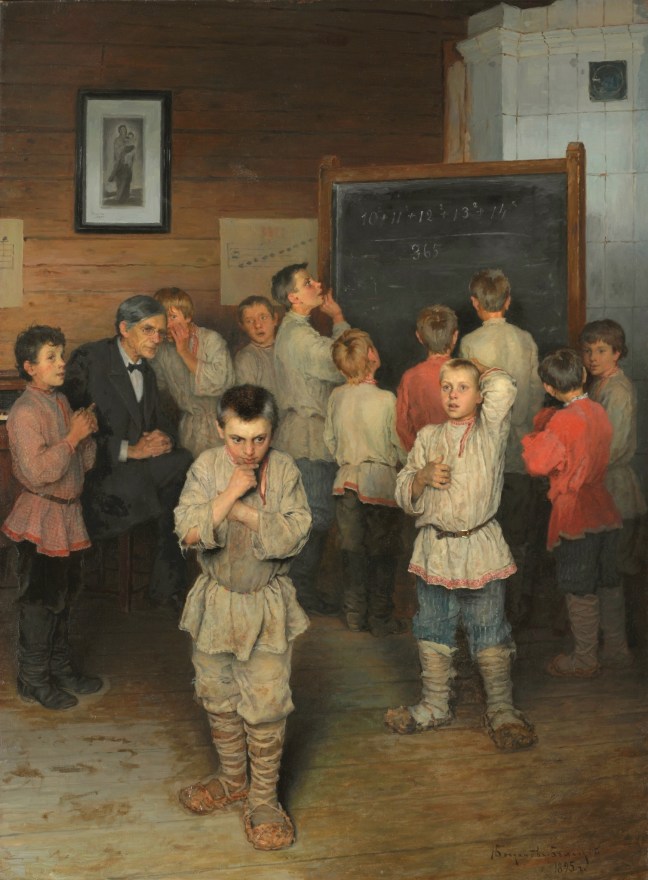
This lovely puzzle (for upper-elementary and beyond) is from Nikolay Bogdanov-Belsky’s 1895 painting “Mental Calculation. In Public School of S. A. Rachinsky.” Pat Ballew posted it on his blog On This Day in Math, in honor of the 365th day of the year.

I love the expressions on the boys’ faces. So many different ways to manifest hard thinking!

Here’s the question:

No calculator allowed. But you can talk it over with a friend, as the boys on the right are doing.

You can even use scratch paper, if you like.

Thinking About Square Numbers

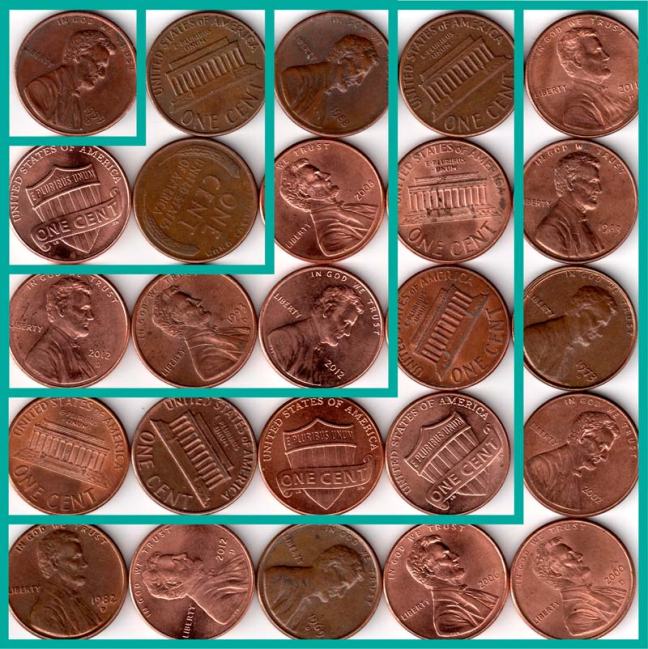
And if you’d like a hint, you can figure out square numbers using this trick. Think of a square number made from rows of pennies.

Can you see how to make the next-bigger square?

Any square number, plus one more row and one more column, plus a penny for the corner, makes the next-bigger square.

So if you know that ten squared is one hundred, then:

… and so onward to your answer. If the Russian schoolboys could figure it out, then you can, too!

Update

Simon Gregg (@Simon_Gregg) added this wonderful related puzzle for the new year:

Holiday Math and More: Playful Math Education Carnival 114

Do you enjoy math? I hope so! If not, the links in this post just may change your mind.

Welcome to the 114th edition of the Math Teachers At Play math education blog carnival — a smorgasbord of articles by bloggers all around the internet who have great ideas for learning, teaching, and playing around with math from preschool to pre-college.

If you would like to jump straight to our featured blog posts, click here to see the Table of Contents.

By the way, I found a cool, semi-self-referential trivia tidbit about our carnival number: 27 − 14 = 114. And if you put 114 dots into a 1←7 Exploding Dots machine, you’ll get the code 222. Pretty neat!

As you scroll through the links below, you find several puzzle graphics from the wonderful Visual Patterns website. Use them as conversation-starters with your kids: What do you notice? How does each pattern grow? For older students: Can you write a formula to describe how each pattern? What will it look at stage 43?

Pattern #7, Trees

A BIT OF FUN

Setting the mood: Enjoy this bit of seasonal fidgeting from Vi Hart (@vihartvihart).

If you don’t understand some of the references, that’s normal! Pick a phrase, Google it, and enjoy the fun of learning something new.


TABLE OF CONTENTS

And now, on to the main attraction: the blog posts. Some articles were submitted by their authors; others were drawn from the immense backlog in my rss reader. If you’d like to skip directly to your area of interest, click one of these links.

Let the mathematical fun begin!

Continue reading Holiday Math and More: Playful Math Education Carnival 114

Check Out These Cool Math Sales

I’ve been following Sonya’s Arithmophobia No More blog for a couple of years, and I love the work she is doing. But this month, she’s teamed up with Lacy at Play, Discover, Learn (another great blog to follow!) to offer a humongous bundle of playful math.

You get math journaling pages, games, creative task cards, thought-provoking worksheets, and video training resources to help you build your child’s understanding of math from arithmetic to early algebra. Wow!

These activities are perfect for homeschooling families or anyone looking to supplement their child’s current math curriculum with effective discovery-based activities. If you’ve ever wondered what to do with those Cuisenaire rods you picked up on sale way back when, this bundle is for you.

I’m so looking forward to using some of these ideas with my elementary homeschool co-op kids next year!

Sale price is $30 from December 2-15.

Cuisenaire Rod Activities Blowout Bundle

But Wait, There’s More

If you’ve been reading my blog for very long, you’ve probably seen how much I love the blog, books, and classes available from the Natural Math folks.

Their newest book is just off the presses — Funville Adventures, a math adventure chapter book.

And until December 20, they’re having a holiday sale. Make your own bundle of any Natural Math books. Playful algebra, calculus for 5-year-olds, inquiry problems and more: Great deal!

Natural Math Book Sale

Stock Up on My Playful Math Books

Finally, if you’ve been wanting to pick up a paperback copy of Let’s Play Math or some of my game books, or maybe a set of dot-grid math journals, I’m currently offering a discount on bulk orders.

Bundle ANY assortment of titles. Stock up on books for your family, friends, or homeschool group.

  • 2–4 books: 15% discount off retail prices
  • 5–9 books: 25% discount
  • 10–19 books: 35% discount
  • 20+ books: 35% discount, and free Continental U.S. standard shipping or the equivalent discount off other shipping options

Bulk Order Playful Math Paperbacks

(US customers only: We’re sorry we can’t offer bulk discounts for our international readers, but the complexities of international duties and tax laws are too much for this very small family business.)

Do You Know of Any Math Deals?

Apollonian greetings from my homeschool co-op kids, and best wishes for a grace-filled holiday season.

If you’ve seen a great deal or holiday price on a math resource you love, please share!

Add your deal to the comment section below, so we can all take advantage of the math joy this season.

Playful Math Education Carnival 113 at Three J’s Learning

Check out the new carnival of playful math for all ages!

Each carnival brings you a great new collection of puzzles, math conversations, crafts, teaching tips, and all sorts of mathy fun.

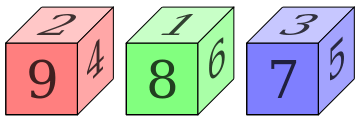
This month we have whole-body math, notice-and-wonder puzzles, a game to build math vocabulary, intransitive dice, making sense of trig identities, and playing Go on a hundred chart. And plenty more!

Click Here to Read the Carnival Blog

Hey, Blogger, Can You Spare a Time?

We need help!

Do you write an education or family blog? Classroom teacher, math coach, homeschooler, parent, college professor, unschooler — anyone interested in helping kids play around with math?

Please consider volunteering to host the MTaP blog carnival for one month.

We still need a home for the last carnival of 2017.

Or plan ahead: 2018 is wide open.

You choose the month that fits your schedule and decide how much effort you want to put in. Writing the carnival can take a couple of hours for a simple post — or you can spend several days searching out and polishing playful math gems to share.

If you want more information, read the MTaP Math Education Blog Carnival home page.

Then let me know which month you want.