
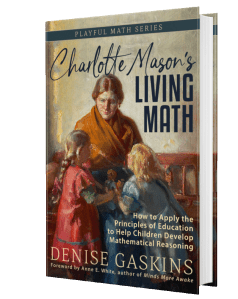
 One of the stretch goals for my Charlotte Mason’s Living Math Kickstarter campaign is to add a math journaling prompt to the end of each chapter. So, I’ve been playing around with ideas to get readers writing.
Since the book’s all about how to build mathematical reasoning, I’m looking for ways to prompt creative thinking and flexibility in math calculations.
I found some fun ideas in Guy Gattegno and Martin Hoffman’s Handbook of Activities for the Teaching of Mathematics (which you can download here), including the following riff off a puzzle created by Lewis Carroll.








 Denise Gaskins' Let's Play Math