The Game of Algebra

NFL football
Photo by velo_city.

My pre-algebra class hit the topic of equations just as the NFL season moved into the playoffs. The result was this series of class notes called “The Game of Algebra.”

We used the Singapore Math NEM 1 textbook, which is full of example problems and quality exercises. These notes simply introduce or review the main concepts and vocabulary in a less-textbooky way.

I hope you find them useful.

Continue reading The Game of Algebra

Puzzles for the New Year

by Koshyk via flickr

As we all head back to school, here are some interesting calendar puzzles:

  • 2008 is a leap year. Why do leap years happen? If we didn’t add a leap day every so often, would January eventually come in the summer?
  • Today is Thursday. What day of the week will it be exactly one year from today?
  • January 1, 2008, came on a Tuesday. When will be the next year that begins on Tuesday?
  • My birthday (in March) lands on a Monday this year. When is the next year my birthday will come on a Monday? How about YOUR birthday — when is the next time it will happen on the same day of the week as this year?
  • Can you find a pattern in the way dates move from one day of the week to another, year after year?

Continue reading Puzzles for the New Year

A-Hunting They Will Go

Alexandria Jones and her family piled into the car for a drive in the country. This year, they were determined to find an absolutely perfect Christmas tree at Uncle William Jones’s tree farm.

“I want the tallest tree in Uncle Will’s field,” Alex said.

“Hold it,” said her mother. “I refuse to cut a hole in the roof.”

“But, Mom!” Leon whined. “The Peterkin Papers…”

“Too bad. Our ceiling will stay a comfortable 8 feet high.”

Continue reading A-Hunting They Will Go

What Do We Mean by “Assume”?

Almost all math problems call for the student to assume one thing or another. Without assumptions — definitions, postulates, axioms, common notions, or whatever you want to call them — mathematics of any kind is impossible. Tony at Pencils Down (who plans to be a math teacher when he grows up) reminds us that, necessary though it may be, we are stepping on dangerous ground when we assume:

Random Samples: Making an Ass of You and Me

Continue reading What Do We Mean by “Assume”?

High School Math Challenge

The USA Mathematical Talent Search (USAMTS) has posted its current set of challenge problems, the first of four rounds scheduled for the 2007-2008 school year. USAMTS is a free competition open to all United States middle school and high school students. Young mathematicians have a little over a month (until October 9) to write and send in solutions for the five questions.

According to the USAMTS website:

Student solutions to the USAMTS problems are graded by mathematicians and comments are returned to the students. Our goal is to help all students develop their problem solving skills, improve their technical writing abilities, and mature mathematically while having fun. We wish to foster not only insight, ingenuity and creativity, but also the virtue of perseverance, which is equally essential in scientific endeavors.

A mere five questions. How hard can it be? (Ha!)

Writing to Learn Math

2009 Challenge - Day 72: Pencil
Image by ☼zlady via Flickr

Have you considered experimenting with writing in your math class this year? It seems that math journals are a growing fad, and for good reason:

Writing is how we think our way into a subject and make it our own.

William Zinsser
Writing to Learn

Math journal entries can be as simple as class notes, or they can be research projects that take hours of experimentation and pondering. Students may use the journal to store their thoughts as they work several days to solve a challenge problem of the week, or they might jot down quick reflections about what they learned in today’s math class.

Continue reading Writing to Learn Math

Hints and Solutions: Patty Paper Trisection

No peeking! This post is for those of you who have given the trisection proof a good workout on your own. If you have a question about the proof or a solution you would like to share, please post a comment here.

But if you haven’t yet worked at the puzzle, go back and give it a try. When someone just tells you the answer, you miss out on the fun. Figure it out for yourself — and then check the answer just to prove that you got it right.

Continue reading Hints and Solutions: Patty Paper Trisection

Puzzle: Patty Paper Trisection

[Feature photo above by Michael Cory via Flickr (CC BY 2.0).]

trisection

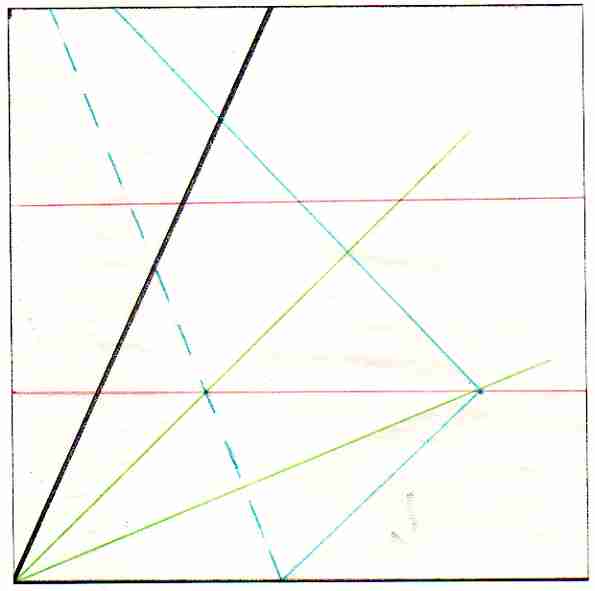
One of the great unsolved problems of antiquity was to trisect any angle using only the basic tools of Euclidean geometry: an unmarked straight-edge and a compass. Like the alchemist’s dream of turning lead into gold, this proved to be an impossible task. If you want to trisect an angle, you have to “cheat.” A straight-edge and compass can’t do it. You have to use some sort of crutch, just as an alchemist would have to use a particle accelerator or something.

One “cheat” that works is to fold your paper. I will show you how it works, and your job is to show why.

Continue reading Puzzle: Patty Paper Trisection

How Can We Teach Problem Solving?

We continue to plan our co-op courses for next fall. Some of the classes I had hoped for will not happen, and my children are going to have to make some tough choices between the remaining topics. Unfortunately, they have not yet mastered the ability to be in two classrooms at once.

I have three math courses to plan, and I think I will focus as much as I can on teaching math through problems, even at the elementary level. These are once-a-week enrichment classes for homeschooled students, so I assume they have a “normal” math program at home. I want to introduce a few topics they might not otherwise see, to deepen their understanding of the topics they have studied, and to give them a taste of that “Aha!” feeling that comes from conquering a challenging problem. Has anybody done something like this, and can you recommend some good resources?

Continue reading How Can We Teach Problem Solving?

Geometry: Can You Find the Center of a Circle?

Is it possible that AB is a chord but NOT a diameter? That is, could circle ABC have a center that is NOT point O?

For the last couple of days, I have been playing around with this geometry puzzle. If you have a student in geometry or higher math, I recommend you print out the original post (but not the comments — it’s no fun when someone gives you the answer!) and see what he or she can do with it.

[MathNotations offers many other puzzles for 7-12th grade math students. While you are at his blog, take some time to browse past articles.]