Mental Math: Advanced Division

Father and daughter working mental math

The farther we go in math, the more division disappears. It ceases to exist as a separate concept.

Instead, we learn to see division as:

  • an inverse multiplication
  • a fraction (ratio)
  • a proportional relationship

Each of these perspectives offers us a new way to think about and make sense of our calculations.

Continue reading Mental Math: Advanced Division

Mental Math: Advanced Multiplication, Part 2

Father and son celebrate a mental math answer

The methods in last week’s Advanced Multiplication post only work for certain numbers, but we have another, more powerful multiplication tool: We can always use a ratio table to make sense of any multiplication.

Ratios are the beginning of proportional thinking. We can systematically alter the numbers in a ratio to reach any quantity required by our problem.

Students begin working with ratios in story problems that help them visualize and make sense of a proportional relationship.

Continue reading Mental Math: Advanced Multiplication, Part 2

Mental Math: Advanced Multiplication, Part 1

Mother and daughter working mental math together

Mental math is the key to algebra because the same principles underlie them both.

As our children learn to do calculations in their heads, they make sense of how numbers work together and build a strong foundation of understanding.

Remember that while mental math is always done WITH the mind, reasoning our way to the answer, it doesn’t have to be only IN the mind. Make sure your students have scratch paper or a whiteboard handy to jot down intermediate steps as needed.

Besides, math is always more fun when kids get to use colorful markers on a whiteboard.

Continue reading Mental Math: Advanced Multiplication, Part 1

Happy Pythagorean Triple Day!

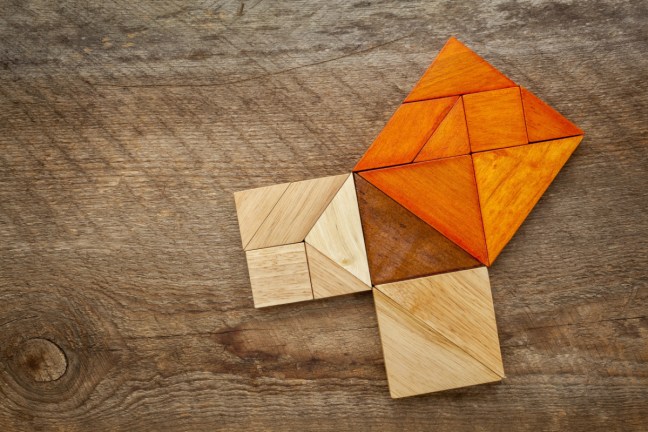
Pythagorean Theorem demonstrated with tangrams

Thursday is Pythagorean Triple Day, one of the rarest math holidays.

The numbers of Thursday’s date: 7/24/25 or 24/7/25, fit the pattern of the Pythagorean Theorem: 7 squared + 24 squared = 25 squared.

Any three numbers that fit the a2 + b2 = c2 pattern form a Pythagorean Triple.

Continue reading Happy Pythagorean Triple Day!

Monday is Square Root Day

square tree with roots

On May 5, we celebrate one of the rarest math holidays: Square Root Day, 5/5/25.

Here are a few ideas for playing math with squares and roots.

What is a Square Root?

Five is the square root of twenty-five, which means it is the number we can “square” (multiply times itself) to get 25.

The root is the base number from which the square grows. In physical terms, it is the side of the square.

Imagine a straight segment of length 5, perhaps a stick or a piece of chalk. Now lay that segment down and slide it sideways for a distance equal to its length. Drag the stick across sand, or pull the chalk across paper or a slate.

Notice how this sideways motion transforms the one-dimensional length into a two-dimensional shape, a square.

The area of this shape is the square of its root: 5 × 5 = 25.

What do you think would happen if you could drag the square through a third dimension, or drag that resulting shape through a fourth dimension?
How many shapes do you suppose might grow from that original root of 5?

Continue reading Monday is Square Root Day

If Not Methods: Dividing Fractions

Mother and daughter working together on math homewrok

As I said in an earlier post, we don’t want to give our children a method because that acts as a crutch to keep them from making sense of math.

But what if our children get stumped on a tough fraction calculation like 1 1/2 ÷ 3/8?

Continue reading If Not Methods: Dividing Fractions

Middle School Math Proof

Homeschool Memories…

Kitten (my daughter) and I sat on the couch sharing a whiteboard, passing it back and forth as we took turns working through our prealgebra book together.

The chapter on number theory began with some puzzles about multiples and divisibility rules.

Continue reading Middle School Math Proof

Numberless Word Problems

As I mentioned yesterday, my new book includes links to online resources to help you play with word problems. So this week, I’m sharing a few of my favorites.

Visit the Kickstarter

Today we examine a time-tested method to help kids reason about math: Leave out the numbers.

First up, there’s Brian Bushart’s numberless problem bank for young students. Then we’ll look at Farrar Williams’s modern revision of a math teaching classic with problems for upper-elementary and middle school students.

Have fun thinking math with your kids!

Word Problem Bank

Word problems are commonplace in mathematics classrooms, and yet they regularly confound students and lead to frustrated teachers saying things like:

  • “They just add all the numbers! It doesn’t matter what the problem says.”
  • “They don’t stop to think! They just start computing as soon as they’re done reading the problem.”

Brian Bushart offers a collection of ready-to-go slide presentations that walk through the steps of making a word problem make sense.

Visit the Site

Math With No Numbers
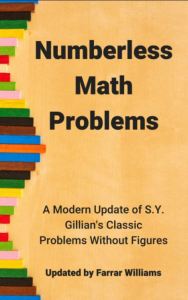
Discover Farrar Williams’s book Numberless Math Problems: A Modern Update of S.Y. Gillian’s Classic Problems Without Figures, available in ebook or paperback.

Williams writes: “In order to answer the question, they’ll have to explain it, because the problem doesn’t give you anything to calculate with. The only way to answer is by explaining your process. See how sneaky a numberless problem is? It makes students really think about the process of solving the problem.”

Find Out More

“When students face a word problem, they often revert to pulling all the numbers out and “doing something” to them. They want to add, subtract, multiply, or divide them, without really considering which operation is the right one to perform or why.

    “When you don’t have numbers, it sidesteps that problem.

      “For students who freeze up when they see the numbers, this can be a really good way to get them to think about their process with math.”

      —Farrar Williams, Math With No Numbers

      CREDITS: Feature photo (top) by saeed karimi via Unsplash.com.

      Problem Solving with James Tanton

      At the back of my new Word Problems from Literature book, I’ve included an appendix with links to recommended online resources.

      Check in on the Kickstarter

      So I thought this week, I’d share some of my favorites with you. First up: Problem Solving Tips from James Tanton.

      You may know Tanton from the popular Exploding Dots and other activities at the Global Math Project website. But he’s been busy for decades sharing the delight and the beauty of the subject. He currently serves as the Mathematician-at-Large for the Mathematical Association of America.

      Read on to discover several of Tanton’s best problem-solving tips for middle school and older students.

      Have fun exploring math with your kids!

      How to Think like a School Math Genius

      In this 4-video series, Tanton presents five key principles for brilliant mathematical thinking, along with loads and loads of examples to explain what he means by each of them. A call for parents and teachers to be mindful of the life thinking we should foster, encourage, promote, embrace and reward — even in a math class!

      Watch the Videos

      Two Key — but Ignored —Steps to Solving Any Math Problem

      How many degrees in a Martian circle?
      Every challenge or problem we encounter in mathematics (or life!) elicits a human response. The dryness of textbooks and worksheets in the school world might suggest otherwise, but connecting with one’s emotions is fundamental and vital for success — and of course, joy — in doing mathematics.

      Read the Article

      MAA AMC Curriculum Inspirations

      Essays and videos showing how to approach math puzzles in a way that a) is relevant and connected to the curriculum, and b) revels in deep, joyous, mulling and flailing, reflection, intellectual play and extension, insight, and grand mathematical delight.

      Scroll down and start with the Ten Problem-Solving Strategies.

      Download the Puzzles

      Think Puzzles and Think Cool Math

      Here are some essays illustrating astounding tidbits of mathematical delight. And here are some purely visual puzzles to surprise.

      Explore and Enjoy

      “The true joy in mathematics, the true hook that compels mathematicians to devote their careers to the subject, comes from a sense of boundless wonder induced by the subject.

        “There is transcendental beauty, there are deep and intriguing connections, there are surprises and rewards, and there is play and creativity.

          “Mathematics has very little to do with crunching numbers. Mathematics is a landscape of ideas and wonders.”

          —James Tanton

          CREDITS: Feature photo (top) by Ian Stauffer via Unsplash.com.