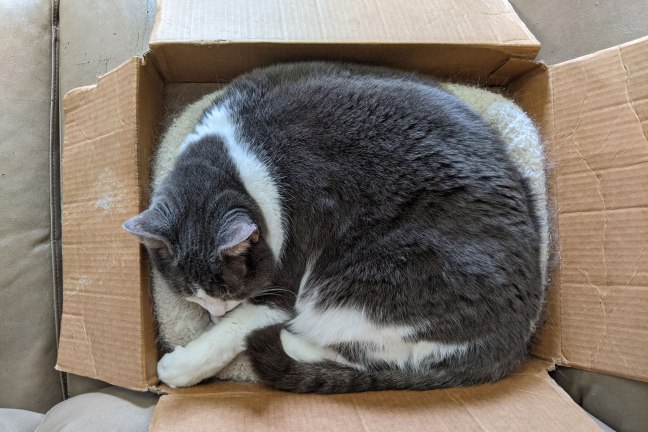
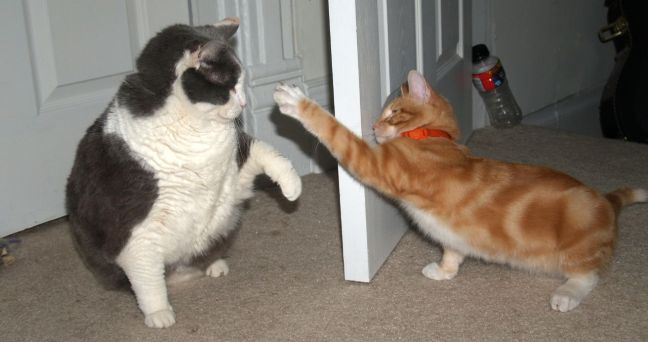
It may look like Cimorene has lain down on the job, but don’t be fooled! She’s hard at work, creating a math investigation for your students to explore.
Cats know how important it can be for students to experiment with math and try new things. Playing with ideas is how kittens (and humans!) learn.
Cimorene wants you to know that the Make 100 Math Rebels Kickstarter offers a great way for human children to learn math through play. She encourages you to go watch the video and read all about the project.
Too often, school math can seem stiff and rigid. To children, it can feel like “Do what I say, whether it makes sense or not.” But cats know that kids are like kittens — they can make sense of ideas just fine if we give them time to play around.
So Cimorene says you should download the free sample journaling pages from the Math Rebels Kickstarter page. The beautiful parchment design makes doing math an adventure.
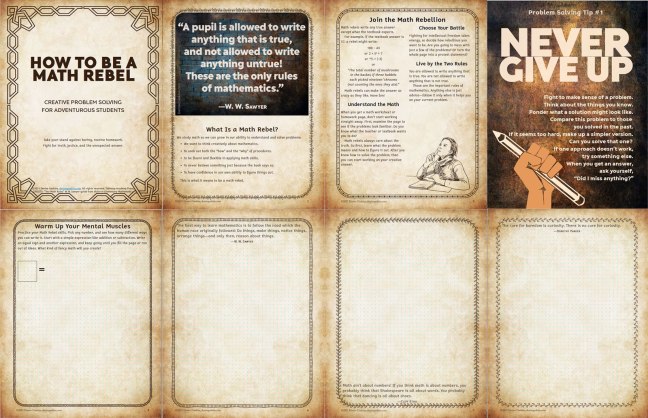
[The free download will always be there, even after the Kickstarter project ends.]
Make 100 Math Rebels Kickstarter
Cimorene’s Puzzle Challenge
Cimorene’s math puzzle is a classic geometry problem from the ancient Kingdom of Cats: Squaring the Circle.
Draw a circle on your journal page. Can you draw a square (or rectangle) that has the same area?
How would you even begin such a task?
Notice Cimorene’s hint in the photo above: Try drawing the square that just touches the edges of your circle. (We call those just-touching lines “tangents” to the circle.)
- What do you notice? Do the square and the circle have the same area? How close are they?
The tangent square sets an upper limit on the area of the circle. You can see that any square that exactly matches the circle would have to be smaller than the tangent square.
- Can you find a square that sets a lower limit on the area of the circle? That is, a square that must have less area than the circle?
- What’s the biggest square you can draw inside your circle? Can you find a square that has all four corners on the circle?
We call that biggest-inside square “inscribed” in the circle. Any polygon whose corners all sit on the circle is an inscribed polygon.
- Play around with circles and squares. How close can you get to matching their size?
Further Exploration
After you have explored for awhile on your own, Cimorene has one more twist in her puzzle.
In the ancient Kingdom of Cats, the wise ones estimated the area of a circle this way:
Divide the width of the circle in thirds, and then in thirds again. (That is, cut the diameter into nine parts.) Draw a square with sides measured by eight such parts.
You can try this on your journaling page by drawing a circle that is nine squares wide. Then draw a square overlapping it, with sides that are eight squares in length.
- How closely do the areas match?
Playing with Pi
Here’s a surprise: Cimorene’s puzzle isn’t really about squares, but about calculus.
The problem of Squaring the Circle is really a much bigger question: Finding the area of a square, rectangle, or other polygon is relatively easy, but how can we discover the area of a curved shape?
For a circle, the area is related to the number pi, which is the number of times you would have to walk across the circle to equal the distance of one time walking around it.
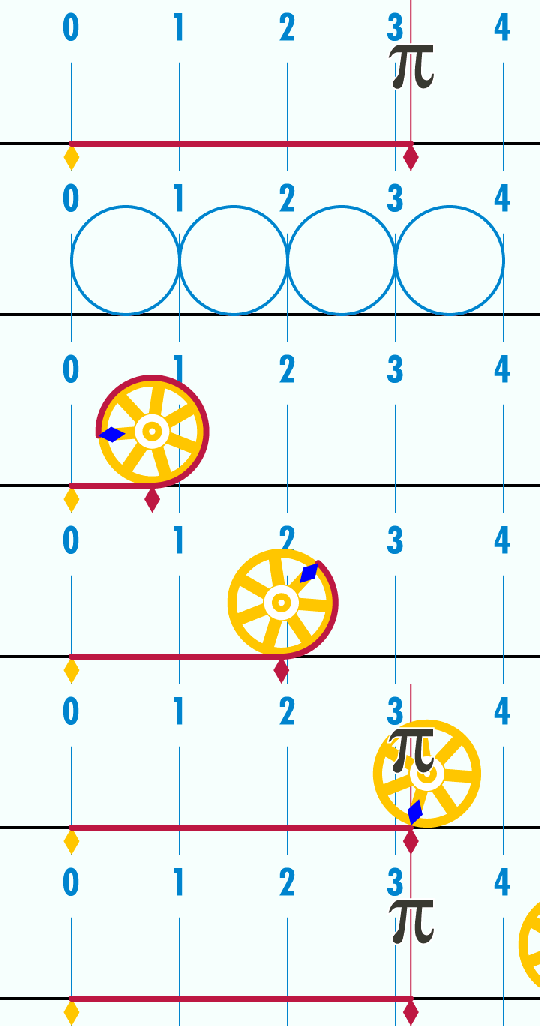 graphic by John Reid (cc by-sa 3.0)So the problem of Squaring the Circle is really the same as asking, “What is the value of pi?”
- Can you figure out what approximate value for pi matches the 8/9 square used in the ancient Kingdom of Cats?
If you’d like to learn more about pi, get ready for a celebration: Pi Day is coming soon! Every year, millions of children celebrate math on March 14th, because if you write the date as 3/14, it’s the same as the first three digits of pi.
Find out more about playing with pi in my Pi Day Round-Up post.
You may also enjoy:
Share Your Stories
Cimorene would love to hear about your children’s experiences playing with math! Please share your story in the comments below.
This blog is reader-supported.
If you’d like to help fund the blog on an on-going basis, then please head to my Patreon page.
If you liked this post, and want to show your one-time appreciation, the place to do that is PayPal: paypal.me/DeniseGaskinsMath. If you go that route, please include your email address in the notes section, so I can say thank you.
Which I am going to say right now. Thank you!
“Math Puzzle from the Ancient Kingdom of Cats” copyright © 2021by Denise Gaskins. Image at the top of the post copyright © Denise Gaskins.

 At the back of my new Word Problems from Literature book, I’ve included an appendix with links to recommended online resources.
  In this 4-video series, Tanton presents five key principles for brilliant mathematical thinking, along with loads and loads of examples to explain what he means by each of them. He says it’s “a call for parents and teachers to be mindful of the life thinking we should foster, encourage, promote, embrace and reward — even in a math class!”
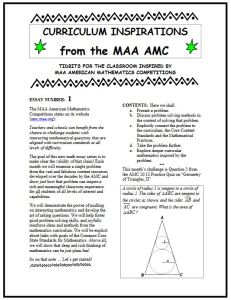 Essays and videos showing how to approach math puzzles in a way that a) is relevant and connected to the curriculum, and b) revels in deep, joyous, mulling and flailing, reflection, intellectual play and extension, insight, and grand mathematical delight.
 Here are some essays illustrating astounding tidbits of mathematical delight. And here are some purely visual puzzles to surprise.



 Here is a math problem in honor of one of our family’s favorite movies…
 Denise Gaskins' Let's Play Math