Mental Math: Advanced Subtraction

mother and daughter talking about math homework

As our children grow and develop their math skills, the mental math strategies grow with them.

The basics of mental math don’t change:

  • Use friendly numbers.
  • Estimate and adjust the answer.

But we have new ways to help children do math in their heads as the numbers get bigger and the problems more challenging.

For example, how might kids figure out a multi-digit subtraction like 67 − 38?

First, we need to adjust our mindset…

Continue reading Mental Math: Advanced Subtraction

Mental Math: Advanced Addition

photo of kids having fun with math

Mental math is doing calculations with our minds, and perhaps with the aid of scratch paper or a whiteboard to jot down notes along the way.

But we cannot simply transfer the standard pencil-and-paper calculations to a mental chalkboard. That’s far too complicated.

We still want to follow our basic strategies of using friendly numbers, estimating, and adjusting the answer. So how can we help children do math in their heads as the numbers get bigger and the problems more challenging?

How might kids figure out a multi-digit addition like 87 + 39?

Here are three useful strategies…

Continue reading Mental Math: Advanced Addition

Mental Math: Early Division

Boy doing mental math calculation

Mental math is doing calculations with our minds, though we can use scratch paper or whiteboards to make notes as we work.

Doing mental math, children use the basic principles of arithmetic to simplify problems so they can think about number relationships, mastering the basic structures of how numbers work, the same structures that underlie algebraic reasoning.

As always, we rely on two key mental-math strategies.

  • Use friendly numbers.
  • Estimate, then adjust.

Division is the mirror image of multiplication, the inverse operation that undoes multiplication, which means we are scaling numbers down into smaller parts. Important friendly numbers include halves, thirds, and tenths, plus the square numbers and any multiplication facts the student happens to remember.

Continue reading Mental Math: Early Division

Mental Math: Early Multiplication

mother and daughter talking math together

Children learn best through interaction with others, and mental math prompts can lead to fascinating conversations, listening as our kids apply their creativity to the many ways numbers interact.

With mental math, students master the true 3R’s of math: to Recognize and Reason about the Relationships between numbers.

And these 3Rs are the foundation of algebra, which explains why flexibility and confidence in mental math is one of the best predictors of success in high school math and beyond.

Let’s Try an Example

Multiplication involves scaling one number by another, making it grow twice as big, or three times as much, or eightfold the size. Multiplication by a fraction scales the opposite direction, shrinking to half or a third or five-ninths the original amount.

The key friendly numbers for multiplication and division are the doubles and the square numbers. As with addition and subtraction, students can estimate the answer using any math facts they know and then adjust as needed.

How many ways might children think their way through the most-missed multiplication fact, 8 × 7?

Continue reading Mental Math: Early Multiplication

Mental Math: Early Subtraction

mother and child doing math homework

By doing mental math, we help our children use the basic principles of arithmetic to simplify problems so they can think about number relationships, mastering the basic structures of how numbers work.

And the more our children practice these structures in mental math, the better prepared they will be to recognize the same principles in algebra.

The basic idea of subtraction is finding the difference between two quantities: comparing a larger amount to a smaller one, figuring out what’s left when you remove a part, or finding the distance between two measurements (or two points on the number line).

When you work with young children learning subtraction, remember our two key mental-math strategies.

  • Use friendly numbers.

For early subtraction with numbers less than 20, the most important friendly numbers are 5 and 10, the pairs of numbers that make 10, and the doubles.

  • Estimate, then adjust.

When children apply their creative minds to reasoning about math, they can use friendly numbers to get close to an answer, and then tweak the result as needed.

Continue reading Mental Math: Early Subtraction

Monday is Square Root Day

square tree with roots

On May 5, we celebrate one of the rarest math holidays: Square Root Day, 5/5/25.

Here are a few ideas for playing math with squares and roots.

What is a Square Root?

Five is the square root of twenty-five, which means it is the number we can “square” (multiply times itself) to get 25.

The root is the base number from which the square grows. In physical terms, it is the side of the square.

Imagine a straight segment of length 5, perhaps a stick or a piece of chalk. Now lay that segment down and slide it sideways for a distance equal to its length. Drag the stick across sand, or pull the chalk across paper or a slate.

Notice how this sideways motion transforms the one-dimensional length into a two-dimensional shape, a square.

The area of this shape is the square of its root: 5 × 5 = 25.

What do you think would happen if you could drag the square through a third dimension, or drag that resulting shape through a fourth dimension?
How many shapes do you suppose might grow from that original root of 5?

Continue reading Monday is Square Root Day

FAQ: Memorizing the Math Facts

It came up again this week, one of the most frequently asked questions about homeschooling math:

“I believe it’s important for children to memorize the math facts, but my kids are struggling with mental math. How can I help them master these important number relationships?”

We all want our children to own the math facts, those basic relationships between small numbers that form the foundation of all arithmetic.

But I don’t think emphasizing memorization will develop the sort of fluency your children need.

The human brain remembers what it thinks about, so we want children using their brains and thinking as deeply as possible about number relationships from as many different perspectives as we can get, noticing patterns, finding connections, making sense of the math.

Continue reading FAQ: Memorizing the Math Facts

Numberless Word Problems

As I mentioned yesterday, my new book includes links to online resources to help you play with word problems. So this week, I’m sharing a few of my favorites.

Visit the Kickstarter

Today we examine a time-tested method to help kids reason about math: Leave out the numbers.

First up, there’s Brian Bushart’s numberless problem bank for young students. Then we’ll look at Farrar Williams’s modern revision of a math teaching classic with problems for upper-elementary and middle school students.

Have fun thinking math with your kids!

Word Problem Bank

Word problems are commonplace in mathematics classrooms, and yet they regularly confound students and lead to frustrated teachers saying things like:

  • “They just add all the numbers! It doesn’t matter what the problem says.”
  • “They don’t stop to think! They just start computing as soon as they’re done reading the problem.”

Brian Bushart offers a collection of ready-to-go slide presentations that walk through the steps of making a word problem make sense.

Visit the Site

Math With No Numbers
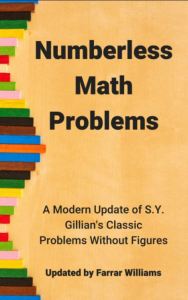
Discover Farrar Williams’s book Numberless Math Problems: A Modern Update of S.Y. Gillian’s Classic Problems Without Figures, available in ebook or paperback.

Williams writes: “In order to answer the question, they’ll have to explain it, because the problem doesn’t give you anything to calculate with. The only way to answer is by explaining your process. See how sneaky a numberless problem is? It makes students really think about the process of solving the problem.”

Find Out More

“When students face a word problem, they often revert to pulling all the numbers out and “doing something” to them. They want to add, subtract, multiply, or divide them, without really considering which operation is the right one to perform or why.

    “When you don’t have numbers, it sidesteps that problem.

      “For students who freeze up when they see the numbers, this can be a really good way to get them to think about their process with math.”

      —Farrar Williams, Math With No Numbers

      CREDITS: Feature photo (top) by saeed karimi via Unsplash.com.

      Multiplication Escape Room Game

      Ashly Latham, a student of the math-game superhero John Golden, has created an escape room game for third-grade students learning multiplication.

      What fun!

      https://youtu.be/7DCAAUJLCvM&rel=0

      Did your device hide the video? Find it on YouTube here.

      Read about the game at Math Hombre blog:

      What Is Multiplication, Anyway?

      At some point during the process of teaching multiplication to our children, we really need to come to terms with this question:

      What IS multiplication?

      https://youtu.be/FnqrpKiCNuE&rel=0

      Did your device hide the video? Find it on YouTube here.

      “What’s my answer? It’s not one that society’s going to like. Because society expects — demands, even — that mathematics be concrete, real-world, absolute, having definitive answers.

        I can’t give a definitive answer.

          Multiplication manifests itself in different ways. So maybe the word ‘is’ there is just too absolute. And it’s actually at odds with what mathematicians do.

            Mathematicians do attend to real-world, practical scenarios — by stepping away from them, looking at a bigger picture.”

            —James Tanton, What is Multiplication?

            For Further Study

            You may also enjoy these posts from my blog archive: