Homeschoolers, you can have your math and enjoy it, too! Play a mathematics game every day until Christmas at nrich.maths.org:
How to Be a Math Genius
Measure the Earth: Useful Links
To find the latitude of your position:
To convert your latitude to a distance measurement:
- GPS Latitude and Longitude Distance Calculator
Enter your latitude, but enter 0 (zero) for longitude. Then enter 0 for both latitude and longitude for the equator. Click to calculate your distance to the equator in meters, km, feet, or miles.
[I will also add these to the original post.]
Sept-Oct 2010 Math Calendars
As I was preparing for Wednesday’s Homeschool Math Club Games & Activities meeting, I remembered my old math calendars and thought, that would be a fun activity to offer. So I pulled up the files and discovered that the days of the week matched perfectly. What a cool coincidence!
So in case you missed the math calendars last year, or in case it’s been long enough that your children have forgotten, here are the “new” versions:
Addendum
Umm Ahmad created an easier version for young students:
The Arithmetic Fairy

[Photo by trazomfreak.]
Homeschool Freebie of the Day (which introduced me to Number Stories of Long Ago) shares another gem today: an mp3 recording of The Arithmetic Fairy, by E. Nesbit, one of my family’s favorite authors.
Young Edwin is an English schoolboy who deplores his daily math class. He wishes he could easily solve the problems he faces each day…
You can download the entire book of fairy tales from LibriVox:
“The Arithmetic Fairy” is chapter 7. Enjoy!
Word Problems from Literature
[Photo by Passion of Bilwa.]
I’ve put the word problems from my elementary problem solving series into printable worksheets:
The Cookie Factory Guide to Long Division
[Photo by scubadive67.]
Help! My son was doing fine in math until he started long division, but now he’s completely lost! I always got confused with all those steps myself. How can I explain it to him?
Long division. It’s one of the scariest of the Math Monsters, those tough topics of upper-elementary and middle school mathematics. Of all the topics that come up on homeschool math forums, perhaps only one (“How can I get my child to learn the math facts?”) causes parents more anxiety.
Most of the “helpful advice” I’ve seen focuses on mnemonics (“Dad/Mother/Sister/Brother” to remember the steps: Divide, Multiply, Subtract, Bring down) or drafting (turn your notebook paper sideways and use the lines to keep your columns straight).
I worry that parents are too focused on their child mastering the algorithm, learning to follow the procedure, rather than on truly understanding what is happening in long division.
An algorithm is simply a step-by-step recipe for doing a mathematical calculation. But WHY does the algorithm work? If our students could understand the reason for the steps, they wouldn’t have to work so hard on memory tricks.
Review: Math Mammoth
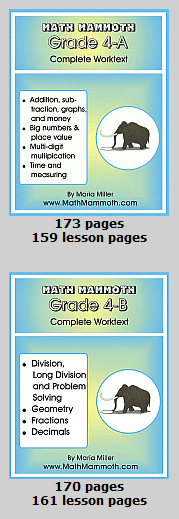
When Maria of Homeschool Math Blog asked if I would review her Math Mammoth curriculum, I jumped at the chance. I’ve always enjoyed her blog posts, and I liked the worksheets I had seen on her website. (Maria gives away more than 300 pages absolutely free!)
She sent me her then-new 4th grade worktexts, and Kitten and I dug in.

Well, that was longer ago than I care to admit. But of course, it takes quite a bit of daily use before one can be absolutely sure of one’s opinion about a homeschool program — or at least, it does for me. Too many times a homeschool resource will look great in the catalog, and we’ll start it with high hopes only to bog down in the day-to-day grind and abandon it after a few weeks or months. So I wanted to give Math Mammoth a thorough workout before I wrote this review.
And all excuses aside, I really am a pro at crastinating…
My aim is to help parents and teachers teach math so our children and students can really understand what is going on. I’ve strived to explain the concepts so that both the teacher and the student can “get it” by reading the explanations in the books.
— Maria Miller
author of Math Mammoth worktexts
and Homeschool Math Blog
Game: Target Number (or 24)
[Photo by stevendepolo via Flickr (CC BY 2.0).]
Math concepts: addition, subtraction, multiplication, division, powers and roots, factorial, mental math, multi-step thinking
Number of players: any number
Equipment: deck of math cards, pencils and scratch paper, timer (optional)
Set Up
All players must agree on a Target Number for the game. Try to choose a number that has several factors, which means there will be a variety of ways to make it. Traditionally, I start my math club students with a target of 24.
Shuffle the deck, and deal four cards face down to each player. (For larger target numbers, such as 48 or 100, deal five or six cards to each player.) The players must leave the cards face down until everyone is ready. Set the remainder of the deck to one side.
Prime Numbers Are like Monkeys
[Photo by mape_s.]
I’m afraid that Math Club may have fallen victim to the economy, which is worse in our town than in the nation in general. Homeschooling families have tight budgets even in the best of times, and now they seem to be cutting back all non-essentials. I assumed that last semester’s students would return, but I should have asked for an RSVP.
Still, Kitten and I had a fun time together. We played four rounds of Tens Concentration, since I had spread out cards on the tables in the library meeting room before we realized that no one was coming. Had to pick up the cards one way or another, so we figured we might as well enjoy them! She won the first two rounds, which put her in a good mood for our lesson.
I had written “Prime numbers are like monkeys!” on the whiteboard, and Kitten asked me what that meant. That was all the encouragement I needed to launch into my planned lesson, despite the frustrating dearth of students. The idea is taken from Danica McKellar’s book Math Doesn’t Suck.