Just as I was looking for a creative Valentine’s craft for Kitten, this showed up in my inbox:

Xi at 360 provides step-by-step instructions, with photos:
And for more Valentine’s Day fun:
Just as I was looking for a creative Valentine’s craft for Kitten, this showed up in my inbox:
Xi at 360 provides step-by-step instructions, with photos:
And for more Valentine’s Day fun:

<a href="http://www.flickr.com/photos/goetter/2352128932/"Photo by Raphael Goetter via Flickr
Alex and Leon enjoyed their baby sister, but they were amazed at how much work taking care of a baby could be. One particularly colicky night, everyone in the family took turns holding the baby, rocking the baby, patting her back, and walking her around before she finally succumbed to sleep.
Then Alex collapsed on the couch, and Leon sank into the recliner. They teased each other with these story problems.
Homeschoolers, you can have your math and enjoy it, too! Play a mathematics game every day until Christmas at nrich.maths.org:
To find the latitude of your position:
To convert your latitude to a distance measurement:
[I will also add these to the original post.]

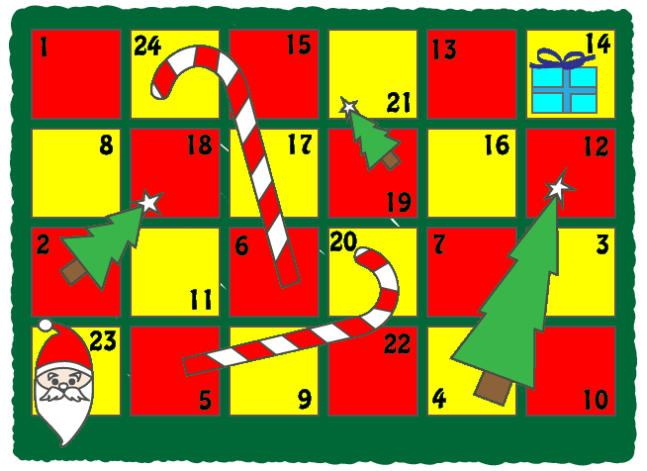
As I was preparing for Wednesday’s Homeschool Math Club Games & Activities meeting, I remembered my old math calendars and thought, that would be a fun activity to offer. So I pulled up the files and discovered that the days of the week matched perfectly. What a cool coincidence!
So in case you missed the math calendars last year, or in case it’s been long enough that your children have forgotten, here are the “new” versions:
Umm Ahmad created an easier version for young students:

[Photo by trazomfreak.]
Homeschool Freebie of the Day (which introduced me to Number Stories of Long Ago) shares another gem today: an mp3 recording of The Arithmetic Fairy, by E. Nesbit, one of my family’s favorite authors.
Young Edwin is an English schoolboy who deplores his daily math class. He wishes he could easily solve the problems he faces each day…
You can download the entire book of fairy tales from LibriVox:
“The Arithmetic Fairy” is chapter 7. Enjoy!
 [Photo by Passion of Bilwa.]
I’ve put the word problems from my elementary problem solving series into printable worksheets:

[Photo by scubadive67.]
Help! My son was doing fine in math until he started long division, but now he’s completely lost! I always got confused with all those steps myself. How can I explain it to him?
Long division. It’s one of the scariest of the Math Monsters, those tough topics of upper-elementary and middle school mathematics. Of all the topics that come up on homeschool math forums, perhaps only one (“How can I get my child to learn the math facts?”) causes parents more anxiety.
Most of the “helpful advice” I’ve seen focuses on mnemonics (“Dad/Mother/Sister/Brother” to remember the steps: Divide, Multiply, Subtract, Bring down) or drafting (turn your notebook paper sideways and use the lines to keep your columns straight).
I worry that parents are too focused on their child mastering the algorithm, learning to follow the procedure, rather than on truly understanding what is happening in long division.
An algorithm is simply a step-by-step recipe for doing a mathematical calculation. But WHY does the algorithm work? If our students could understand the reason for the steps, they wouldn’t have to work so hard on memory tricks.

When Maria of Homeschool Math Blog asked if I would review her Math Mammoth curriculum, I jumped at the chance. I’ve always enjoyed her blog posts, and I liked the worksheets I had seen on her website. (Maria gives away more than 300 pages absolutely free!)
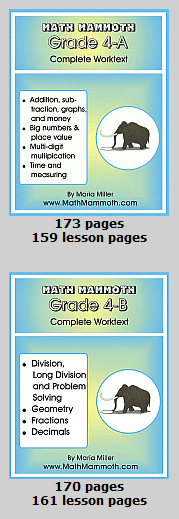 She sent me her then-new 4th grade worktexts, and Kitten and I dug in.
Well, that was longer ago than I care to admit. But of course, it takes quite a bit of daily use before one can be absolutely sure of one’s opinion about a homeschool program — or at least, it does for me. Too many times a homeschool resource will look great in the catalog, and we’ll start it with high hopes only to bog down in the day-to-day grind and abandon it after a few weeks or months. So I wanted to give Math Mammoth a thorough workout before I wrote this review.
And all excuses aside, I really am a pro at crastinating…
My aim is to help parents and teachers teach math so our children and students can really understand what is going on. I’ve strived to explain the concepts so that both the teacher and the student can “get it” by reading the explanations in the books.
— Maria Miller
author of Math Mammoth worktexts
and Homeschool Math Blog

