PUFM 1.4 Subtraction

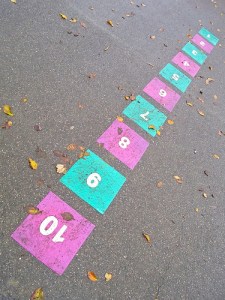
Photo by Martin Thomas via flickr. In this Homeschooling Math with Profound Understanding (PUFM) Series, we are studying Elementary Mathematics for Teachers and applying its lessons to home education.

When adding, we combine two addends to get a sum. For subtraction we are given the sum and one addend and must find the “missing addend”.

— Thomas H. Parker & Scott J. Baldridge
Elementary Mathematics for Teachers

Notice that subtraction is not defined independently of addition. It must be taught along with addition, as an inverse (or mirror-image) operation. The basic question of subtraction is, “What would I have to add to this number, to get that number?”

Inverse operations are a very fundamental idea in mathematics. The inverse of any math operation is whatever will get you back to where you started. In order to fully understand a math operation, you must understand its inverse.

Continue reading PUFM 1.4 Subtraction

Multiplication Challenge

Can you explain why the multiplication method in the following video works? How about your upper-elementary or middle school students — can they explain it to you?

Pause the video at 4:30, before he gives the interpretation himself. After you have decided how you would explain it, hit “play” and listen to his explanation.

Continue reading Multiplication Challenge

PUFM 1.3 Addition

Photo by Luis Argerich via flickr. In this Homeschooling Math with Profound Understanding (PUFM) Series, we are studying Elementary Mathematics for Teachers and applying its lessons to home education.

The basic idea of addition is that we are combining similar things. Once again, we meet the counting models from lesson 1.1: sets, measurement, and the numberline. As homeschooling parents, we need to keep our eyes open for a chance to use all of these models — to point them out in the “real world” or to weave them into oral story problems — so our children gain a well-rounded understanding of math.

Addition arises in the set model when we combine two sets, and in the measurement model when we combine objects and measure their total length, weight, etc.

One can also model addition as “steps on the number line”. In this number line model the two summands play different roles: the first specifies our starting point and the second specifies how many steps to take.

— Thomas H. Parker & Scott J. Baldridge
Elementary Mathematics for Teachers

Continue reading PUFM 1.3 Addition

Tell Me a (Math) Story

[Feature photo above by Keoni Cabral via Flickr (CC BY 2.0).]

My favorite playful math lessons rely on adult/child conversation — a proven method for increasing a child’s reasoning skills. What better way could there be to do math than snuggled up on a couch with your little one, or side by side at the sink while your middle-school student helps you wash the dishes, or passing the time on a car ride into town?

As soon as your little ones can count past five, start giving them simple, oral story problems to solve: “If you have a cookie and I give you two more cookies, how many cookies will you have then?”

The fastest way to a young child’s mind is through the taste buds. Children can easily visualize their favorite foods, so we use mainly edible stories at first. Then we expand our range, adding stories about other familiar things: toys, pets, trains.

Continue reading Tell Me a (Math) Story

Fibonacci Numbers and Plants

Have you ever wondered why so many plants grow in Fibonacci Numbers? Vi Hart offers a great explanation (with hands-on activities) in these three videos — and she introduces a new species called the slugcat, which my daughter thinks is adorable.

Spirals, Fibonacci, and Being a Plant [1 of 3]

Continue reading Fibonacci Numbers and Plants