

Do you know of any great math-related seasonal games, crafts, or activities I missed? Please add them to the comments section below.
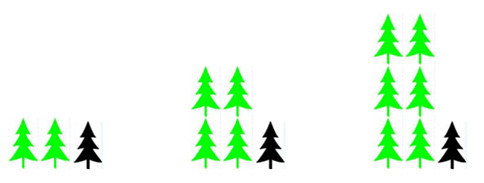
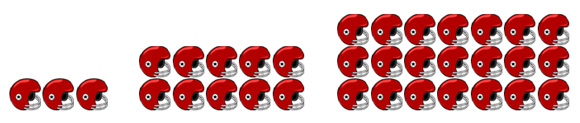
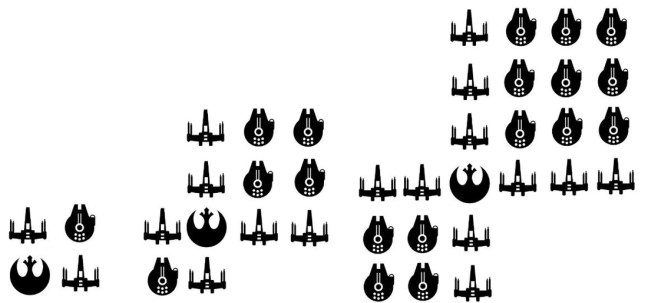
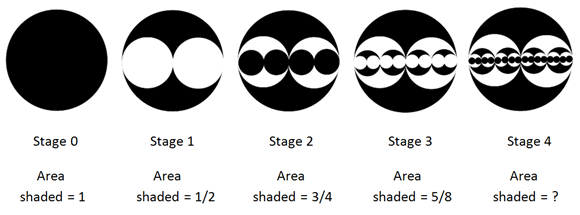
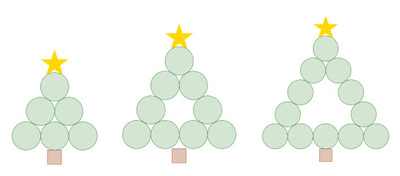
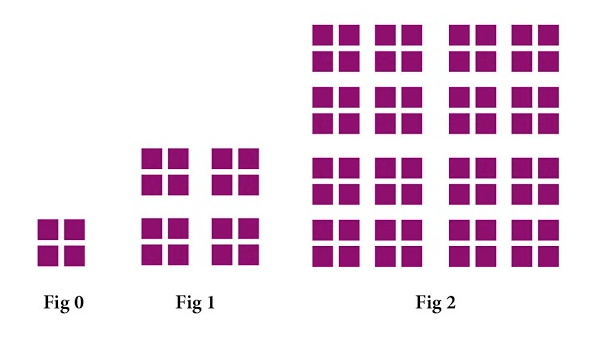
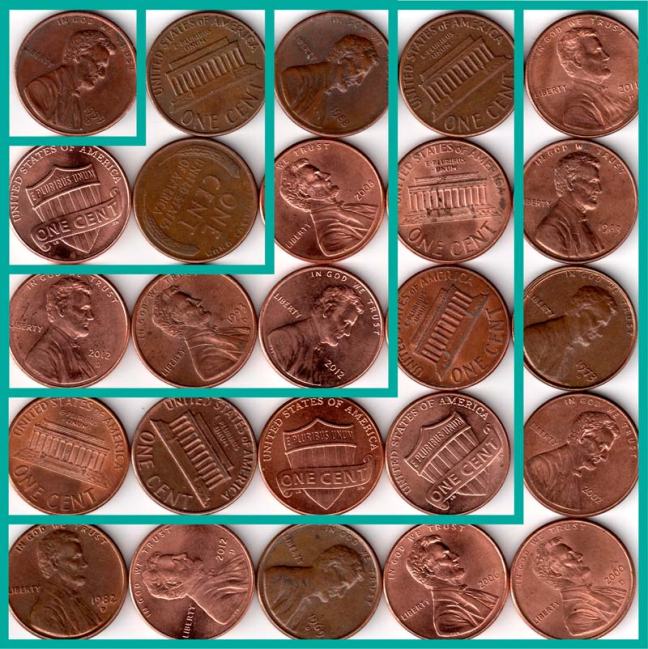
As you scroll through the links below, you find several puzzle graphics from the wonderful Visual Patterns website.
Use them as conversation-starters with your kids: What do you notice? How does each pattern grow?
For older students: Can you write a formula to describe how each pattern? What will it look at stage 43?
A Bit of Fun
Setting the mood: Enjoy this bit of seasonal fidgeting from Vi Hart. If you don’t understand some of the references, that’s normal! Pick a phrase, Google it, and enjoy the fun of learning something new.
- Vi Hart’s (@vihartvihart) Christmas and Winter Holidays page.
Advent Math Activity Calendars
Every year, some of my favorite websites offer a seasonal selection of activities to encourage your children’s (and your own!) mathematical creativity, one for each day in the run-up to Christmas.
Colleen Young updates the list every year, so check out her pages:

Let It Snow! Let It Snow! Let It Snow!
- Create math art with Sarah’s (@FrugalFun4Boys) Pattern Block Snowflakes. Or play around with her DIY Popsicle Stick Snowflake Building Kit.
- Chelsey (@buggyandbuddy) puts together a fun craft kit for her kids to make Symmetrical Snowflakes.
- Paula (@PaulaKrieg) celebrates paper-snowflake time and shares a new discovery: Spiraling Paper Ornament. These triskele globes made the perfect final project for my math classes last December.
- Erica (Erica Blawat) examines the math of Snow Crystal Geometry.
- Clarissa (@c0mplexnumber) demonstrates how to make beautiful, challenging origami snowflakes. She recommends beginners try the first few folds — which create a pretty cool design on their own. Let it Snow…
- Mathwire.com offers a grab-bag of hands-on winter math activity ideas for every elementary and middle school student on your list:
Winter math activities 2005
Winter math activities 2006
Winter math activities 2007
- K (@Ms_Kmp) reviews the distributive property with Algebra snowflakes and links to a make-your-own puzzle generator for math review at any level. Or download one of Craig’s (@mrbartonmaths) pre-made Tarsia Jigsaws.
Happy Hanukkah
- Karyn (@TeachBesideMe) shares a cool Hanukkah STEM activity: Paper Circuit Menorah. Or try making her Gingerbread House Paper Circuits.
- Brian (@Yummymath) examines the Hebrew calendar in Egad! It’s already time for Hanukkah. And check out his puzzle about the Soda Box Menorah.
- Ben (@benorlin) reveals The Terrible Truth About Dreidel.

Hands-on Holidays
- Have a big bag of colorful bows? Dyan (@andnextcomesl) suggests letting your kids try Graphing with Gift Bows. And be sure to save your wrapping paper tubes to make her Christmas Boredom Buster: Jingle Bell Run.
- I adore Svenja’s (meine.svenja) beautiful stained-glass Tracing-Paper Poinsettias.
- My math class had great fun with Matthew’s (@mscroggs) Christmas Flexagons (and more).
- Paula (@PaulaKrieg) will keep you busy into the new year with her Round-up of Holiday Season Projects.
- David (davidshaw) shares a 3-D Christmas present packing puzzle to keep your kids busy.
- Clarissa (@c0mplexnumber) and students are Folding Christmas Fractals.
- Adam (@mrslack_maths) challenges high school students’ geometry skills with these Christmas Constructions activities.
Following Yonder Star
- Jmommymom (@jmommymom) and kids create several types of Folded Paper Stars.
- Rohini (@RohiniWahi) is making DIY Origami Star Decorations.
- Charlotte (about) shows how to make a beautiful DIY Moravian Star Tree Topper.
- And Clarissa (@c0mplexnumber) links to instructions for a variety of Origami Christmas Decorations. And still More Origami Christmas Decorations (with an Outer Space theme).

Mathy Christmas Cards
- Vicky (@VickyMaths1729) creates geometric holiday cards: Solving for Xmas.
- Clarissa (@c0mplexnumber) demonstrates how to make a beautiful golden pentagram in Construct-a-Christmas-card.
- Or check out Fractal Foundation’s Fractal Cutout Pop-Up Card.
Santa Claus Is Coming
- Dear Santa: All I want for Christmas is a few pennies… A Penny for Your Math.
- Where does Santa leave a mathematician’s presents? In the Christmas Stocking Theorem!
- Chuckie (chuckieirish) challenges your students’ reasoning skills in the murder mystery Who Killed Santa? Or they can test their math-deduction ability in Whieldon’s (whieldon) Murder mystery for Christmas.
- Did you know that NORAD’s Santa Tracker began with A Typo And A Good Sport?
- Every year, physics-literalists have fun analyzing Santa’s magical journey:
The science behind Santa Claus
A Scientific Disproof of the Santa Theory, and a couple of Rebuttals Thereto
And for a mathemagical perspective: The Mathematics Of Santa Claus’ Present Delivery System

Rockin’ Around the Christmas Tree
- Chelsey (@buggyandbuddy) shares a cute Symmetry Christmas Tree Art Project for Kids. And you can decorate your real-world tree with her simple and surprisingly graceful Paper Strip Angel Ornament.
- Sarah’s (@FrugalFun4Boys) family works together to create this beautiful Christmas Tree Tessellation. Check out all their other Christmas crafts and Lego activity ideas.
- Karyn (@teachbesideme) turns Pascal’s Triangle into a coloring puzzle: Pascal’s Triangle Christmas Tree Math.
- Bethany (@mathgeekmama) offers a free printable game for addition and subtraction: Grow a Christmas Tree Farm. Older kids might enjoy her series of Christmas Math and Logic Puzzles.
- Graeme’s (@GraemeAnshaw) students explore area, fractions, and percentages with Mathematical Christmas Trees & Menorah Lamps.
- Jim (@teachmaths) challenges his high school students to use their math skills (and a bit of luck) in The Great Elf Game.
Puzzles Under the Tree
- Iva (@findthefactors) brings us A Gift-Wrapped Puzzle for the holidays. Or play with her Oh Christmas Tree and other Christmas multiplication puzzles.
- Challenge your students with the real-world problems in Brian’s (@Yummymath) Pre-Winter Holiday Activities. Or check out the latest additions to his collection of Annual Holiday Puzzles.
- Unfortunately, the holidays come smack in the middle of flu season. Did you come down with The Grinch Bug?
- Word puzzles are fun, too! Can your students Translate that Christmas Carol?

- Speaking of Christmas carols, the Christmas Price Index shows the current cost for one set of each of the gifts given in the song “The Twelve Days of Christmas.” I wonder what’s the cumulative cost of all the gifts, when you count each repetition in the song?
- Craig (@mrbartonmaths) links to A countdown of maths resources to see you through to the Christmas holidays.
- And try your hand at a few assorted Christmas math problems and puzzles from Transum. Or these challenge worksheets from Oxford University Press: Foundation Questions, and Shapes and Space.
- Can you solve Alex’s (@alexbellos) holiday puzzles about Christmas wish lists, Victorian mince pies, and present-sorting machines?
- For an algebra-1-level version (no logarithms), see Rafael’s (@OneMinuteMath) video Merry Christmas in Mathematics Language and Concepts.
Christmas Adventures with Alexandria Jones
Alexandria Jones and her family are fictional characters from my old Mathematical Adventures newsletter. Their stories appear sporadically as I find time to transcribe them from the back-issues. You can find them all on this blog page.
Here are all the Alexandria Jones stories Christmas stories, with activity and craft ideas…
- November/December 1998 Issue:
Alexandria Jones and the Christmas Present Quandary
A-Hunting They Will Go
The Golden Christmas Tree
Leon’s Christmas Gift
Magic Square Puzzles
Christmas Puzzle Answers
- November/December 1999 Issue:
Renee’s Platonic Mobile
The Graph-It Game
A New Graph-It Puzzle (non-religious)
- December 2000/January 2001 Issue:
Alexandria Jones and the Magic Christmas Cards
How to Make a Flexagon
A Polyhedra Construction Kit
The Mysterious Block Puzzle
What About Worksheets?
Do you need to keep your kids busy and work in a bit of math practice? Try these Christmas word problems:
- Christmas Candy and Presents (second grade)
- Holiday Shopping and Parties (third grade)
- Merry Christmas (middle school)
- Maths Relay Races (middle school)
- Happy Holidays (middle school)
- Santa’s Secret (middle/high school)
- Maths Christmas Puzzle Sheet (middle/high school)
- Maths Christmas Activities Booklet (middle/high school)
Or visit the sites below for worksheets to cover all ages:
- Christmas Math Activities From Math-Salamanders.com
- Christmas Themed Math Pages from KidZone.ws
- Christmas Math Worksheets, Lessons, and Printables from EduHelper.com
- Christmas Math Worksheets at Math-Drills.com
- Teachers Pay Teachers Christmas Freebies
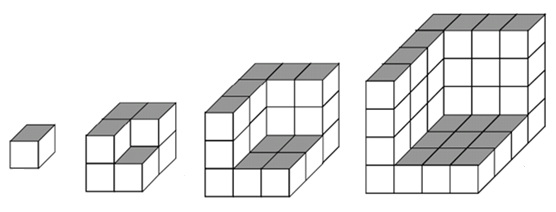
CREDITS: “Circle Packing” feature graphic (top) by fdecomite via Flickr (CC BY 2.0). Picture pattern puzzles from Visual Patterns website.

 articles from bloggers all across the internet.†




 I’d love to hear your favorite math explorations or journaling tips!





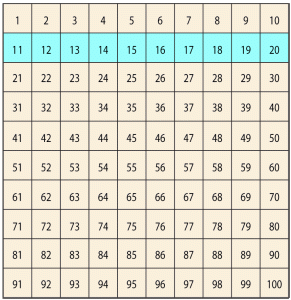
 of one hundred chart
 of that hundred chart
 of the pair of charts
 of the whole pair of charts.







 Denise Gaskins' Let's Play Math