[About the video.]
More ways to celebrate:

Photo of Lex times 11, by Dan DeChiaro, via flickr.
We are finishing up an experiment in mental math, using the world’s oldest interactive game — conversation — to explore multiplication patterns while memorizing as little as possible.
Take your time to fix each of these patterns in mind. Ask questions of your student, and let her quiz you, too. Discuss a variety of ways to find each answer. Use the card game Once Through the Deck (explained in part 3)as a quick method to test your memory. When you feel comfortable with each number pattern, when you are able to apply it to most of the numbers you and your child can think of, then mark off that row and column on your times table chart.
So far, we have studied the times-1 and times-10 families and the Commutative Property (that you can multiply numbers in any order). Then we memorized the doubles and mastered the facts built on them. And then last time we worked on the square numbers and their next-door neighbors.
“We have 4 equations and only 4 unknowns so that gives us a fighting chance of actually solving it.”
— My daughter’s Calculus III teacher
“Of course, he was doing an easy problem compared to the homework. 😛 ”
— My daughter, Niner

Photo of Miss Karen (and computer) times 3, by Karen, via flickr.
If you remember, we are in the middle of an experiment in mental math. We are using the world’s oldest interactive game — conversation — to explore multiplication patterns while memorizing as little as possible. So far, we have studied the times-1 and times-10 families and the Commutative Property (that you can multiply numbers in any order). Then we memorized the doubles and mastered the facts built on them.
Hooray! Moebius Noodles tipped the bucket. Thank you to everyone who chipped in!
The first Moebius Noodles game is a celebration of the Möbius strip. To play:
And for dinner tonight, try Möbius Marinara!
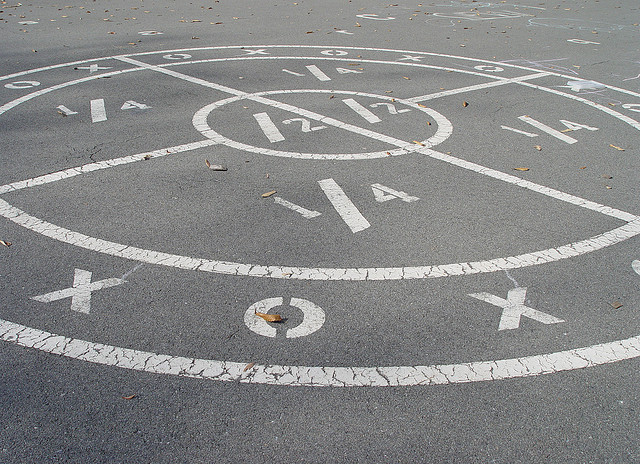
photo by Scott Robinson via flickr
A comment on my post Fraction Division — A Poem deserves a longer answer than I was able to type in the comment reply box. Whitecorp wrote:
Incidentally, this reminds me of a scene from a Japanese anime, where a young girl gets her elder sister to explain why 1/2 divided by 1/4 equals 2. The elder girl replies without skipping a heartbeat: you simply invert the 1/4 to become 4/1 and hence 1/2 times 4 equals 2.
The young one isn’t convinced, and asks how on earth it is possible to divide something by a quarter — she reasons you can cut a pie into 4 pieces, but how do you cut a pie into one quarter pieces? The elder one was at a loss, and simply told her to “accept it” and move on.
How would you explain the above in a manner which makes sense?
Would you love to introduce your preschoolers to the mind-stretching wonder of math? Check out Moebius Noodles, an open community of mathematical resources for parents and educators of young children.
Moebius Noodles activities and games use stuff you already have around the house to explore symmetry, fractals, functions, transformations, topology, and more, in a way that is accessible to babies and toddlers (and their parents!) and easily adapted to include older siblings.
Even a small donation will help this amazing project get off the ground — and Maria is offering a variety of “secret rewards” (like free books, or a secret-message game designed especially for your child) to those who chip in now.

Would you like to do math with your babies and toddlers — real math, not just counting and simple shapes — but don’t know how? For the last few years, Maria Droujkova has been teaching parents to do advanced, fun math with young children. I had the chance to lurk on a discussion group this summer and thoroughly enjoyed it. Now she is taking the next step — and you are invited to join in the fun!
The Moebius Noodles project includes:
Maria is offering a variety of “Secret Rewards” (including free copies of the Moebius Noodles book) to those who chip in toward the project. Check out her Moebius Noodles blog post for more information.

Photo of Javier times 4, by Javier Ignacio Acuña Ditzel, via flickr.
If you remember, we are in the middle of an experiment in mental math. We are using the world’s oldest interactive game — conversation — to explore multiplication patterns while memorizing as little as possible. Talk through these patterns with your student. Work many, many, many oral math problems together. Discuss the different ways you can find each answer, and notice how the number patterns connect to each other.
So far, we have mastered the times-1 and times-10 families and the Commutative Property (that you can multiply numbers in any order).
The MathCounts Club Program provides enrichment activities and puzzles for 6th-8th grade math clubs within schools — and homeschool groups may join, too! Participants receive a free Club in a Box Resource Kit, which includes the Club Resource Guide, two game boards to accompany one of the meeting plans, 12 MathCounts pencils, and a MathCounts tote bag for the coach. (Apparently they had good intentions, but they didn’t follow through. My box had no tote.)
A school (or homeschool group) may choose to participate in the Club Program, the competition or both programs. Since these programs can complement each other, any school that registers for the MathCounts competition automatically gets the Club in a Box Resource Kit, too.
For more information, check out these links:
 Denise Gaskins' Let's Play Math