Review: Math Doesn’t Suck

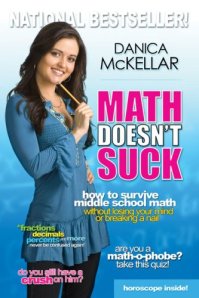
We’ve all heard the saying, Don’t judge a book by its cover, but I did it anyway. Well, not by the cover, exactly — I also flipped through the table of contents and read the short introduction. And I said to myself, “I don’t talk like this. I don’t let my kids talk like this. Why should I want to read a book that talks like this? I’ll leave it to the public school kids, who are surely used to worse.”

Okay, I admit it: I’m a bit of a prude. And it caused me to miss out on a good book. But now Danica McKellar‘s second book is out, and the first one has been released in paperback. A friendly PR lady emailed to offer me a couple of review copies, so I gave Math Doesn’t Suck a second chance.

I’m so glad I did.

Continue reading Review: Math Doesn’t Suck

Online Game: Math Caching

In the treasure-hunting game of Geocaching (pronounced “geo-cashing”), players use GPS systems to locate boxes hidden at different geographical locations across the country.

Now, the creative people at Mathbits.com have come up with an online treasure-hunting activity for junior high and high school students, called MathCaching. Students solve mathematical problems to find hidden “boxes” on the Internet. Each box reveals clues to the location of the next one.

The MathCaching game covers pre-algebra through trigonometry topics, with calculus levels under development. For more information, visit the MathCaching site, or read the post on my Frugal Homeschooling blog.

The Olympics: Math Puzzles and a Game


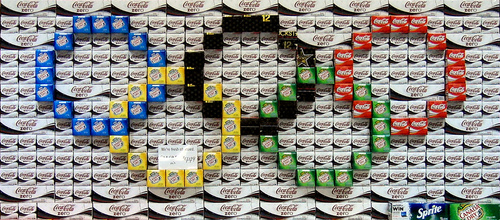
[Photo by striatic.]

Maybe it’s because school is out for the summer, but there don’t seem to be all that many Olympics-related math resources on the Web. I did find one cool game, however, and a nice stack of word problems. I hope you enjoy them!

Update: Be sure to see my blog post Olympic Logic for more links and puzzles!

Continue reading The Olympics: Math Puzzles and a Game

Free Math History: Number Stories of Long Ago

If you teach elementary children, check out this read-aloud math history resource from Homeschool Freebie of the Day:

Number Stories of Long Ago
by David Eugene Smith

[This download is available for one day only. If you missed it, see the end of this post for other ways to get the book.]

From the Preface

“These are the stories that were really told in the crisp autumn evenings, the Story Teller sitting by the fire that burned in the great fireplace in the cottage by the sea. These are the stories as he told them to the Tease and the rest of the circle of friends known as the Crowd. Sitting by the fire and listening to the stories, in the lights and shadows of the dancing flames they could see the forms of Ching and Lugal and all the rest with their curious dress of long ago…”

Continue reading Free Math History: Number Stories of Long Ago

Christmas in July Math Problem

[Photo by Reenie-Just Reenie.]

In honor of my Google searchers, to demonstrate the power of bar diagrams to model ratio problems, and just because math is fun…

Eccentric Aunt Ethel leaves her Christmas tree up year ’round, but she changes the decorations for each passing season. This July, Ethel wanted a patriotic theme of flowers, ribbons, and colored lights.

When she stretched out her three light strings (100 lights each) to check the bulbs, she discovered that several were broken or burned-out. Of the lights that still worked, the ratio of red bulbs to white ones was 7:3. She had half as many good blue bulbs as red ones. But overall, she had to throw away one out of every 10 bulbs.

How many of each color light bulb did Ethel have?

Before reading further, pull out some scratch paper. How would you solve this problem? How would you teach it to a middle school student?

Continue reading Christmas in July Math Problem

What’s Wrong with “Repeated Addition”?

[Photo by Alejandra Mavroski.]

Myrtle called it The article that launched a thousand posts…, and counting comments on this and several other blogs, that may not be too much of an exaggeration. Yet the discussion feels incomplete — I have not been able to put into words all that I want to say. Thus, at the risk of once again revealing my mathematical ignorance, I am going to try another response to Keith Devlin’s multiplication articles.

Let me state up front that I speak as a teacher, not as a mathematician. I am not qualified, nor do I intend, to argue about the implications of Peano’s Axioms. My experience lies primarily in teaching K-10, from elementary arithmetic through basic algebra and geometry. I remember only snippets of my college math classes, back in the days when we worried more about nuclear winter than global warming.

I will start with a few things we can all agree on…

Continue reading What’s Wrong with “Repeated Addition”?

Crazy 4 Math Contest

I heard of this contest in an e-mail from ClickSchooling:

Kids, share your creative math ideas! Describe how you use math in any activity you love to do — a sport, game, craft, hobby, or anything else.

Send in a description of the activity and how it uses math, as well as any drawing(s) or diagram(s). There are many great prizes to be won. Please ensure you’ve read and understand our contest’s rules and regulations before entering.

Sounds like fun! If you want to enter, act quickly. Entries must be submitted online by July 30th. Visit Crazy4Math.com for more information and to check out the winners from previous years.

Euclid’s Geometric Algebra

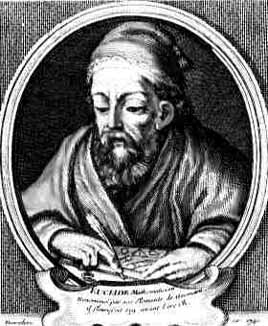
Picture from MacTutor Archives.

After the Pythagorean crisis with the square root of two, Greek mathematicians tried to avoid working with numbers. Instead, the Greeks used geometry to demonstrate mathematical concepts. A line can be drawn any length, so straight lines became a sort of non-algebraic variable.

You can see an example of this in The Pythagorean Proof, where Alexandria Jones represented the sides of her triangle by the letters a and b. These sides may be any length. The sizes of the squares will change with the triangle sides, but the relationship a^2 + b^2 = c^2 is always true for every right triangle.

Continue reading Euclid’s Geometric Algebra

If It Ain’t Repeated Addition, What Is It?

[Photo by SuperFantastic.]

Keith Devlin’s latest article, It Ain’t No Repeated Addition, brought me up short. I have used the “multiplication is repeated addition” formula many times in the past — for instance, in explaining order of operations. But according to Devlin:

Multiplication simply is not repeated addition, and telling young pupils it is inevitably leads to problems when they subsequently learn that it is not.

I found myself arguing with the article as I read it. (Does anybody else do that?) If multiplication is not repeated addition, then what in the world is it?

Continue reading If It Ain’t Repeated Addition, What Is It?