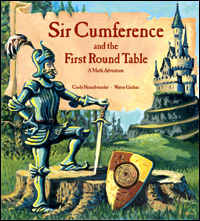
If you and your students have enjoyed the Sir Cumference picture book series, then you will love these two worksheets from Waltzing Matilda:
[Hat tip: Living and Loving Numbers forum.]
If you and your students have enjoyed the Sir Cumference picture book series, then you will love these two worksheets from Waltzing Matilda:
[Hat tip: Living and Loving Numbers forum.]

Photo by Sister72.
Dave at MathNotations offers another version of Nim that will give your students something to think about:
[1,2]-3-[4,5]-6-[7,8]…21 Helping Children Devise and Understand Winning Strategies
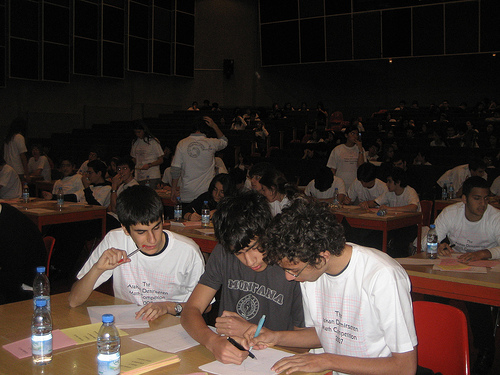
Photo by ccarlstead.
Congratulations, math team! All your hard work paid off, and I hope you enjoyed yourselves thoroughly. Of course, as C. S. Lewis wrote:
…if you do one good deed, your reward usually is to be set to do another and harder and better one.
Now it’s time to practice for the state level in March. You can find practice problems online at:
Preparation Drills for MATHCOUNTS
or
The “Go Figure!” math challenge
[ACK! MathCounts has re-written their website. The old link is no longer any good, but I haven’t yet found the new location for this game.]
And give the new interactive Countdown Round game a try:
Dave Marain of MathNotations is running a poll about how to teach multiplication, but the question has broader application:
How should we teach the arithmetic algorithms
— or should we teach them at all?
Algorithms are step-by-step methods for doing something. In arithmetic, we have standard algorithms for addition, subtraction, multiplication, and long division. Once the student masters the steps for any particular algorithm, he can follow the steps to a correct answer without ever thinking about what the numbers mean.
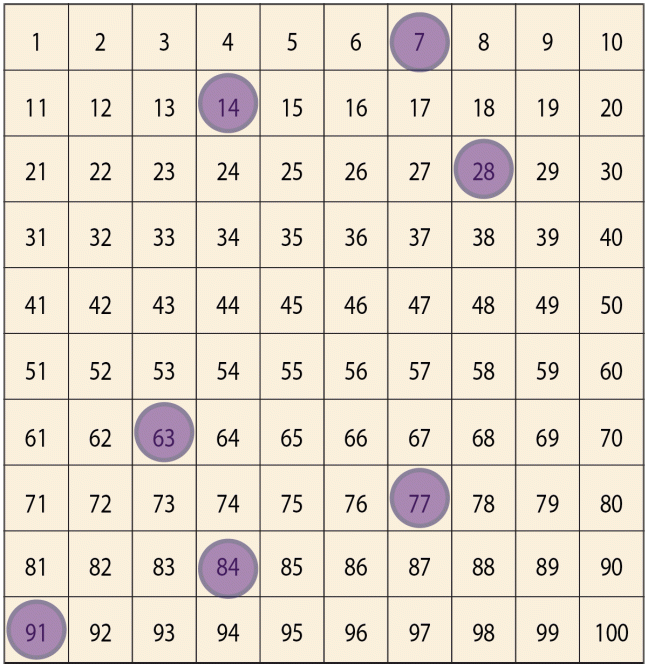
Math concepts: subtraction within 100, number patterns, mental math
Number of players: 2 or 3
Equipment: printed hundred chart (also called a hundred board), and highlighter or translucent disks to mark numbers — or use this online hundred chart
Place the hundred chart and highlighter where all players can reach them.
My pre-algebra class hit the topic of equations just as the NFL season moved into the playoffs. The result was this series of class notes called “The Game of Algebra.”
We used the Singapore Math NEM 1 textbook, which is full of example problems and quality exercises. These notes simply introduce or review the main concepts and vocabulary in a less-textbooky way.
I hope you find them useful.
Are you ready for a challenge? Join us for the 2008 Mathematics Game. Here are the rules:
Use the digits in the year 2008 and the operations +, -, x, ÷, sqrt (square root), ^ (raise to a power), and ! (factorial) — along with parentheses, brackets, or other grouping symbols — to write expressions for the counting numbers 1 through 100.
- All four digits must be used in each expression.
- Only the digits 2, 0, 0, 8 may be used.
- Multi-digit numbers such as 20, 208, or .02 MAY be used this year.
- The square function may NOT be used.
- The integer function may NOT be used.
By definition:
[See Dr. Math’s Why does 0 factorial equal 1?]
For this game we will accept the value:
[See the Dr. Math FAQ 0 to the 0 power.]

As we all head back to school, here are some interesting calendar puzzles:


UPDATE: Some of the links below have gone missing, as internet sites tend to do. Check out my *huge* new blog post:
We interrupt our regularly scheduled math program to bring you the following Christmas links…
First, A to Z Home’s Cool offers some fun for older students and teachers:
Also check out the annual Price of Christmas Index to see what the “12 Days of Christmas” gifts would cost you this year. Or explore the Nrich Advent Math Calendars to play with a new math activity every day until Christmas.
You can find just the song here: http://vihart.com/music/gauss12days.mp3.

Maria at Homeschool Math Blog has posted a fun set of worksheets:
Pan balance problems to teach algebraic reasoning.
Princess Kitten, at nearly 9yo, keeps telling me, “I hate math, but I like algebra.” So I printed all four pages for her to try. These get pretty complicated, and the 2-variable problems had her flummoxed for awhile. But after an explanation and bit of pouting (I think she hates math because she’s such a perfectionist that she can’t bear to get something wrong, even the first time), she came back and conquered the toughest ones.



 Denise Gaskins' Let's Play Math