Never Give Up

Have you read the Standards for Mathematical Practice? Good idea in theory, but horribly dull and stilted. Like math standards in general, the SMPs sound as if they were written by committee. (Duh!)

I’ve seen several attempts to rewrite the SMPs into student-friendly language. Many of those seem too over-simplified, almost babyish.

Probably I’m just too critical.

Anyway, I decided to try my hand at the project. Here’s the first installment…

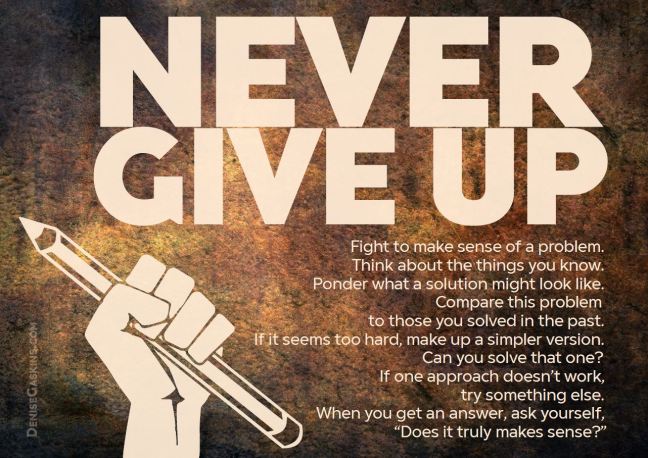
Math Tip # 1: Never Give Up.

  • Fight to make sense of a problem.
  • Think about the things you know.
  • Ponder what a solution might look like.
  • Compare this problem to those you solved in the past.
  • If it seems too hard, make up a simpler version. Can you solve that one?
  • If one approach doesn’t work, try something else.
  • When you get an answer, ask yourself, “Does it truly makes sense?”

Download the poster, if you like:

What do you think? Would this resonate with your students?

What changes do you suggest?

You can find the whole SMP series (eventually) under the tag: Posters.

Update: I Made a Thing

I had so much fun making these posters that I decided to put them into a printable activity guide. It includes the full-color poster shown above and a text-only version, with both also in black-and-white if you need to conserve printer ink.

Here’s the product description…

Join the Math Rebellion: Creative Problem-Solving Tips for Adventurous Students

Take your stand against boring, routine homework.

Fight for truth, justice, and the unexpected answer.

Join the Math Rebellion will show you how to turn any math worksheet into a celebration of intellectual freedom and creative problem-solving.

This 42-page printable activity guide features a series of Math Tips Posters (in color or ink-saving black-and-white) that transform the Standards for Mathematical Practice to resonate with upper-elementary and older students.

Available with 8 1/2 x 11 (letter size) or A4 pages.
Check It Out

More Math War with Special Decks

Just updated my blog post Math Game: War with Special Decks to add a couple of games I missed the first time around:

And…

If you’d like more ways to play with math from preschool to high school, check out My Favorite Math Games.

 
* * *

This blog is reader-supported.

If you’d like to help fund the blog on an on-going basis, then please join me on Patreon for mathy inspiration, tips, and an ever-growing archive of printable activities.

If you liked this post, and want to show your one-time appreciation, the place to do that is PayPal: paypal.me/DeniseGaskinsMath. If you go that route, please include your email address in the notes section, so I can say thank you.

Which I am going to say right now. Thank you!

“More Math War with Special Decks” copyright © 2020 by Denise Gaskins. “Red playing cards” photo by José Pablo Iglesias via Unsplash.com.

Prealgebra & Geometry Preorders

Math You Can Play series by Denise Gaskins

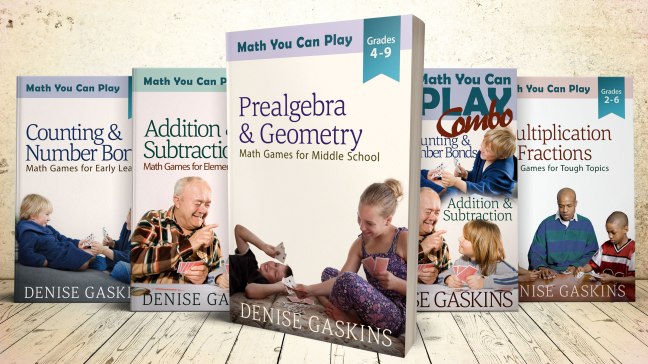
My book Prealgebra & Geometry: Math Games for Middle School is scheduled for release to regular bookstores in February, 2021. Because no publisher wants to send a new book into the world during such hectic, unsettled times as a big election, the winter holidays, or during inauguration season.

But preorder links are beginning to appear at several of the major online booksellers. And more stores will join them, as the information filters through their website systems.

The paperback will also be up for preorder, whenever the sites catch that update.

And remember: If you don’t favor a particular bookstore, you can buy the early-release ebook right now at my publisher’s webstore — and get a 10% discount if you order before 15 October.

Math Journals for Kids and Adults

Journaling is a fantastic way to learn and remember any topic — including math. That’s why I created my dot grid journals for kids and adults.

But I just discovered that my printer hates journals and blank books. They refuse to publish them any more.

How frustrating!

So from now on, you can only get my math journals from Amazon. The largest-river-in-the-world store doesn’t mind dot grid pages (so far).

Silver Lining: Because the books aren’t available to regular bookstores, I don’t have to allow for the traditional bookstore discount. Which means I can cut the prices. By a LOT — the new prices are 30% off the original cost of the books!

Continue reading Math Journals for Kids and Adults

Parallel and Perpendicular Art

I love this easy-but-beautiful math art project!

1. Print a page of dotty or lined graph paper for each student. You’ll also need a ruler and a large assortment of markers or colored pencils.

2. Students draw a line across the page, lining up their ruler with the grid points. The first line can be vertical, horizontal, or diagonal.

3. Keep drawing lines, but NEVER cross a line you’ve already drawn. Following the grid will create many lines parallel or perpendicular to each other. What angles can you identify?

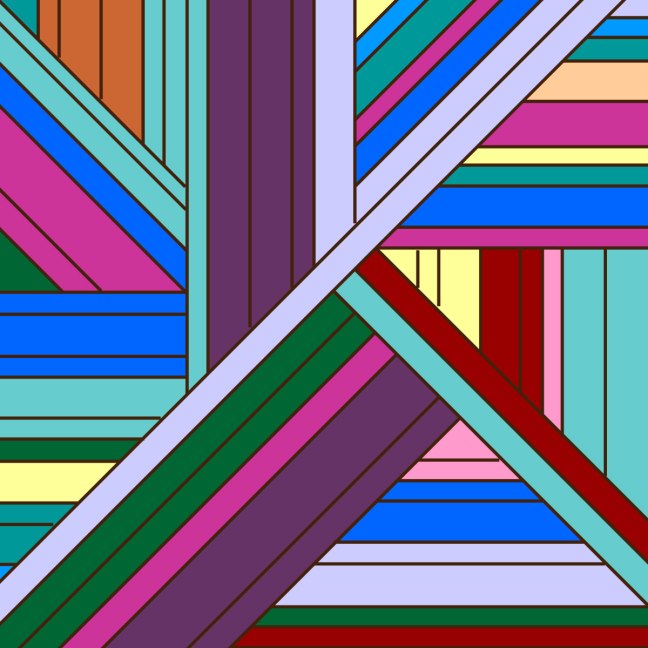
4. Color as desired. For a stained-glass effect, outline the colored areas with a black Sharpie marker.

Look for more math art ideas in my new book Geometric Coloring Designs 2: Create Your Own Art.

CREDITS: I saw this project at Cindy’s Love2Learn2Day blog. She got the idea from Zachary‘s MathActivities site.

FAQ: I’ve Ruined My Daughter

My daughter is only eleven, but I’m afraid I’ve ruined her chance of getting into college because she is so far behind in math. We’ve tried tutors, but she still has trouble, and standardized testing puts her three years below grade level. She was a late reader, too, so maybe school just isn’t her thing. What else can I do?

Standardized tests are not placement tests. They cannot tell you at what level your daughter should be studying. They aren’t designed that way. The “placement” they give is vague and general, not indicative of her grade level but rather a way of comparing her performance on that particular test with the performance of other students.

There can be many different reasons for a low score. I’ve listed a few of them in my post In Honor of the Standardized Testing Season.

Continue reading FAQ: I’ve Ruined My Daughter

Playing Math with Michael and Nash

Michael and Nash have been creating and posting new math games with astonishing regularity throughout the pandemic. Their YouTube channel is a great resource for parents who want to play math with elementary-age children.

Today’s entry: Closest to Ten, a quick game for addition and subtraction fluency with a tiny bit of multiplication potential.

And here’s one of my favorites for older players: Factor Triangles, a card game for 2-digit multiplication.

Check out their channel, and have fun playing math with your kids!

Visit Michael and Nash on YouTube

Prime Factor Art on a Hundred Chart

The best way to practice math is to play with it — to use the patterns and connections between math concepts in your pursuit of something fun or beautiful.

So this art project is a great way to practice multiplication. Use the prime factors of numbers from one to one hundred to create a colorful design.

Start with a Hundred Chart

First, download this printable file of hundred charts in non-photo blue (or light gray, if you’re printing in grayscale). The file includes:

  • Line-by-line traditional chart, counting from top to bottom.
  • Line-by-line bottom’s-up chart, counting from bottom to top.
  • Ulam’s Spiral chart, spiraling out from the center.
  • Blank grids for making your own patterns.

Download the Printable Charts

Continue reading Prime Factor Art on a Hundred Chart

Kenken is Mathematical Play

It’s back-to-school time here in the States. And that means it’s time for the Kenken Classroom Newsletter. Yay for math puzzles!

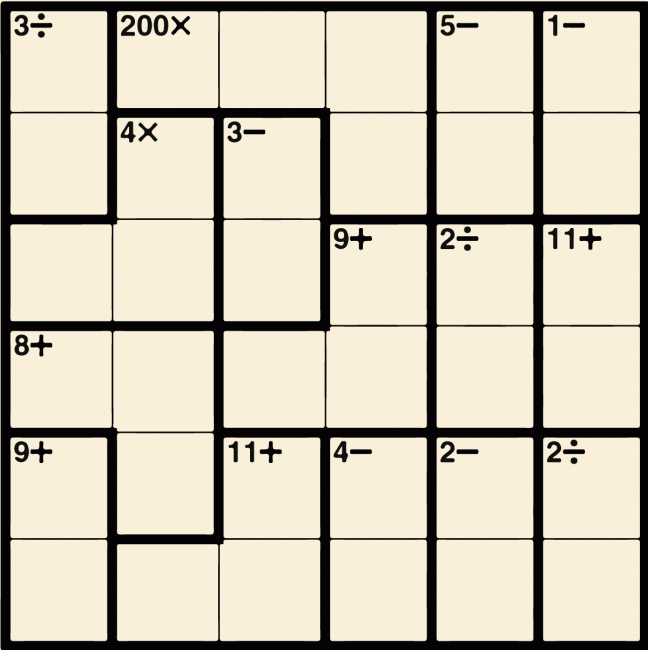
KenKen arithmetic puzzles build mental math skills, logical reasoning, persistence, and mathematical confidence.

Free via email every Friday during the school year.

What a great way to prepare your children for success in math!

Sign up anytime:

Click Here for KenKen Classroom Newsletter

Continue reading Kenken is Mathematical Play

The Best Math Game Ever

The Substitution Game features low-floor, high-ceiling cooperative play that works with any age (or with a mixed-age group) — and you can use it while distance learning, too. It’s great for building algebraic thinking.

Excerpted from my new book, Prealgebra & Geometry: Math Games for Middle School. Look for it at your favorite online bookstore.

The Substitution Game

Math Concepts: addition, subtraction, multiplication, division, order of operations, integers, fractions, equivalence and substitution.

Players: any number (a cooperative game).

Equipment: whiteboard and markers (preferred) or pencil and paper to share. Calculator optional.

Continue reading The Best Math Game Ever