The Creative Way To Help Your Kids Learn Math

Are you a parent, homeschooler, or teacher? Do your children struggle to learn math? Are you worried about them falling behind?

So many parents (and teachers, too!) feel like they are “not a math person,” yet they know how important math is for their children to learn. How can we teach something we don’t really understand ourselves?

Others feel comfortable with math themselves — and may even love it — yet still struggle to pass on their knowledge to their kids. How can we share the joy we see in numbers, shapes, and patterns with youngsters who think they hate math?

Continue reading The Creative Way To Help Your Kids Learn Math

Carnival 150: Keeping Playful Math Alive

Welcome to the 150th edition of the Playful Math Education Blog Carnival — a smorgasbord of delectable tidbits of mathy fun. It’s like a free online magazine devoted to learning, teaching, and playing around with math from preschool to high school.

Bookmark this post, so you can take your time browsing.

There’s so much playful math to enjoy!

We didn’t have a volunteer host for October, so I’m squeezing this in between extended-family situations that require my time. If you’d like to help keep the Playful Math Carnival alive, we desperately need hosts for 2022!

Try These Sum-Difference Puzzles

By tradition, we start the carnival with a puzzle/activity in honor of our 150th edition. This puzzle comes from the archives of Iva Sallay’s delightful Find the Factors blog.

Copy the puzzle diagrams below. Write numbers in the boxes to make true statements going uphill, and use the same numbers to make true statements going downhill:
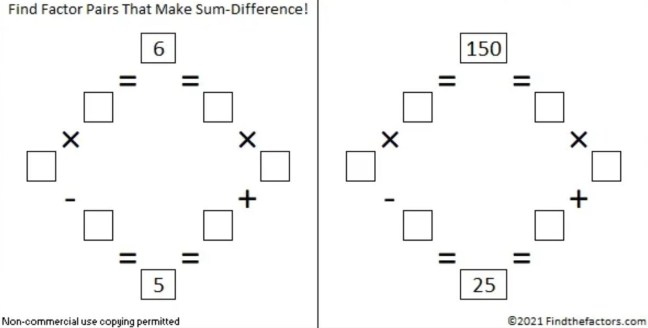
Six has two factor pairs. One of those factor pairs adds up to 5, and the other one subtracts to 5. Can you place those factors in the proper boxes to complete the first puzzle?

150 has six factor pairs. One of those factor pairs adds up to 25, and another one subtracts to 25. If you can identify those factor pairs, then you can complete the second puzzle!

How are the two puzzles related?

Iva also posts one of my favorite multiplication puzzles, her scrambled times tables. Check out puzzle #150 in this post (it’s Level 3, or medium difficulty) and then browser her site for plenty more.

Click here for all the mathy goodness!
Parents: Math Is Figure-Out-Able

I love listening to podcasts during my morning walk with the dogs. One of my favorites over the past year has been Pam Harris and Kim Montague’s Math is Figure-Out-Able podcast.

Figure-out-able. What a great word!

Figure-out-able sums up what I mean when I tell parents that math is “applied common sense.” Kids can use the things they know to figure out things they don’t yet know.

And figuring things out like that is fun, like a mental game where we play with the ideas of numbers, shapes, and patterns.

Usually, the podcast targets teachers, and the hosts try to show how they can help students learn to mathematize — to think mathematically. Over the past few weeks, however, Pam and Kim have been talking directly to parents about how to help their children learn math.

Continue reading Parents: Math Is Figure-Out-Able

Playful Math Education Carnival 147

Welcome to the 147th edition of the Playful Math Education Blog Carnival — a smorgasbord of delectable tidbits of mathy fun. It’s like a free online magazine devoted to learning, teaching, and playing around with math from preschool to high school.
Bookmark this post, so you can take your time browsing. There’s so much playful math to enjoy!

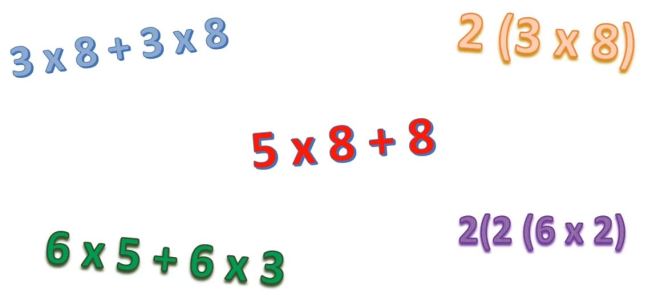
By tradition, we start the carnival with a puzzle in honor of our 147th edition. But if you’d rather jump straight to our featured blog posts, click here to see the Table of Contents.

Continue reading Playful Math Education Carnival 147

Playful Math Carnival 144: Anniversary Edition

Welcome to the 144th edition of the Playful Math Education Blog Carnival — a smorgasbord of delectable tidbits of mathy fun. It’s like a free online magazine devoted to learning, teaching, and playing around with math from preschool to high school.
Bookmark this post, so you can take your time browsing.

There’s so much playful math to enjoy!

By tradition, we would start the carnival with a puzzle/activity in honor of our 144th edition. But this time, I want to take a peek back at the history of our carnival.

But if you’d rather jump straight to our featured blog posts, click here to see the Table of Contents.

Continue reading Playful Math Carnival 144: Anniversary Edition

Math Journals and Creative Reasoning

Learning math requires more than mastering number facts and memorizing rules. At its heart, math is a way of thinking.

So more than anything else, we need to teach our kids to think mathematically. To make sense of math concepts and persevere in figuring things out. To notice the numbers, shapes, and patterns all around. To wonder about big ideas.

Journaling is a great way to help children learn to see with mathematical eyes. Not just to remember what we tell them, but to create their own math.

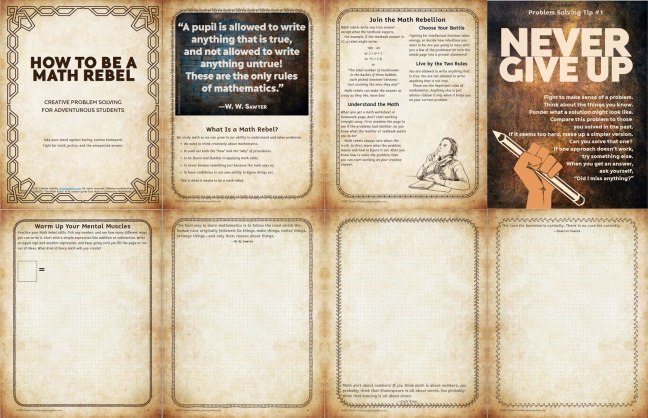
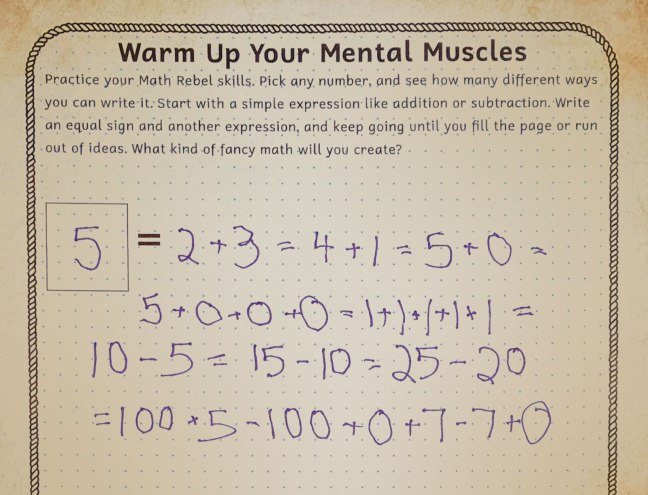
Get started with creative math journaling today. Visit the Make 100 Math Rebels Kickstarter page to download the free “How To Be a Math Rebel” sampler pictured above, which contains one of my all-time favorite math prompts.

Make 100 Math Rebels

It doesn’t matter whether your students are homeschooled or in a classroom, distance learning or in person. Everyone can enjoy the experience of playing around with math.

Puzzle from the free Math Rebel Sampler.

Continue reading Math Journals and Creative Reasoning

What Is Multiplication, Anyway?

At some point during the process of teaching multiplication to our children, we really need to come to terms with this question:

What IS multiplication?

Did your device hide the video? Find it on YouTube here.

“What’s my answer? It’s not one that society’s going to like. Because society expects — demands, even — that mathematics be concrete, real-world, absolute, having definitive answers.

    I can’t give a definitive answer.

      Multiplication manifests itself in different ways. So maybe the word ‘is’ there is just too absolute. And it’s actually at odds with what mathematicians do.

        Mathematicians do attend to real-world, practical scenarios — by stepping away from them, looking at a bigger picture.”

        —James Tanton, What is Multiplication?

        For Further Study

        You may also enjoy these posts from my blog archive:

        Memorizing the Times Table: A Life Skills Approach

        Continuing on my theme of times table facts, here’s the inimitable James Tanton:

        Did your device hide the video? Find it on YouTube here.

        “If our task is to memorize this table, please make it about mathematics — about thinking your way through a challenge, and what can I do to make my life easier.”

        —James Tanton, Making Memorising Multiplication Facts (if one really must) a meaningful Life Skill Lesson

        For Further Study

        You may also enjoy my blog post series about working through the times tables, paying attention to mathematical relationships (and a bit of prealgebra) along the way.

        Times Tables Series

        Click the button to see the whole series. Scroll down to the first post to go through it in order.

        Only Three Facts to Memorize

        A comment from a friend got me playing around with multiplication. I found a few videos from some of my favorite math people, so I’ll be sharing over the next few days.

        Here’s one from Sonya Post of Learning Well at Home. Also, Sonya just hosted Playful Math Education Carnival #143, which is well worth your time to explore!

        Did your device hide the video? Find it on YouTube here.

        “When students have to drill multiplication facts, it’s frustrating, unproductive and it makes them hate math. A better way to master the multiplication table is work on the skills that allow students to multiply quickly and efficiently.”

        —Sonya Post, Why We Don’t Drill Multiplication Facts – What We Do Instead

        Doubling and Halving

        Making doubles and halves are a great foundation for all sorts of math.

        Do you ever play the doubling game with your children? One player picks a starting number, and then you take turns doubling it until your mental math skills run out. How far can you go?

        Or try the halving game: One player chooses a starting number, and you take turns cutting it in half. How tiny can you go?

        As Sonya demonstrated, these skills help your child master their multiplication facts. And they are fantastic preparation for exponents and logarithms, too!

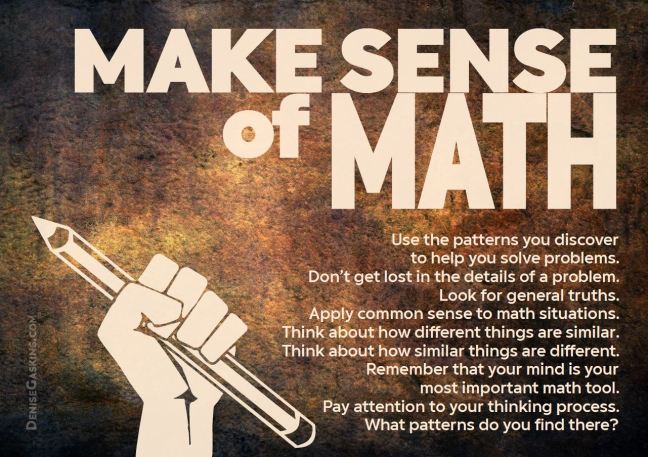
        Make Sense of Math

        So, I decided to rewrite the Standards for Mathematical Practice into student-friendly language.

        Here’s the final installment…

        Math Tip # 8: Make Sense of Math.

        • Use the patterns you discover to help you solve problems.
        • Don’t get lost in the details of a problem. Look for general truths.
        • Apply common sense to math situations.
        • Think about how different things are similar.
        • Think about how similar things are different.
        • Remember that your mind is your most important math tool.
        • Pay attention to your thinking process. What patterns do you find there?

        Continue reading Make Sense of Math