One of the best ways we can help our children learn mathematics (or anything else) is to always be learning ourselves.
Here are a few stories to read with your Friday morning coffee:
In the spirit of cracking eggs to make omelets, Michael Pershan cracks open some of the ideas around Equations and Equivalence and relational thinking.
“My experience is that when I have vague hope that children will learn something from an activity that is related to the mathematics I want them to learn, they usually don’t.”
Kathy Iwanicki’s students explore an unsolved math puzzle: the Hailstone Sequence. I think my co-op class might enjoy this activity, too.
If you want to understand how number concepts develop through the school years, Graham Fletcher’s Progression Videos are a great place to start. Watch, re-watch, and learn.
Clothesline math is a wonderful hands-on way for students to build number sense. And it’s not just for little kids! Check out Chris Luzniak’s unit circle clothesline project (and calculus, too).
Can applied math change the world? People can now move wheelchairs, control robots, and type using a portable wireless brain-machine interface. Wow!
“Learning occurs when we get something wrong and have to correct it. This is analogous to the much better known fact that when we subject our bodies to physical strain, say by walking, jogging, or lifting weights, the muscles we strain become stronger — we gain greater fitness. …
“Indeed, the learning is better if the correction occurs some time after the error is made. Stewing for a while in frustration at being wrong, and not seeing how to fix it, turns out to be a good thing. Cracking your ego is an unavoidable part of learning.”
On a lighter note, I’m sure any classroom or homeschool teacher can think of several ways to use Sara VanDerWerf’s collection of Math Fails. Scroll down for links to earlier collections, too.
“I told them that actually what they did was exactly what maths is — reasoning things out using the information you have and being able to be sure of your method and your answer. Just because there’s no symbols, it doesn’t mean it’s not maths.”
“I am not willing to teach mindless math. It leads to mindless adults. Thinking is not an add-on once they have memorized. Thinking is the basic tool to negotiate the world.”
Welcome to the 130th edition of the Playful Math Education Blog Carnival, a feast of delectable tidbits of mathy fun.
The Playful Math Carnival is like a free online magazine devoted to learning, teaching, and playing around with math. It’s back-to-school time in the U.S., so this month’s edition focuses on establishing a creative math mindset from preschool to high school.
You’re sure to find something that will delight both you and your child.
By tradition, we start the carnival with a puzzle in honor of our 130th edition. But if you would like to jump straight to our featured blog posts, use our handy Table of Contents.
One of the most common questions I get from parents who want to help their children enjoy math is, “Where do we start?”
My favorite answer: “Play games!”
Math games meet children each at their own level. The child who sits at the head of the class can solidify skills. The child who lags behind grade level can build fluency and gain confidence.
And (as Peggy Kaye pointed out in her book Games for Math) both will learn something even more important — that hard mental effort can be fun.
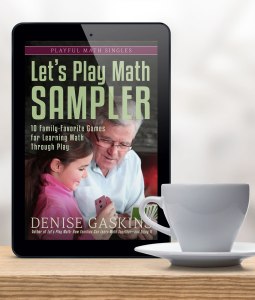
Now I’ve put together a short, inexpensive book to help families begin playing with math.
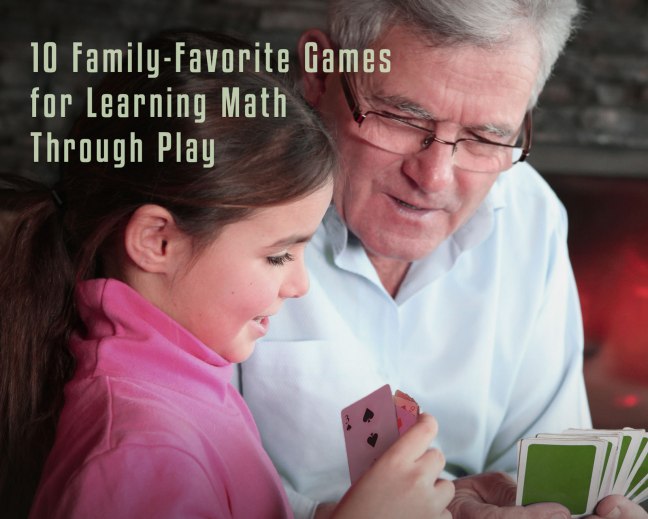
Let’s Play Math Sampler: 10 Family-Favorite Games for Learning Math Through Play contains short excerpts from my most popular books, including a preview of two games from my work-in-progress Prealgebra & Geometry Games.
“Denise Gaskins is that sound voice of reason that comes into my head when I get agitated teaching. This isn’t performance — this is play. My kids aren’t on trial, they are learning to learn.”
—Sonya Post
“By exploring math in a playful way, your kids will be happy to learn and will discover an enjoyment of math in the process. You might even have fun, too! ”
Hapollonian Holiday Greetings from my co-op class kids, and best wishes for a grace-filled holiday season.
Do you know of any great math-related seasonal games, crafts, or activities I missed? Please add them to the comments section below.
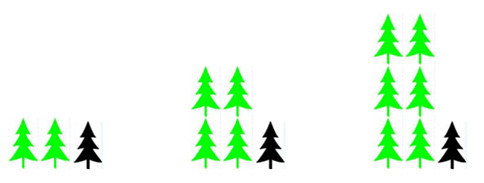
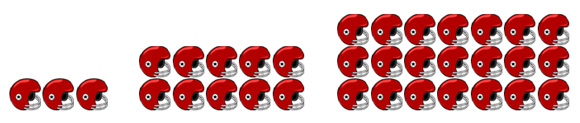
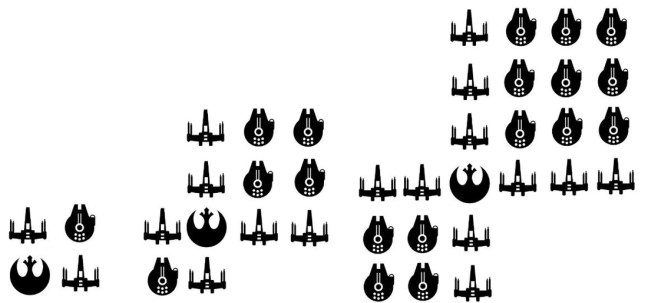
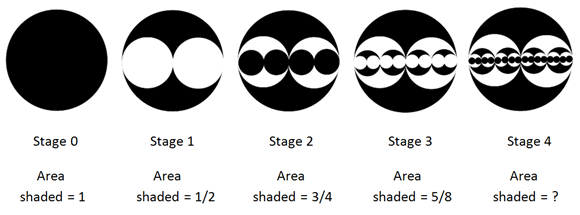
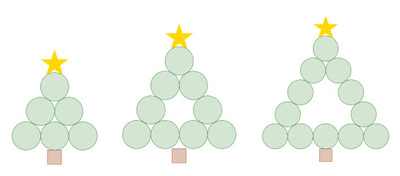
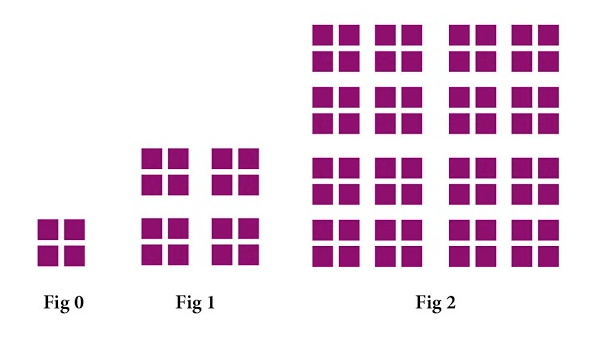
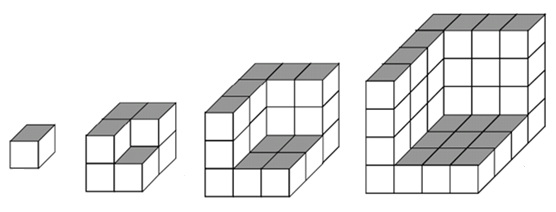
As you scroll through the links below, you find several puzzle graphics from the wonderful Visual Patterns website.
Use them as conversation-starters with your kids: What do you notice? How does each pattern grow?
For older students: Can you write a formula to describe how each pattern? What will it look at stage 43?
Pattern #7, Trees
A Bit of Fun
Setting the mood: Enjoy this bit of seasonal fidgeting from Vi Hart. If you don’t understand some of the references, that’s normal! Pick a phrase, Google it, and enjoy the fun of learning something new.
Every year, some of my favorite websites offer a seasonal selection of activities to encourage your children’s (and your own!) mathematical creativity, one for each day in the run-up to Christmas.
Colleen Young updates the list every year, so check out her pages:
Clarissa (@c0mplexnumber) demonstrates how to make beautiful, challenging origami snowflakes. She recommends beginners try the first few folds — which create a pretty cool design on their own. Let it Snow…
K (@Ms_Kmp) reviews the distributive property with Algebra snowflakes and links to a make-your-own puzzle generator for math review at any level. Or download one of Craig’s (@mrbartonmaths) pre-made Tarsia Jigsaws.
Speaking of Christmas carols, the Christmas Price Index shows the current cost for one set of each of the gifts given in the song “The Twelve Days of Christmas.” I wonder what’s the cumulative cost of all the gifts, when you count each repetition in the song?
Alexandria Jones and her family are fictional characters from my old Mathematical Adventures newsletter. Their stories appear sporadically as I find time to transcribe them from the back-issues. You can find them all on this blog page.
Here are all the Alexandria Jones stories Christmas stories, with activity and craft ideas…
The Playful Math Carnival is like a free online magazine devoted to learning, teaching, and playing around with math from preschool to high school. This month’s edition features articles from bloggers all across the internet.†
You’re sure to find something that will delight both you and your child.
By tradition, we start the carnival with a puzzle in honor of our 123rd edition. But if you would like to jump straight to our featured blog posts, click here to see the Table of Contents.
†Or more, depending on how you count. And on whether I keep finding things to squeeze in under the looming deadline. But if there are more, then there are certainly 36. Right?
Do the holidays mess with your schedule? They sure do mine!
Every year, we get busy. Distracted. Just can’t focus on lessons.
I love easy activities that require minimal preparation so I can pull something out and play when we’re having one of those no-energy days.
If that sounds good to you, too, then you’ll want to check out my new ebook 70+ Things To Do with a Hundred Chart: Number, Shape, and Logic Activities from Preschool to Middle School.
Long years ago, when I did workshops at homeschooling conferences, I used to share a list of seven ways to play with a hundred chart. The all-time most visited post on my blog offers 34 playful activities. Now I’ve more than doubled that total for this book.
So many ways to play! One of them is sure to be perfect for you and your children.
Take your child on a mathematical adventure with these playful, practical activities.
“It is exactly the kind of math exploration that I want to undertake with my kids.
“After reading through the book, I noticed myself making more room to trust my kids’ ability to make connections and not try to dominate by telling them how math ‘should’ work.
“An excellent way for me to move outside my math and teaching comfort zones and explore math more deeply with my kids.”
— Olisia Barron, author of ThimbleberryHome.wordpress.com
P.S.: If you have a blog and would like to host a giveaway for 70+ Things To Do with a Hundred Chart (or any of my other books), I’d be glad to provide the prize. Leave a comment below or use the contact form on my “About” page, and we’ll set up all the details.
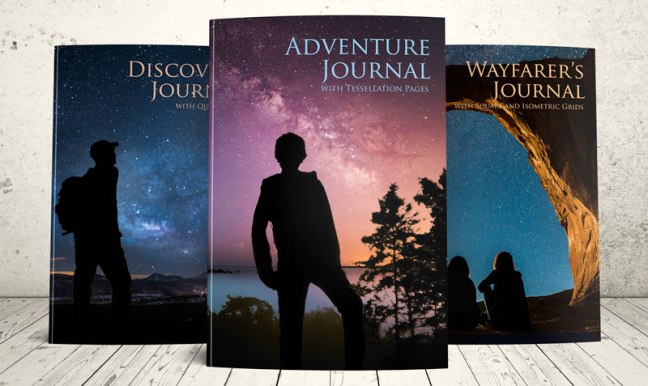
This fall, my homeschool co-op math class will play with math journaling.
But my earlier dot-grid notebooks were designed for adults. Too thick, too many pages. And the half-cm dot grid made lines too narrow for young writers.
So I created a new series of paperback dot-grid journals for my elementary and middle school students.
I’m sure we’ll use several of these activities in my homeschool co-op math class this fall.
Noticing and Wondering
Learning math requires more than mastering number facts and memorizing rules. At its heart, math is a way of thinking.
So more than anything else, we need to teach our kids to think mathematically — to make sense of math problems and persevere in figuring them out.
Help your children learn to see with mathematical eyes, noticing and wondering about math problems.
Whenever your children need to learn a new idea in math, or whenever they get stuck on a tough homework problem, that’s a good time to step back and make sense of the math.
Kids can write their noticings and wonderings in the math journal. Or you can act as the scribe, writing down (without comment) everything child says.
For more tips on teaching students to brainstorm about math, check out these online resources from The Math Forum:
Problem-solving is a habit of mind that you and your children can learn and grow in. Help your kids practice slowing down and taking the time to fully understand a problem situation.
Puzzles Are Math Experiments
Almost anything your child notices or wonders can lead to a math experiment.
For example, one day my daughter played an online math game…
A math journal can be like a science lab book. Not the pre-digested, fill-in-the-blank lab books that some curricula provide. But the real lab books that scientists write to keep track of their data, and what they’ve tried so far, and what went wrong, and what finally worked.
Here are a few open-ended math experiments you might try:
Explore Shapes
Pick out a 3×3 set of dots. How many different shapes can you make by connecting those dots? Which shapes have symmetry? Which ones do you like the best?
What if you make shapes on isometric grid paper? How many different ways can you connect those dots?
Limit your investigation to a specific type of shape. How many different triangles can you make on a 3×3 set of dots? How many different quadrilaterals? What if you used a bigger set of dots?
Explore Angles
On your grid paper, let one dot “hold hands” with two others. How many different angles can you make? Can you figure out their degree without measuring?
Are there any angles you can’t make on your dot grid? If your paper extended forever, would there be any angles you couldn’t make?
Does it make a difference whether you try the angle experiments on square or isometric grid paper?
Explore Squares
How many different squares can you draw on your grid paper? (Don’t forget the squares that sit on a slant!) How can you be sure that they are perfectly square?
Number the rows and columns of dots. Can you find a pattern in the corner positions for your squares? If someone drew a secret square, what’s the minimum information you would need to duplicate it?
Does it make a difference whether you try the square experiments on square or isometric grid paper?
I’d love to hear your favorite math explorations or journaling tips!
Please share in the comments section below.
* * *
P.S.: Do you have a blog? If you’d like to feature a math journal review and giveaway, I’ll provide the prize. Send a message through my contact form or leave a comment below, and we’ll work out the details.
This blog is reader-supported.
If you’d like to help fund the blog on an on-going basis, then please head to my Patreon page.
If you liked this post, and want to show your one-time appreciation, the place to do that is PayPal: paypal.me/DeniseGaskinsMath. If you go that route, please include your email address in the notes section, so I can say thank you.
Welcome to the 115th edition of the Playful Math Education Blog Carnival — a smorgasbord of links to bloggers all around the internet who have great ideas for learning, teaching, and playing around with math from preschool to pre-college.
In honor of Women’s History Month, this carnival features quotes from fifteen women mathematicians.
They came from many countries and followed a variety of interests.
They conquered new topics in mathematics and expanded the world’s understanding of old ones.
They wrestled with theorems, raised children, published articles, won awards, faced discrimination, led professional organizations, and kept going through both success and failure.
Some gained international renown, but most enjoyed quiet lives.
They studied, learned, and lived (and some still live) as most of us do — loving their families and friends, joking with colleagues, hoping to influence students.
I think you’ll find their words inspiring.
“What I really am is a mathematician. Rather than being remembered as the first woman this or that, I would prefer to be remembered, as a mathematician should, simply for the theorems I have proved and the problems I have solved.”
—Julia Robinson (1919–1985)
“All in all, I have found great delight and pleasure in the pursuit of mathematics. Along the way I have made great friends and worked with a number of creative and interesting people. I have been saved from boredom, dourness, and self-absorption. One cannot ask for more.”
—Karen Uhlenbeck (b. 1942)









 articles from bloggers all across the internet.†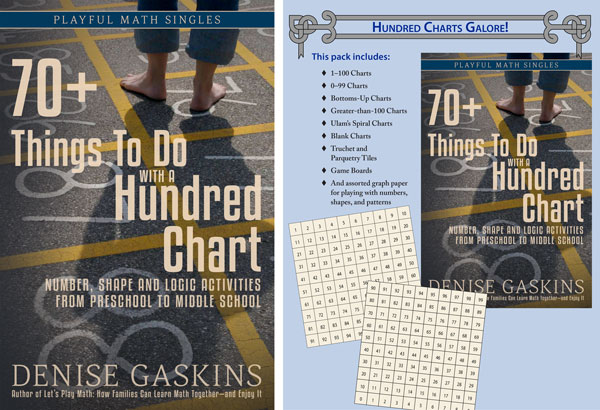


 I’d love to hear your favorite math explorations or journaling tips!
 Welcome to the 115th edition of the Playful Math Education Blog Carnival — a smorgasbord of links to bloggers all around the internet who have great ideas for learning, teaching, and playing around with math from preschool to pre-college.

 Denise Gaskins' Let's Play Math