A Revolutionary New Approach to Homeschool Math

There’s a great new homeschool math program that can radically transform your children’s experience of math, building understanding through creative exploration.

First, a bit of history…

What Is Algebra Before Arithmetic?

Back when I was still homeschooling, I read a couple of articles by Keith Devlin about the benefits of teaching children algebra, even before they study numbers.

As a homeschooler leaning toward Charlotte Mason-style education, I found the notion of algebra-first math intriguing. What if we could introduce students to the big ideas of math, the foundational concepts that explain how numbers relate, before they get distracted by details like math facts and memorized rules?

Continue reading A Revolutionary New Approach to Homeschool Math

Playful Math Education 162: The Math Games Carnival

Welcome to the 162nd edition of the Playful Math Education Blog Carnival — a smorgasbord of delectable tidbits of mathy fun. It’s like a free online magazine devoted to learning, teaching, and playing around with math from preschool to high school.

Bookmark this post, so you can take your time browsing.

There’s so much playful math to enjoy!

By tradition, we start the carnival with a puzzle/activity in honor of our 162nd edition. But if you’d rather jump straight to our featured blog posts, click here to see the Table of Contents.

Try This Puzzle/Activity

The number 162 is a palindromic product:

162 = 3 x 3 x 2 x 3 x 3
and 162 = 9 x 2 x 9

  • How would you define palindromic products?
  • What other numbers can you find that are palindromic products?
  • What do you notice about palindromic products?
  • What questions can you ask?

Make a conjecture about palindromic products. (A conjecture is a statement you think might be true.)

Make another conjecture. How many can you make? Can you think of a way to investigate whether your conjectures are true or false?

Click here for all the mathy goodness!

The Colors-of-Fall Carnival: Playful Math #160

Welcome to the 160th edition of the Playful Math Education Blog Carnival — a smorgasbord of delectable tidbits of mathy fun. It’s like a free online magazine devoted to learning, teaching, and playing around with math from preschool to high school.

Bookmark this post, so you can take your time browsing.

There’s so much playful math to enjoy!

By tradition, we start the carnival with a puzzle/activity in honor of our 160th edition. But if you’d rather jump straight to our featured blog posts, click here to see the Table of Contents.

Try This Puzzle/Activity

Appropriately for an October carnival, 160 is an evil number.

A number is evil if it has an even number of ones in binary form. Can you find the binary version of 160? (Hint: Exploding Dots.)

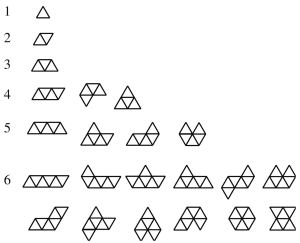
160 is also a polyiamond number. If you connect 9 equilateral triangles side-to-side, a complete set of 9-iamond shapes would have 160 pieces.

But sets that large can be overwhelming. Try playing with smaller sets of polyiamonds. Download some triangle-dot graph paper and see how many different polyiamond shapes you can make.

What do you notice? Does it make you wonder?

What designs can you create with your polyiamonds?


Photo by Daiga Ellaby on Unsplash

Click here for all the mathy goodness!

Numberless Word Problems

As I mentioned yesterday, my new book includes links to online resources to help you play with word problems. So this week, I’m sharing a few of my favorites.

Visit the Kickstarter

Today we examine a time-tested method to help kids reason about math: Leave out the numbers.

First up, there’s Brian Bushart’s numberless problem bank for young students. Then we’ll look at Farrar Williams’s modern revision of a math teaching classic with problems for upper-elementary and middle school students.

Have fun thinking math with your kids!

Word Problem Bank

Word problems are commonplace in mathematics classrooms, and yet they regularly confound students and lead to frustrated teachers saying things like:

  • “They just add all the numbers! It doesn’t matter what the problem says.”
  • “They don’t stop to think! They just start computing as soon as they’re done reading the problem.”

Brian Bushart offers a collection of ready-to-go slide presentations that walk through the steps of making a word problem make sense.

Visit the Site

Math With No Numbers

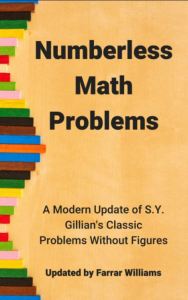
Discover Farrar Williams’s book Numberless Math Problems: A Modern Update of S.Y. Gillian’s Classic Problems Without Figures, available in ebook or paperback.

Williams writes: “In order to answer the question, they’ll have to explain it, because the problem doesn’t give you anything to calculate with. The only way to answer is by explaining your process. See how sneaky a numberless problem is? It makes students really think about the process of solving the problem.”

Find Out More

“When students face a word problem, they often revert to pulling all the numbers out and “doing something” to them. They want to add, subtract, multiply, or divide them, without really considering which operation is the right one to perform or why.

    “When you don’t have numbers, it sidesteps that problem.

      “For students who freeze up when they see the numbers, this can be a really good way to get them to think about their process with math.”

      —Farrar Williams, Math With No Numbers

      CREDITS: Feature photo (top) by saeed karimi via Unsplash.com.

      6th Grade Minimalist Math Curriculum

      For details on using a Minimalist Math Curriculum, see my earlier post How To Make Time for Exploration.

      If you’re teaching or homeschooling students in 6th grade, here’s the new minimalist curriculum link:

      As I mentioned in my earlier post, a minimalist curriculum can be a great way to free up time for playing math games and exploring enrichment activities (like these).

      How To Make Time for Exploration

      Perhaps the most common objection I hear to using math games and enrichment activities is, “I don’t have the time. I can’t even get through our regular math book!”

      Well, here’s one possible solution: Use a “Minimalist Math” outline to guide your instruction, turning your regular textbook into a backup resource, teaching only the topics your children don’t already know, leaving more time free for exploration and playful discovery.

      Minimalist Math: Getting Down to Basics

      Michelle at ResearchParent.com condensed the elementary math curriculum down to 360 problems per year, just 10 per week.

      Take just a few puzzles each day, and talk math with your kids:

      • What do they notice in the problem?
      • Does it remind them of anything?
      • How might they try to figure it out?
      • Does it make them wonder about numbers, shapes, or patterns?

      Use colorful markers on a whiteboard for low-stress exploration. If your children can solve a problem and explain their reasoning, you don’t need to study that topic. When they get stuck, follow the Notice-Wonder-Create method described in this blog post series.

      If you’re both stymied, that’s when you pull out your regular textbook (or look the topic up online).

      Practice with Games

      Of course, children still need plenty of practice to master the math facts and solidify their knowledge.

      Since you’re not spending as much time on lessons and homework, you can plan on playing lots of math games. Games are a fun, low-stress way to firm up math skills.

      Check out My Best (Free) Math Games for All Ages, and follow the Math Game Monday posts on my blog.
      Read Library Books

      To enrich your child’s mind with the great ideas of mathematics and whet their appetite for learning, nothing beats a “living” math book.

      A living book is one that brings our minds into direct contact with the great ideas of life.

      Check out my Math with Living Books lists to get started, and ask your librarian for more suggestions.

      For Older Students

      Michelle’s Minimalist Math Curriculum goes through 6th grade (so far). But you could use the Corbettmaths 5-a-Day problems in the same way for older students.

      And for enrichment activities to fill up your free math time, I can’t think of a better resource for all ages than the NrichMaths website.

      “When I first started homeschooling, math became the most overwhelming, unpleasant part of our day. As someone who loves math, I didn’t want to continue on a path that was leading to such bad attitudes.

      “My Minimalist Math Curriculum covers the same breadth of topics as a traditional curriculum without all the repetition. You are welcome to use what I created in whatever way serves your family.”

      Michelle, Research Parent
      Mathematics Activities for Kids

       
      * * *

      This blog is reader-supported.

      If you’d like to help fund the blog on an on-going basis, then please join me on Patreon for mathy inspiration, tips, and an ever-growing archive of printable activities.

      If you liked this post, and want to show your one-time appreciation, the place to do that is PayPal: paypal.me/DeniseGaskinsMath. If you go that route, please include your email address in the notes section, so I can say thank you.

      Which I am going to say right now. Thank you!

      “How To Make Time for Exploration” copyright © 2022 by Denise Gaskins. Image at the top of the post copyright © Aron Visuals, Andrew Ebrahim, and Melissa Askew via Unsplash.com.

      Playful Math Carnival #154: The Math Journaling Edition

      Welcome to the 154th edition of the Playful Math Education Blog Carnival — a smorgasbord of delectable tidbits of mathy fun. It’s like a free online magazine devoted to learning, teaching, and playing around with math from preschool to high school.

      Bookmark this post, so you can take your time browsing.

      There’s so much playful math to enjoy!

      By tradition, we start the carnival with a puzzle/activity in honor of our 154th edition. But if you’d rather jump straight to our featured blog posts, click here to see the Table of Contents.

      Try This Puzzle/Activity

      Since 154 is a nonagonal number, I think you might enjoy visiting some of my old “Adventures of Alexandria Jones” posts about figurate numbers:

      And then try this math journaling prompt: Build or draw your own nonagonal numbers — numbers built from 9-sided polygons.

      How many nonagonal numbers can you find? What do you notice? Does it make you wonder?

      Click here for all the mathy goodness!

      5 Ways To Enrich Your Student’s Experience of Math

      In previous posts, I encouraged parents, homeschoolers, and teachers to explore the world of math and introduced one of my favorite learning tools, the math journal.

      But you may be wondering, what can my students do with their journal? How do I find good math prompts?

      Here are five different ways your children can explore math through writing, classified by the type of reasoning involved.

      #1: Game Prompts

      Ask your children to play a number or strategy game and then write about it.

      Game prompts break through the idea that math is dull and boring. They help students develop a positive attitude toward math while practicing their number skills or strategic thinking.

      Continue reading 5 Ways To Enrich Your Student’s Experience of Math

      The Creative Way To Help Your Kids Learn Math

      Are you a parent, homeschooler, or teacher? Do your children struggle to learn math? Are you worried about them falling behind?

      So many parents (and teachers, too!) feel like they are “not a math person,” yet they know how important math is for their children to learn. How can we teach something we don’t really understand ourselves?

      Others feel comfortable with math themselves — and may even love it — yet still struggle to pass on their knowledge to their kids. How can we share the joy we see in numbers, shapes, and patterns with youngsters who think they hate math?

      Continue reading The Creative Way To Help Your Kids Learn Math

      Carnival 150: Keeping Playful Math Alive

      Welcome to the 150th edition of the Playful Math Education Blog Carnival — a smorgasbord of delectable tidbits of mathy fun. It’s like a free online magazine devoted to learning, teaching, and playing around with math from preschool to high school.

      Bookmark this post, so you can take your time browsing.

      There’s so much playful math to enjoy!

      We didn’t have a volunteer host for October, so I’m squeezing this in between extended-family situations that require my time. If you’d like to help keep the Playful Math Carnival alive, we desperately need hosts for 2022!

      Try These Sum-Difference Puzzles

      By tradition, we start the carnival with a puzzle/activity in honor of our 150th edition. This puzzle comes from the archives of Iva Sallay’s delightful Find the Factors blog.

      Copy the puzzle diagrams below. Write numbers in the boxes to make true statements going uphill, and use the same numbers to make true statements going downhill:

      Six has two factor pairs. One of those factor pairs adds up to 5, and the other one subtracts to 5. Can you place those factors in the proper boxes to complete the first puzzle?

      150 has six factor pairs. One of those factor pairs adds up to 25, and another one subtracts to 25. If you can identify those factor pairs, then you can complete the second puzzle!

      How are the two puzzles related?

      Iva also posts one of my favorite multiplication puzzles, her scrambled times tables. Check out puzzle #150 in this post (it’s Level 3, or medium difficulty) and then browser her site for plenty more.

      Click here for all the mathy goodness!