Are You Smarter than a 3rd-6th Grader?

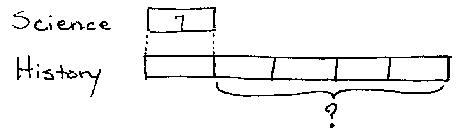
Here are a few challenging word problems from Singapore:

I did fine on the 3rd-grade problems, but I stumbled a bit on the 4/5th-grade “How much sugar…” problem. The toy cars were tricky, but manageable. I misread the problem with the chocolate and sweets at first — I think of chocolates as a sub-category of sweets, but in this problem they are totally different. (Perhaps “sweets” are what I would call “hard candy”?) Finally, I had to resort to algebra for the last two Grade 6 questions.

How many can you solve?

Alex’s Puzzling Papyrus

(In the last episode, Dr. Fibonacci Jones discovered a torn scrap of papyrus, covered with hieroglyphic numbers. He promised to teach his daughter, Alexandria, how the ancient Egyptian scribes worked multiplication problems using only the times-two table.)

Back at their tent, Dr. Jones handed the papyrus scrap to Alexandria. “What do you see?” he asked.

“Well, there are two columns of numbers,” Alex said. “Let me write them down.” She got a piece of notebook paper and translated the hieroglyphs. Papyrus fragment

Click on the image for a larger view. Translate the numbers for yourself before reading on. If you need help, read Egyptian Math in Hieroglyphs.

Continue reading Alex’s Puzzling Papyrus

Trouble with Percents

Can your students solve this problem?

There are 20% more girls than boys in the senior class.
What percent of the seniors are girls?

This is from a discussion of the semantics of percent problems and why students have trouble with them, going on over at MathNotations. (Follow-up post here.)

Our pre-algebra class just finished a chapter on percents, so I thought Chickenfoot might have a chance at this one. Nope! He leapt without thought to the conclusion that 60% of the class must be girls.

After I explained the significance of the word “than”, he solved the follow-up problem just fine.

The Procrastinating Blogger Award

Procrastination is the art of keeping up with yesterday.

Don Marquis

Joyful Days kindly nominated me for the Thinking Blogger Award back in the days of the dinosaurs. Well, she isn’t that old, really — it was only last April. I am grateful to her for thinking of me, and ever since then I have been thinking deeply about whom to nominate in my turn. Or, to be more precise, I printed out the nomination post as a reminder, and then it got lost in a pile of “to sort/read/file” papers on a shelf under my desk…

Continue reading The Procrastinating Blogger Award

Egyptian Math in Hieroglyphs

Egyptians wrote in hieroglyphs, a type of picture writing, and in hieratics, which were like a cursive form of hieroglyphs.

Hieroglyphs came first. They were carved in the stone walls of temples and tombs, written on monuments, and used to decorate furniture. But they were a nuisance for scribes, who simplified the pictures and slurred some lines together when they wrote in ink on paper-like papyrus. This hieratic writing — like some people’s cursive today — can be hard to read, so we are only using hieroglyphic numbers on this blog.

Download this page from my old newsletter, and try your hand at translating some Egyptian hieroglyphs:

Then try writing some hieroglyphic calculations of your own.

Edited to add: The answers to these puzzles (and more) are now posted here.

To Be Continued…

Read all the posts from the September/October 1998 issue of my Mathematical Adventures of Alexandria Jones newsletter.

Puzzle: Random Blocks

Red block puzzle

In the first section of George Lenchner’s Creative Problem Solving in School Mathematics, right after his obligatory obeisance to George Polya (see the third quote here), Lechner poses this problem. If you have seen it before, be patient — his point was much more than simply counting blocks.

A wooden cube that measures 3 cm along each edge is painted red. The painted cube is then cut into 1-cm cubes as shown above. How many of the 1-cm cubes do not have red paint on any face?

And then he challenges us as teachers:

Do you have any ideas for extending the problem?
If so, then jot them down.

This is strategically placed at the end of a right-hand page, and I was able to resist turning to read on. I came up with a list of 15 other questions that could have been asked — some of which will be used in future Alexandria Jones stories. Lechner wrote only seven elementary-level problems, and yet his list had at least two questions that I had not considered. How many can you come up with?

Continue reading Puzzle: Random Blocks

Quotations XIII: Mathematics Education Is Much More Complicated than You Expected

Registrations have been rolling in for our homeschool co-op, and the most popular classes are full already. Math doesn’t seem to be a “most popular” class. I can’t imagine why! Still, many of my students from last year are coming back for another go, and I am getting spill-over from the science class waiting list.

Anyway, I have started planning in earnest for our fall session. As usual, I look to those wiser than myself for inspiration…

Many teachers are concerned about the amount of material they must cover in a course. One cynic suggested a formula: since, he said, students on the average remember only about 40% of what you tell them, the thing to do is to cram into each course 250% of what you hope will stick.

Paul Halmos

Continue reading Quotations XIII: Mathematics Education Is Much More Complicated than You Expected

The Thief in the Night

Alexandria Jones and her faithful dog Ramus slipped out of the tent when the talking started. One of Dad’s assistants had made the long drive into town to bring back pizza for supper. But now, all the adults would be working past midnight to finish the final site report.

Paperwork was necessary, she knew, but so-o-o boring.

Alex and Rammy wandered around the nearly-dark camp. Many of the tents were down. Crates stood near the road. All the artifacts had been carefully cleaned and labeled, and some were already shipped to the museum lab.

She ran a hand over the edge of a crate, then jerked back, wincing at the splinter that dug into her palm.

Continue reading The Thief in the Night