Did You Get Your Playful Math?

Mary Everest Boole first wrote about string art in 1904.
Mary Everest Boole first wrote about string art in her 1904 book, The preparation of the child for science.

My February playful math newsletter went out yesterday morning to all subscribers.

This month’s issue featured a couple of string art projects for Valentine’s Day, the cardioid curve, make-your-own math art, and the link between string art and calculus.

If you didn’t see it, check your Updates or Promotions tab (in Gmail) or your Spam folder. And to make sure you get all the future newsletters, add denise (dot) gaskins (at) tabletopacademypress (dotcom) to your contacts or address book.

Click to View the Newsletter

Not a subscriber? Don’t miss next month’s playful math activities! Click the link below to sign up today, and we’ll send you our free math and writing booklets, too.

As a Bonus: You’ll receive my 8-week email series “Playful Math for Families” and be one of the first to hear about any new books, revisions, and sales or other promotions

Math Journals: Save the Cat!

Puck is concerned that some people don’t understand the idea behind the Math Rebel journals. He decided to create a journaling prompt so your children can experience the joy of creative reasoning (and save cats from their mortal enemy!)

Journaling is a great way to help children learn to see with mathematical eyes. Not just to remember what we tell them, but to create their own math.

Many people know it’s important for students to do hands-on experiments in science. But Puck realized that most adults don’t know how to do a math experiment.

So Puck created this Cat Escape puzzle…

Continue reading Math Journals: Save the Cat!

Math Journals and Creative Reasoning

Learning math requires more than mastering number facts and memorizing rules. At its heart, math is a way of thinking.

So more than anything else, we need to teach our kids to think mathematically. To make sense of math concepts and persevere in figuring things out. To notice the numbers, shapes, and patterns all around. To wonder about big ideas.

Journaling is a great way to help children learn to see with mathematical eyes. Not just to remember what we tell them, but to create their own math.

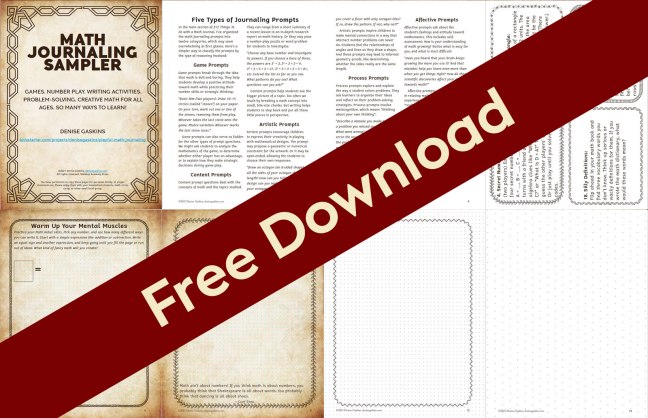
Get started with creative math journaling today. Visit the Make 100 Math Rebels Kickstarter page to download the free “How To Be a Math Rebel” sampler pictured above, which contains one of my all-time favorite math prompts.

Make 100 Math Rebels

It doesn’t matter whether your students are homeschooled or in a classroom, distance learning or in person. Everyone can enjoy the experience of playing around with math.

Puzzle from the free Math Rebel Sampler.

Continue reading Math Journals and Creative Reasoning

A New Resource for Playful Math

Check out the Make 100 Math Rebels Kickstarter project, which just might transform your child’s experience of math.

What Is a Math Rebel?

Math rebels believe in Truth. We refuse to accept something just because the teacher or textbook says it. We want to see the connections between math concepts and to understand why things work.

Math rebels care about Justice. We resist society’s push for speed and conformity. We reject the cultural narrative that math has only One Right Answer.

Math rebels celebrate Creative Reasoning. We delight in finding new ways to look at math topics. We want to think deeply about ideas, and we are confident in our ability to figure things out.

Launch your family’s math rebellion today with my free printable PDF booklet, “How To Be a Math Rebel,” available only on the Make 100 Math Rebels Kickstarter page.

Here’s the link again:

Make 100 Math Rebels on Kickstarter

What Is Multiplication, Anyway?

At some point during the process of teaching multiplication to our children, we really need to come to terms with this question:

What IS multiplication?

Did your device hide the video? Find it on YouTube here.

“What’s my answer? It’s not one that society’s going to like. Because society expects — demands, even — that mathematics be concrete, real-world, absolute, having definitive answers.

    I can’t give a definitive answer.

      Multiplication manifests itself in different ways. So maybe the word ‘is’ there is just too absolute. And it’s actually at odds with what mathematicians do.

        Mathematicians do attend to real-world, practical scenarios — by stepping away from them, looking at a bigger picture.”

        —James Tanton, What is Multiplication?

        For Further Study

        You may also enjoy these posts from my blog archive:

        Memorizing the Times Table: A Life Skills Approach

        Continuing on my theme of times table facts, here’s the inimitable James Tanton:

        Did your device hide the video? Find it on YouTube here.

        “If our task is to memorize this table, please make it about mathematics — about thinking your way through a challenge, and what can I do to make my life easier.”

        —James Tanton, Making Memorising Multiplication Facts (if one really must) a meaningful Life Skill Lesson

        For Further Study

        You may also enjoy my blog post series about working through the times tables, paying attention to mathematical relationships (and a bit of prealgebra) along the way.

        Times Tables Series

        Click the button to see the whole series. Scroll down to the first post to go through it in order.

        Happy Mathy Hanukkah

        Hiding among all the other winter-themed activity ideas, I found a few posts for those who celebrate the Festival of Lights.

        For More Holiday Math

        CREDITS: Candle photo (top) by Enrique Macias via Unsplash.com.

        Only Three Facts to Memorize

        A comment from a friend got me playing around with multiplication. I found a few videos from some of my favorite math people, so I’ll be sharing over the next few days.

        Here’s one from Sonya Post of Learning Well at Home. Also, Sonya just hosted Playful Math Education Carnival #143, which is well worth your time to explore!

        Did your device hide the video? Find it on YouTube here.

        “When students have to drill multiplication facts, it’s frustrating, unproductive and it makes them hate math. A better way to master the multiplication table is work on the skills that allow students to multiply quickly and efficiently.”

        —Sonya Post, Why We Don’t Drill Multiplication Facts – What We Do Instead

        Doubling and Halving

        Making doubles and halves are a great foundation for all sorts of math.

        Do you ever play the doubling game with your children? One player picks a starting number, and then you take turns doubling it until your mental math skills run out. How far can you go?

        Or try the halving game: One player chooses a starting number, and you take turns cutting it in half. How tiny can you go?

        As Sonya demonstrated, these skills help your child master their multiplication facts. And they are fantastic preparation for exponents and logarithms, too!

        Playful Math Carnival 143 via Learning Well at Home

        Check out the latest carnival of playful math:

        Each monthly Playful Math Education Blog Carnival brings you a great new collection of puzzles, math conversations, teaching tips, and all sorts of mathy fun. It’s like a free online magazine of mathematical adventures, helpful and inspiring no matter when you read them.

        Sonya put together this wonderful collection of mathematical games, art projects, holiday activities, paper crafts (LOTS of snowflakes!), and more.

        She writes:

          “It doesn’t matter where you look, there are always things to count and lots of things to wonder about. How many snowflakes in a snowman? How many points are on a star? How many turkeys do we eat every year? Does anyone actually eat all the fruitcake that is sold each year?
          “Here is Winter and her holidays by the numbers…
          “This was probably my favorite Playful Math Education Blog Carnival to write. There is so much out there to explore that I’m sure I’ve barely scratched the surface.
          “Come back because I’m going to keep adding to this post…”

        —Sonya Post, Carnival #143

        Click Here to Read the Carnival Blog

        Continue reading Playful Math Carnival 143 via Learning Well at Home