Running out of time on my Math You Can Play Kickstarter, so I better get to work on that Kickstarter Special Edition math-art book I promised to all the backers as a bonus reward.
Today I’m working on the Isometric Drawing and Impossible Figures section, because my co-op math classes had so much fun learning how to draw those.
Here’s a starter image on how to draw Minecraft blocks. At first I called them “isometric blocks” — but changing the name to “Minecraft” made the students really excited to learn. I’m not sure whether I like the pencil sketch, or if I should remake the illustrations on the computer…
Key steps:
Make a Y.
Turn it into an M.
Slant down for the bottom.
Slant up for the top.
Student drawings from my co-op classes.
The most common problem for beginners is that they try to make the base straight. They know a block can sit on a table, so the bottom has to be flat, right? But once students get a feel for how it goes, they can really take off and have fun.
UPDATE: The Kickstarter deals have ended, but my playful math books are still available through your favorite online store or by special order at your local bookshop. (Except for the Prealgebra & Geometry Games book, scheduled for publication in early 2021. Sign up for my email list to get the latest news.)
One of the best ways we can help our children learn mathematics (or anything else) is to always be learning ourselves.
Here are a few stories to read with your morning coffee this week:
Pam Harris explains how to use Strategies vs. Models in helping students clarify their thinking.
“A strategy is how you mess with the numbers, how you use relationships and connections between numbers to solve a problem. A model is a representation of your strategy, the way the strategy looks visibly. Modeling your strategy makes your thinking more clear to others because they can see the thinking and the relationships that went into your process.”
Do you have preschool or elementary students? Michael Minas has a great collection of games on his blog. Easy to learn and full of mathematical thinking.
“Doing mathematics like this deprives students of, well, let’s be honest, mathematics itself. We need to get to the answer faster. We need to move on. No time to stumble around rabbit holes. There is a curriculum to cover.”
When we give students a rule, we give them permission not to think. All they need to do is remember our instructions.
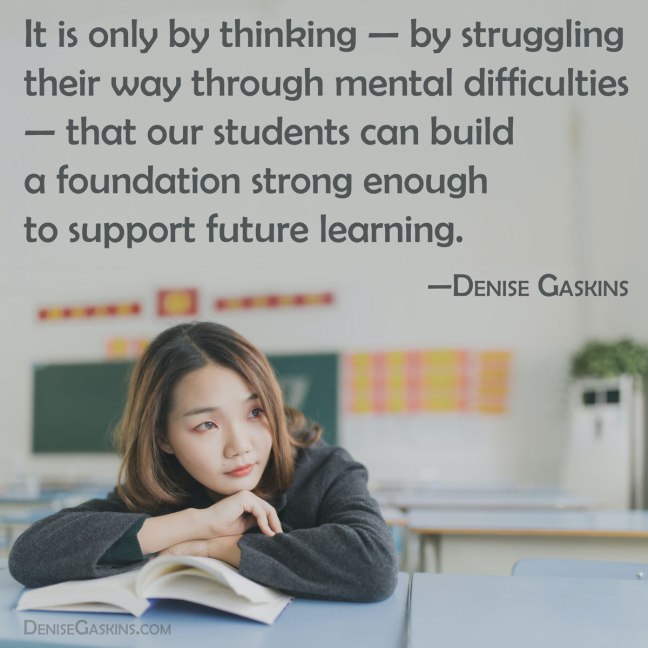
But it is only by thinking — by struggling their way through mental difficulties — that our students can build a foundation of mathematical knowledge strong enough to support future learning.
Prealgebra & Geometry: Math Games for Middle School, scheduled for publication in early 2021. Sign up for my newsletter to get updates.
This blog is reader-supported.
If you’d like to help fund the blog on an on-going basis, then please join me on Patreon for mathy inspiration, tips, and an ever-growing archive of printable activities.
If you liked this post, and want to show your one-time appreciation, the place to do that is PayPal: paypal.me/DeniseGaskinsMath. If you go that route, please include your email address in the notes section, so I can say thank you.
I believe this was the first math game I ever invented. Of course, ideas are common currency, so I’m sure other math teachers thought of it before I did. But to me, it was original.
I’ve blogged about the game before, but here’s the updated version as it appears in my new book Prealgebra & Geometry: Math Games for Middle School — scheduled for publication in early 2021. Sign up for my newsletter to get updates.
Hit Me
Math Concepts: integer addition, absolute value.
Players: two or more.
Equipment: playing cards (two decks may be needed for a large group).
“The happy truth about doing math with your kids is that it’s way more fun than you’re expecting it to be. It’s not about right answers, and it’s not about speed. It’s about playing, counting, building, sorting, and studying the wonderful, colorful world around us.”
The full quote, as it appears in my Math You Can Play books:
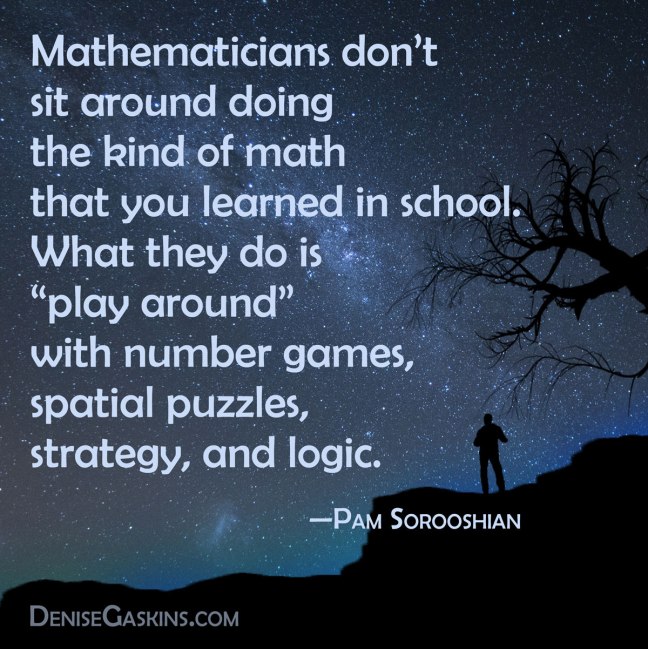
Mathematicians don’t sit around doing the kind of math that you learned in school. What they do is “play around” with number games, spatial puzzles, strategy, and logic.
They don’t just play the same old games, though. They change the rules a little, and then they look at how the game changes.
So, when you play games, you are doing exactly what mathematicians really do — IF you fool with the games a bit, experiment, see how the play changes if you change a rule here and there.
Oh, and when you make up games and they flop, be sure to examine why they flop — that is a big huge part of what mathematicians do, too.
Excerpted from my upcoming book, Prealgebra & Geometry: Math Games for Middle School, scheduled for publication in early 2021. Sign up for my newsletter to get updates.
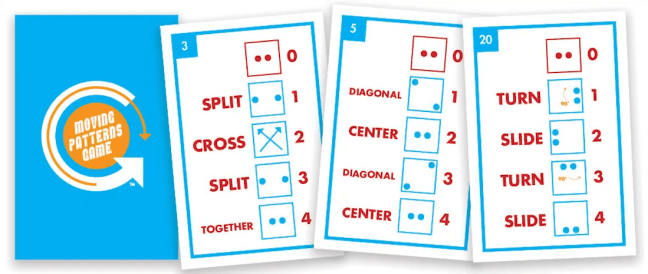
We all know kids like to move. But did you know you can harness all of that innate energy into developing a conceptual understanding of mathematics?
“The Moving Patterns Game is an active, self-directed game featuring patterns, footwork, friends, and math. Dancing makes life fun, and math makes the dancing more interesting!”
Here’s a simple, conversational game you can play anywhere — no equipment necessary. It’s great for helping your children develop number fluency and algebraic thinking.
Excerpted from my upcoming book, Prealgebra & Geometry: Math Games for Middle School, scheduled for publication in early 2021. Sign up for my newsletter to get updates.
What Two Numbers?
Math Concepts: addition, multiplication, inverse operations, positive and negative numbers.




 Denise Gaskins' Let's Play Math
