Do you want to improve your grasp of math so you can help your children understand their homework? Did math pass you by at school, or have your skills grown rusty over the years? Do you find it hard to apply what you know to the real-life problems you need to solve now—like using spreadsheets, interpreting data, or assessing risks?
If so, then the free, online, work-at-your-own-pace Citizen Maths course may be just what you need. Instead of abstract routines, the course uses practical problems to help you grasp some “powerful ideas” in math and see how these ideas apply in work and in life.
If you enjoy this carnival, why not send in a blog post of your own for next month? We love posts on playful ways to explore and learn math from preschool discoveries through high school calculus.
Credit: I contacted @ZoggTheAlien for permission to use the sketch. He said, “Feel free to use it. It’s a Galactic Commons license; you can use it if you don’t claim it’s made by one of your species.”
Please Add Your Comments Below
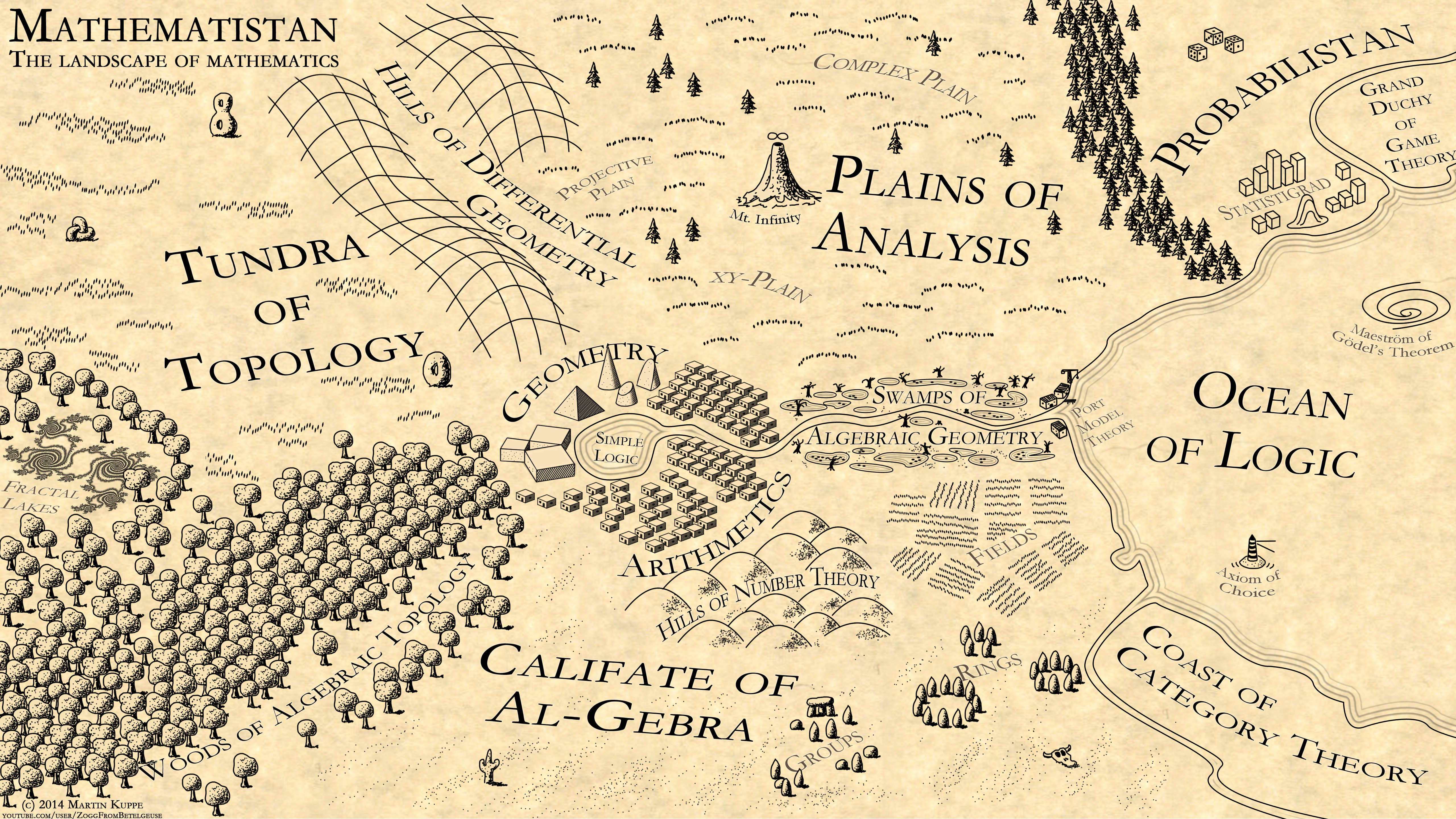
Do you have a favorite place in the Land of Mathematics? Why do you like it?
Most children find themselves stuck in the inner city of Arithmetics. How can we help them get out and explore the landscape?
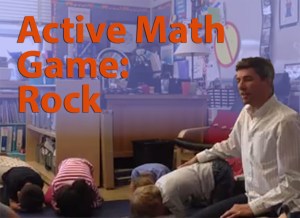
Gordon Hamilton of Math Pickle posted Rock – Low unique number game for grades K–2. If you have a set of active kids and a few minutes to spare, give it a try!
Teacher calls out numbers consecutively, starting at 0.
When a student hears their number being called they immediately raise a hand. When the teacher tags the hand, they stand up.
If more than one hand was raised, those students lose. They become your helpers, tagging raised hands.
If only one hand was raised, that child wins the round.
“Each game takes about 45 seconds,” Hamilton says. “This is part of the key to its success. Children who have not learned the art of losing are quickly thrown into another game before they have a chance to get sad.”
The experience of mathematics should be profound and beautiful. Too much of the regular K-12 mathematics experience is trite and true. Children deserve tough, beautiful puzzles.
What are the best numbers to pick? Patrick Vennebush hosted on online version of the game at his Math Jokes 4 Mathy Folks blog a few years back, though we didn’t have to bend over into rocks—which is a good thing for some of us older folks.
If you’d like to help fund the blog on an on-going basis, then please join me on Patreon for mathy inspiration, tips, and an ever-growing archive of printable activities.
If you liked this post, and want to show your one-time appreciation, the place to do that is PayPal: paypal.me/DeniseGaskinsMath. If you go that route, please include your email address in the notes section, so I can say thank you.
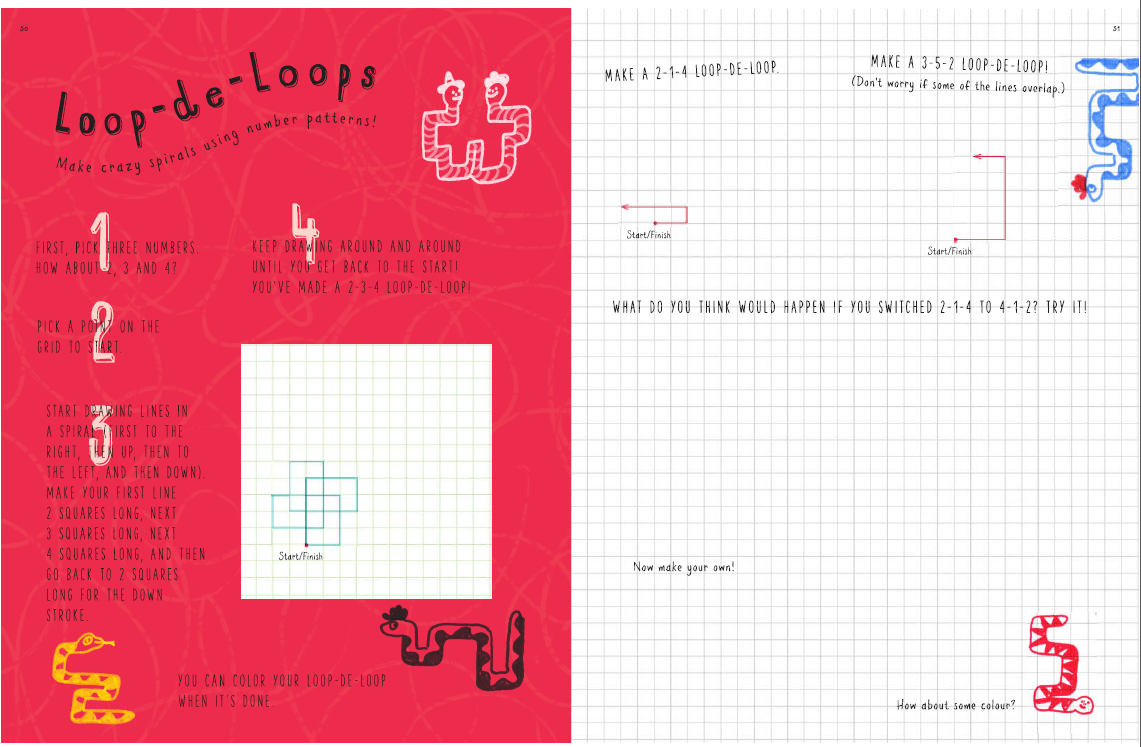
Interrupt your regular math programming to try this fantastic math doodling investigation!
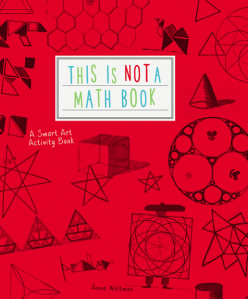
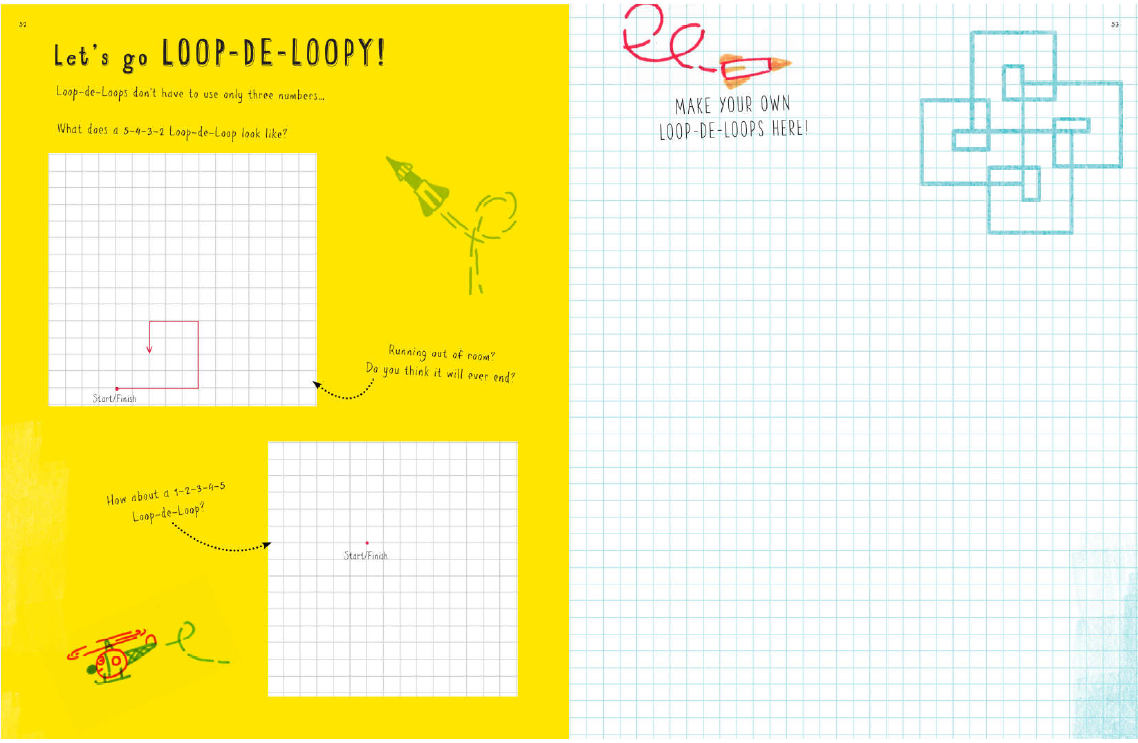
Anna Weltman wrote a math/art book. It’s great fun for all ages, full of fantastic mathematical explorations — including spirolateral math doodles.
How to Get Started
To make a spirolateral, you first pick a short series of numbers (1, 2, 3 is a traditional first set) and an angle (90° for beginners). On graph paper, draw a straight line the length of your first number. Turn through your chosen angle, and draw the next line. Repeat turning and drawing lines, and when you get to the end of your number series, start again at the first number.
Some spirolaterals come back around to the beginning, making a closed loop. Others never close, spiraling out into infinity—or at least, to the edge of your graph paper.
For Further Reading
Mike Lawler and sons explore Loop-de-Loops: Part 1, and Part 2.
Anna Weltman appeared on Let’s Play Math blog once before, with the game Snugglenumber. And she’s a regular contributor to the wonderful Math Munch blog.
Do you have high school students, or do you enjoy puzzles yourself? Did you agree with my post last week, that Professor Povey’s new book looks like fun? If so, I’ve got some good news.
Welcome to the 90th edition of Math Teachers at Play (MTaP) Blog Carnival! I am so excited to host this carnival again. MTaP is a monthly blog carnival with a collection of tips, games, and activities for teachers and students. It is always great fun to participate in anyway to this Carnival ^_^ …
Check out this new puzzle book for upper-level high school students & adults:
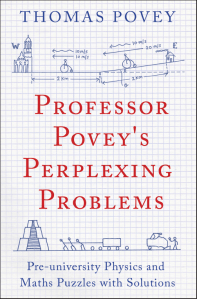
Thomas Povey is a Professor of Engineering Science at the University of Oxford, where he researches jet-engine and rocket technology. In his new book Professor Povey’s Perplexing Problems, he shares his favorite idiosyncratic stumpers from pre-university maths and physics.
These problems “should test your ability to grapple with the unfamiliar,” Povey writes. “You will learn to tease new problems apart, and apply things you already know in ways you had never considered. You have all the tools you need, but you should see what amazing things you can do with them.”
Can You Solve This?
Alex Bellos shared one of Professor Povey’s puzzles in The Guardian. Can you figure it out?
The book starts off with geometry, but most of the chapters focus on various topics from physics. Some of the puzzles are accessible through applied common sense, but for many of them, it helps to have taken an algebra-based (high school level) physics course.
Kitten is just finishing up her physics textbook, and she still has one more year of homeschooling. I’m hoping to work several of these puzzles into our schedule this year. It should be great fun!
Spoiler
If like me you’re a bit rusty on your physics, don’t worry. Each answer is thoroughly explained—in fact, it takes a bit of discipline to close the book and try your hand at each problem before reading on. I wish they’d put the solutions in the back rather than in the main text, to make it easier to browse the problems without reading spoilers.
Speaking of which, here’s the answer to the video puzzle above…
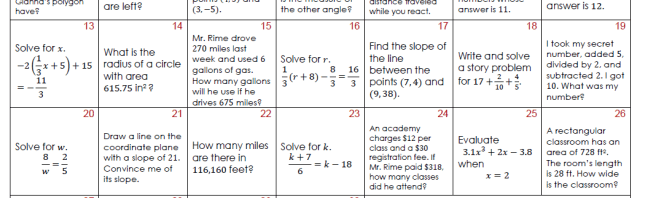
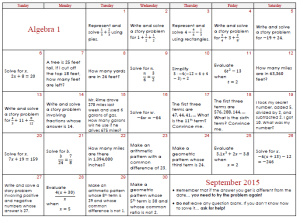
There are no explicit instructions about process being more important than the answer on these, so you’ll need to stress that in class.
I remind students that everyone already knows the answer to each of the questions, and that one of the things we’re practicing is explaining our reasoning…
Enjoy!
And if anyone else has a math review calendar to share, for any grade level, please add your link in the comment section below.




 Update: The giveaway deadline has passed, but I’d still love to hear about your favorite book—I’m always looking for something new to read. 🙂

 Denise Gaskins' Let's Play Math
