Reblog: Putting Bill Gates in Proportion

[Feature photo above by Baluart.net.]

Seven years ago, one of my math club students was preparing for a speech contest. His mother emailed me to check some figures, which led to a couple of blog posts on solving proportion problems.

I hope you enjoy this “Throw-back Thursday” blast from the Let’s Play Math! blog archives:


Putting Bill Gates in Proportion

A friend gave me permission to turn our email discussion into an article…

Can you help us figure out how to figure out this problem? I think we have all the information we need, but I’m not sure:

The average household income in the United States is $60,000/year. And a man’s annual income is $56 billion. Is there a way to figure out what this man’s value of $1mil is, compared to the person who earns $60,000/year? In other words, I would like to say — $1,000,000 to us is like 10 cents to Bill Gates.

Let the Reader Beware

When I looked up Bill Gates at Wikipedia, I found out that $56 billion is his net worth, not his income. His salary is $966,667. Even assuming he has significant investment income, as he surely does, that is still a difference of several orders of magnitude.

But I didn’t research the details before answering my email — and besides, it is a lot more fun to play with the really big numbers. Therefore, the following discussion will assume my friend’s data are accurate…

[Click here to go read Putting Bill Gates in Proportion.]


Bill Gates Proportions II

Another look at the Bill Gates proportion… Even though I couldn’t find any data on his real income, I did discover that the median American family’s net worth was $93,100 in 2004 (most of that is home equity) and that the figure has gone up a bit since then. This gives me another chance to play around with proportions.

So I wrote a sample problem for my Advanced Math Monsters workshop at the APACHE homeschool conference:

The median American family has a net worth of about $100 thousand. Bill Gates has a net worth of $56 billion. If Average Jane Homeschooler spends $100 in the vendor hall, what would be the equivalent expense for Gates?


Continue reading Reblog: Putting Bill Gates in Proportion

Reblog: The Handshake Problem

[Feature photo above by Tobias Wolter (CC-BY-SA-3.0) via Wikimedia Commons.]

Seven years ago, our homeschool co-op held an end-of-semester assembly. Each class was supposed to demonstrate something they had learned. I threatened to hand out a ten question pop quiz on integer arithmetic, but instead my pre-algebra students voted to perform a skit.

I hope you enjoy this “Throw-back Thursday” blast from the Let’s Play Math! blog archives:


If seven people meet at a party, and each person shakes the hand of everyone else exactly once, how many handshakes are there in all?

In general, if n people meet and shake hands all around, how many handshakes will there be?

Cast

1-3 narrators
7 friends (non-speaking parts, adjust to fit your group)

Props

Each friend will need a sheet of paper with a number written on it big and bold enough to be read by the audience. The numbers needed are 0, 1, 2, 3, … up to one less than the number of friends. Each friend keeps his paper in a pocket until needed.

[Click here to go read Skit: The Handshake Problem.]

Math Teachers at Play #72 via Christy’s Houseful of Chaos

mathteachersplay72

[Feature photo above is 72 Pencils by fdecomite via flickr.]

Math Teachers at Play is a traveling blog carnival. It moves around from month to month, and the March edition is now posted at Christy’s Houseful of Chaos. What a fun list of math posts to browse!

This is the 72nd Edition of the Math Teachers at Play (MTaP) blog carnival!

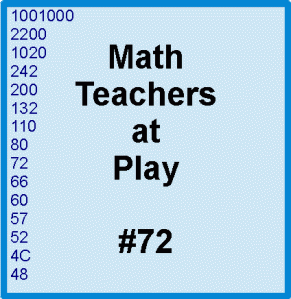
The number 72 is a Harshad number in number bases from binary up to but excluding base 13. Harshad numbers are numbers that are divisible by the sum of their numbers. They are base-dependant. In binary 72 is expressed 1001000. Add the digits together to get 2, one of the factors of 72. With a base of 5, 72 is expressed 242. With base 6 it is expressed 200. You can play around checking the bases of different numbers with an online calculator.

Now on to the math posts….

Click here to go read the whole carnival.

Pi Day Roundup

WhyPi

[Feature photo above by Nicolo’ Canali De Rossi.]

Math holiday alert: March 14th is Pi Day. But why limit ourselves to a single day? Playing with math should be a year-round adventure! Here are some ideas to help you celebrate…

Pi Day Posts on Let’s Play Math! Blog

DragonOfPi

Continue reading Pi Day Roundup

Reblog: The Case of the Mysterious Story Problem

[Feature photo above by Carla216 via flickr (CC BY 2.0).]

Seven years ago, I blogged a revision of the first article I ever wrote about homeschooling math. I can’t even remember when the original article was published — years before the original (out of print) editions of my math books.

I hope you enjoy this “Throw-back Thursday” blast from the Let’s Play Math! blog archives:


Case-of-the-Mysterious-Story-Problem
I love story problems. Like a detective, I enjoy sifting out clues and solving the mystery. But what do you do when you come across a real stumper? Acting out story problems could make a one-page assignment take all week.

You don’t have to bake a pie to study fractions or jump off a cliff to learn gravity. Use your imagination instead. The following suggestions will help you find the clues you need to solve the case…

[Click here to go read the original post.]

Reblog: A Mathematical Trauma

Feature photo (above) by Jimmie via flickr.

My 8-year-old daughter’s first encounter with improper fractions was a bit more intense than she knew how to handle.

I hope you enjoy this “Throw-back Thursday” blast from the Let’s Play Math! blog archives:


Photo (right) by Old Shoe Woman via Flickr.

Nearing the end of Miquon Blue today, my youngest daughter encountered fractions greater than one. She collapsed on the floor of my bedroom in tears.

The worksheet started innocently enough:

\frac{1}{2} \times 8=\left[ \quad \right]

[Click here to go read the original post.]

Math Teachers at Play #71 via Math Mama Writes

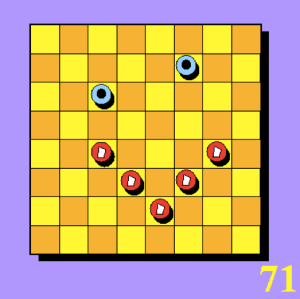
The February math education blog carnival is now posted for your browsing pleasure, featuring 71 playful ways to explore mathematics from preschool to calculus:

71 richard schwartzMath teachers at play know that math is best learned when the student is thoroughly engaged, through their body, their imagination (story-telling), or the world of games. I’ve started out this month’s post with those three categories.

Most of the submissions this month described hands-on, or feet-on, activities. It’s as if there had been a theme agreed upon without anyone mentioning it. Some of the following posts are from submissions, and others are posts that I wanted to share from my internet wanderings.

This post has 71 links. (You might need to digest it in smaller bites.) Enjoy!

Click here to go read the whole, wonderful post.

Quotable: Math as a Second Language

Wenninger 94photo by fdecomite via flickr (CC BY 2.0)

I sat in class three days ago and thought to myself, “They need a class called ‘Math as a second language’ or MSL for short.”

It is easy to understand what a median is, or what attributes a kite has, or why is a rectangle a square but a square not a rectangle… for a minute or a day.

It is easy to temporarily memorize a fact. But without true understanding of the concept those “definitions” fade. If the foundation of truly understanding is not there to begin with then there is little hope for any true scaffolding and even less chance of any true learning.

Duncan
Comment on Christopher Danielson’s Geometry and language

Alexandria Jones and the Strange Attractor

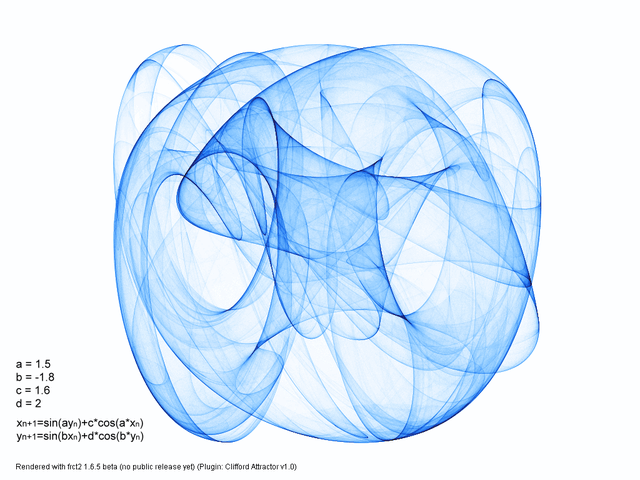
[Feature photo above: Clifford Attractor by Yami89 (public domain) via Wikimedia Commons.]

Alexandria Jones collapsed onto the couch with a dramatic sigh. Her father, the world-famous archaeologist Dr. Fibonacci Jones, glanced up from his newspaper and rolled his eyes.

“I don’t even want to hear about it,” he said.

Alex’s brother Leonhard was playing on the floor, making faces at the baby. He looked up at Alex and grinned.

“I’ll take the bait,” he said. “What happened?”

“Mom called my bedroom a Strange Attractor.”

“Oh? What does it attract?”

“I don’t know. Mostly books and model horses. But what’s so strange about that?”

The Mathematics of Chaos

Animation of a double compound pendulum showing chaotic behaviour.

Dr. Jones laughed and put down his paper. “Strange attractor is a technical term from the branch of mathematics called dynamical systems analysis — often called chaos theory.”

“So my bedroom is a math problem?”

“No. I think Mom meant your bedroom was chaos.”

“Oh.” Alex looked like she might pout, then she shrugged. “I guess she’s right, at that. So what is a strange attractor, really?”

“Well, when scientists first drew graphs of classical, non-chaotic systems — like a planet’s orbit or the flight of a football — it was surprising how often they got an ellipse or parabola or some similar curve,” Dr. Jones explained. “For some reason, nature seemed to be attracted to the shapes of classical geometry.”

Click here to continue reading.