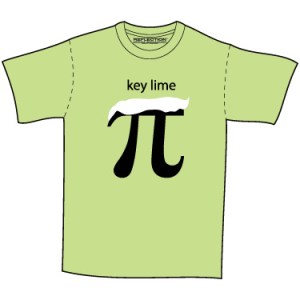
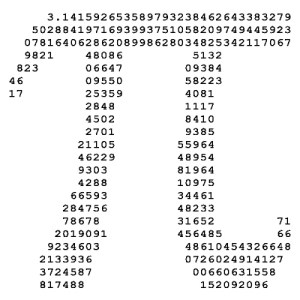
Here are two poems in honor of pi, from the Mathematical Poetry site:

Here are two poems in honor of pi, from the Mathematical Poetry site:

It can be of no practical use to know that Pi is irrational, but if we can know, it surely would be intolerable not to know.
I don’t remember anyone ever mentioning Pi Day when I was in school, but any excuse to celebrate math sounds like fun. March 14 at 1:59 (a.m. or p.m.) is about as close as the calendar can get to 3.14159…
[Feature photo above by Alberto G. (CC-BY-SA-2.0) via flickr.]
The school experience makes a tremendous difference in a child’s learning. Which of the following students would you rather be?
I continued to do arithmetic with my father, passing proudly through fractions to decimals. I eventually arrived at the point where so many cows ate so much grass, and tanks filled with water in so many hours. I found it quite enthralling.
— Agatha Christie
An Autobiography
…or…
“Can you do Addition?” the White Queen asked. “What’s one and one and one and one and one and one and one and one and one and one?”
“I don’t know,” said Alice. “I lost count.”
“She can’t do Addition,” the Red Queen interrupted. “Can you do Subtraction? Take nine from eight.”
“Nine from eight I can’t, you know,” Alice replied very readily: “but—”
“She can’t do Subtraction,” said the White Queen. “Can you do Division? Divide a loaf by a knife — what’s the answer to that?”
“I suppose—” Alice was beginning, but the Red Queen answered for her. “Bread-and-butter, of course.”
“She can’t do sums a bit!” the Queens said together, with great emphasis.— Lewis Carroll
Through the Looking Glass
…in other words…
If you could lead through testing, the U.S. would lead the world in all education categories. When are people going to understand you don’t fatten your lambs by weighing them?
— Jonathan Kozol
at Westfield State College’s 157th Commencement
Continue reading In Honor of the Standardized Testing Season…
Time to catch up on our blackboard quotes.
“I suppose you are two fathoms deep in mathematics, and if you are, then God help you. For so am I, only with this difference: I stick fast in the mud at the bottom, and there I shall remain.”
— Charles Darwin
quoted in the Platonic Realms collection
It’s been ages since I shared the blackboard quotes from my co-op math classes. Here are some of our recent ones for your reading pleasure…
One more quote from W. W. Sawyer’s Mathematician’s Delight before I have to return the book to the library:
If you cannot see what the exact speed is, begin to ask questions. Silly ones are the best to begin with. Is the speed a million miles an hour? Or one inch a century? Somewhere between these limits. Good. We now know something about the speed. Begin to bring the limits in, and see how close together they can be brought. Study your own methods of thought. How do you know that the speed is less than a million miles an hour? What method, in fact, are you unconsciously using to estimate speed? Can this method be applied to get closer estimates?
You know what speed is. You would not believe a man who claimed to walk at 5 miles an hour, but took 3 hours to walk 6 miles. You have only to apply the same common sense to stones rolling down hillsides, and the calculus is at your command.
Comments by W. W. Sawyer, in his wonderful, little book, Mathematician’s Delight:
Earlier we considered the argument, ‘Twice two must be four, because we cannot imagine it otherwise.’ This argument brings out clearly the connexion between reason and imagination: reason is in fact neither more nor less than an experiment carried out in the imagination.
If you’d like to start your week with a laugh, here’s a great quote:
Today I said to the calculus students, “I know, you’re looking at this series and you don’t see what I’m warning you about. You look and it and you think, ‘I trust this series. I would take candy from this series. I would get in a car with this series.’ But I’m going to warn you, this series is out to get you. Always remember: The harmonic series diverges. Never forget it.”
—Rudbeckia Hirta
Learning Curves Blog: The Harmonic Series
quoting Alexandre Borovik
[Rescued from my old blog.]
From Time magazine, June 18, 1956:
“[M]athematics has the dubious honor of being the least popular subject in the curriculum… Future teachers pass through the elementary schools learning to detest mathematics… They return to the elementary school to teach a new generation to detest it.”
Quoted by George Polya in How to Solve It. I finally got my very own copy of this excellent book, so I can quit pestering the librarian to let me order it from library loan again…
Blogger Rudbeckia Hirta teaches math to pre-service teachers, and it seems that not much has changed since 1956. Hirta says the test answers shown were representative of her class — for instance, 25% of her students missed the juice problem. Too bad these students never read Polya’s book, in which he discusses a four-step method for solving problems. Step four is to look back and ask yourself whether the answer makes sense. Good advice!