Quotable: Focus on Being Silent

Children Reading Pratham Books and Akshara[Photo by Pratham Books via Flickr (CC BY 2.0).]

I discovered this gem in my blog reading today. One of the secrets of great teaching:

Audrey seemed, for once, at a loss for words. She was thinking about the question.

I try to stay focused on being silent after I ask young children questions, even semi-serious accidental ones. Unlike most adults, they actually take time to think about their answers and that often means waiting for a response, at least if you want an honest answer.

If you’re only looking for the “right” answer, it’s fairly easy to gently badger a child into it, but I’m not interested in doing that.

Thomas Hobson
Thank You For Teaching Me

Learn Math by Asking Questions

The best way for children to build mathematical fluency is through conversation. For more ideas on discussion-based math, check out these posts:

And be sure to follow Christopher Danielson’s Talking Math with Your Kids blog!

 
* * *

This blog is reader-supported.

If you’d like to help fund the blog on an on-going basis, then please join me on Patreon for mathy inspiration, tips, and an ever-growing archive of printable activities.

If you liked this post, and want to show your one-time appreciation, the place to do that is PayPal: paypal.me/DeniseGaskinsMath. If you go that route, please include your email address in the notes section, so I can say thank you.

Which I am going to say right now. Thank you!

“Quotable: Focus on Being Silent” copyright © 2013 by Denise Gaskins. Image at the top of the post copyright © Pratham Books via Flickr (CC BY 2.0).

A Good Problem Requires Dreaming Time

A-good-problem

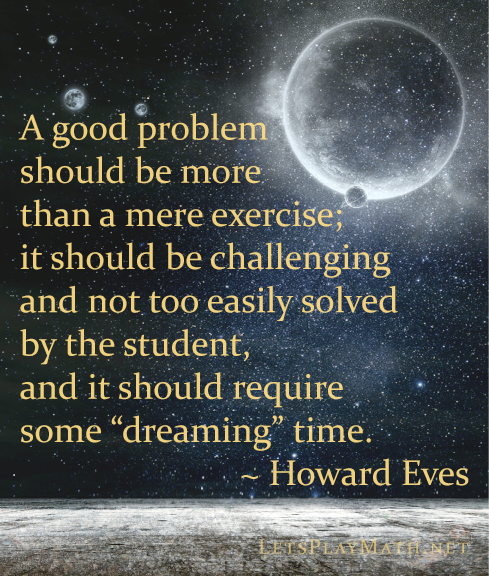
A good problem should be more than a mere exercise; it should be challenging and not too easily solved by the student, and it should require some “dreaming” time.

— Howard Eves

CREDITS: Today’s quote is from Howard Eves, An Introduction to the History of Mathematics. Background photo courtesy of Brenda Clarke (CC BY 2.0) via flickr.

Quotable: Learning the Math Facts

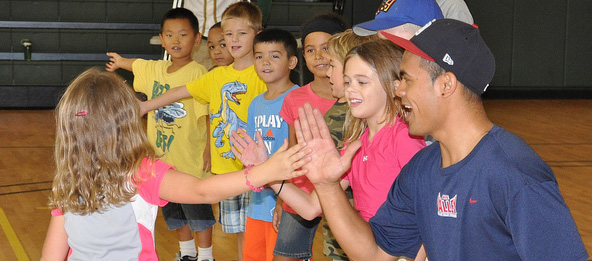
Feature photo above by USAG- Humphreys via Flickr (CC BY 2.0).

During off-times, at a long stoplight or in grocery store line, when the kids are restless and ready to argue for the sake of argument, I invite them to play the numbers game.

“Can you tell me how to get to twelve?”

My five year old begins, “You could take two fives and add a two.”

“Take sixty and divide it into five parts,” my nearly-seven year old says.

“You could do two tens and then take away a five and a three,” my younger son adds.

Eventually we run out of options and they begin naming numbers. It’s a simple game that builds up computational fluency, flexible thinking and number sense. I never say, “Can you tell me the transitive properties of numbers?” However, they are understanding that they can play with numbers.

photo by Mike Baird via flickr

I didn’t learn the rules of baseball by filling out a packet on baseball facts. Nobody held out a flash card where, in isolation, I recited someone else’s definition of the Infield Fly Rule. I didn’t memorize the rules of balls, strikes, and how to get someone out through a catechism of recitation.

Instead, I played baseball.

John Spencer
Memorizing Math Facts

Conversational Math

The best way for children to build mathematical fluency is through conversation. For more ideas on discussion-based math, check out these posts:

Learning the Math Facts

For more help with learning and practicing the basic arithmetic facts, try these tips and math games:

 
* * *

This blog is reader-supported.

If you’d like to help fund the blog on an on-going basis, then please join me on Patreon for mathy inspiration, tips, and an ever-growing archive of printable activities.

If you liked this post, and want to show your one-time appreciation, the place to do that is PayPal: paypal.me/DeniseGaskinsMath. If you go that route, please include your email address in the notes section, so I can say thank you.

Which I am going to say right now. Thank you!

“Quotable: Learning the Math Facts” copyright © 2013 by Denise Gaskins. Image at the top of the post copyright © USAG- Humphreys via Flickr (CC BY 2.0).

How To Master Quadratic Equations

G'Day Math logo

Feature photo above by Junya Ogura via Flickr (CC BY 2.0).

A couple of weeks ago, James Tanton launched a wonderful resource: a free online course devoted to quadratic equations. (And he promises more topics to come.)

Kitten and I have been working through the lessons, and she loves it!

We’re skimming through pre-algebra in our regular lessons, but she has enjoyed playing around with simple algebra since she was in kindergarten. She has a strong track record of thinking her way through math problems, and earlier this year she invented her own method for solving systems of equations with two unknowns.

I would guess her background is approximately equal to an above-average Algebra 1 student near the end of the first semester.

After few lessons of Tanton’s course, she proved — within the limits of experimental error — that a catenary (the curve formed by a hanging chain) cannot be described by a quadratic equation. Last Friday, she easily solved the following equations:

\left ( x+4 \right )^2 -1=80

and:

w^2 + 90 = 22 w - 31

and (though it took a bit more thought):

4x^2 + 4x + 4 = 172

We’ve spent less than half an hour a day on the course, as a supplement to our AoPS Pre-Algebra textbook. We watch each video together, pausing occasionally so she can try her hand at an equation before listening to Tanton’s explanation. Then (usually the next day) she reads the lesson and does the exercises on her own.

So far, she hasn’t needed the answers in the Companion Guide to Quadratics, but she did use the “Dots on a Circle” activity — and knowing that she has the answers available helps her feel more independent.

Continue reading How To Master Quadratic Equations

Math Teachers at Play #62: A Carnival with Books

by Robert Webb

Do you enjoy math? I hope so! If not, browsing this post just may change your mind. Welcome to the Math Teachers At Play blog carnival — a smorgasbord of ideas for learning, teaching, and playing around with math from preschool to pre-college.

Let the mathematical fun begin!

POLYHEDRON PUZZLE

By tradition, we start the carnival with a puzzle in honor of our 62nd edition:

An Archimedean solid is a polyhedron made of two or more types of regular polygons meeting in identical vertices. A rhombicosidodecahedron (see image above) has 62 sides: triangles, squares, and pentagons.

  • How many of each shape does it take to make a rhombicosidodecahedron?
Click for full-size template.
Click for template.

My math club students had fun with a Polyhedra Construction Kit. Here’s how to make your own:

  1. Collect a bunch of empty cereal boxes. Cut the boxes open to make big sheets of cardboard.
  2. Print out the template page (→) and laminate. Cut out each polygon shape, being sure to include the tabs on the sides.
  3. Turn your cardboard brown-side-up and trace around the templates, making several copies of each polygon. I recommend 20 each of the pentagon and hexagon, 40 each of the triangle and square.
  4. Draw the dark outline of each polygon with a ballpoint pen, pressing hard to score the cardboard so the tabs will bend easily.
  5. Cut out the shapes, being careful around the tabs.
  6. Use small rubber bands to connect the tabs. Each rubber band will hold two tabs together, forming one edge of a polyhedron.

So, for instance, it takes six squares and twelve rubber bands to make a cube. How many different polyhedra (plural of polyhedron) will you make?

  • Can you build a rhombicosidodecahedron?

And now, on to the main attraction: the 62 blog posts. Many of the following articles were submitted by their authors; others were drawn from the immense backlog in my blog reader. If you’d like to skip directly to your area of interest, here’s a quick Table of Contents:

Continue reading Math Teachers at Play #62: A Carnival with Books