Musings: School Math vs. Real Math

I was asked to do an interview for a new podcast called Learning is Disruptable, and that got me thinking…

Is Math Education Ripe for Disruption?

Math education is not working. Too many people come out of school with math avoidance, math anxiety or even phobia, a profound conviction that math is not for them.

Generally, humans enjoy success, the feeling that things make sense, that they are capable of understanding big ideas. People like subjects that give them this type of success, where they are meeting and making sense of new ideas, growing in mastery.

But they hate subjects that make them feel like a failure, where things don’t make sense and there seems to be no real chance of success.

Therefore, understanding our students’ attitude toward math gives us a solid indication of how well they are learning.

Continue reading Musings: School Math vs. Real Math

A Revolutionary New Approach to Homeschool Math

There’s a great new homeschool math program that can radically transform your children’s experience of math, building understanding through creative exploration.

First, a bit of history…

What Is Algebra Before Arithmetic?

Back when I was still homeschooling, I read a couple of articles by Keith Devlin about the benefits of teaching children algebra, even before they study numbers.

As a homeschooler leaning toward Charlotte Mason-style education, I found the notion of algebra-first math intriguing. What if we could introduce students to the big ideas of math, the foundational concepts that explain how numbers relate, before they get distracted by details like math facts and memorized rules?

Continue reading A Revolutionary New Approach to Homeschool Math

Podcast: Cultivating Math Curiosity and Reasoning in Kids

I have a new podcast interview, and I think you’ll enjoy it!

Check out Learning Is Disruptable on your favorite podcast app, or listen on the website:

Go to the podcast ❱

Here’s an excerpt…

“I think the most important thing that we need to change…we need to radically change what our idea is of what it means to learn math.

    “Our biggest failure, both in the classroom and in homeschool settings, is that we’ve given our children a totally wrong idea of what math is all about.

    Continue reading Podcast: Cultivating Math Curiosity and Reasoning in Kids

    Limited Time Book Deals

    Do you want to help your children master problem-solving skills?

    Check out my temporary online store for anyone who missed the Kickstarter.

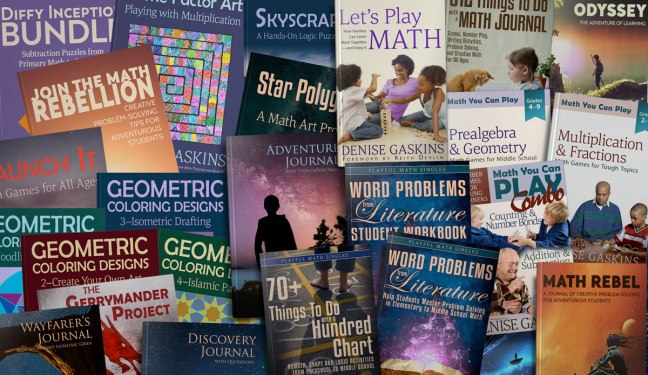
    Through the end of September, you can place a preorder for the early-release edition of Word Problems from Literature, along with the Word Problems Student Workbook and exclusive Audio Commentary (or any of my other books or printable math activity guides).

    I’ll lock down the preorder store when I’m ready to send the Kickstarter order to my printer.

    Books will be delivered with the Kickstarter orders: Digital items in October, physical books by the end of December.

    Shop Now ❯

    6th Grade Minimalist Math Curriculum

    For details on using a Minimalist Math Curriculum, see my earlier post How To Make Time for Exploration.

    If you’re teaching or homeschooling students in 6th grade, here’s the new minimalist curriculum link:

    As I mentioned in my earlier post, a minimalist curriculum can be a great way to free up time for playing math games and exploring enrichment activities (like these).

    How To Make Time for Exploration

    Perhaps the most common objection I hear to using math games and enrichment activities is, “I don’t have the time. I can’t even get through our regular math book!”

    Well, here’s one possible solution: Use a “Minimalist Math” outline to guide your instruction, turning your regular textbook into a backup resource, teaching only the topics your children don’t already know, leaving more time free for exploration and playful discovery.

    Minimalist Math: Getting Down to Basics

    Michelle at ResearchParent.com condensed the elementary math curriculum down to 360 problems per year, just 10 per week.

    Take just a few puzzles each day, and talk math with your kids:

    • What do they notice in the problem?
    • Does it remind them of anything?
    • How might they try to figure it out?
    • Does it make them wonder about numbers, shapes, or patterns?

    Use colorful markers on a whiteboard for low-stress exploration. If your children can solve a problem and explain their reasoning, you don’t need to study that topic. When they get stuck, follow the Notice-Wonder-Create method described in this blog post series.

    If you’re both stymied, that’s when you pull out your regular textbook (or look the topic up online).

    Practice with Games

    Of course, children still need plenty of practice to master the math facts and solidify their knowledge.

    Since you’re not spending as much time on lessons and homework, you can plan on playing lots of math games. Games are a fun, low-stress way to firm up math skills.

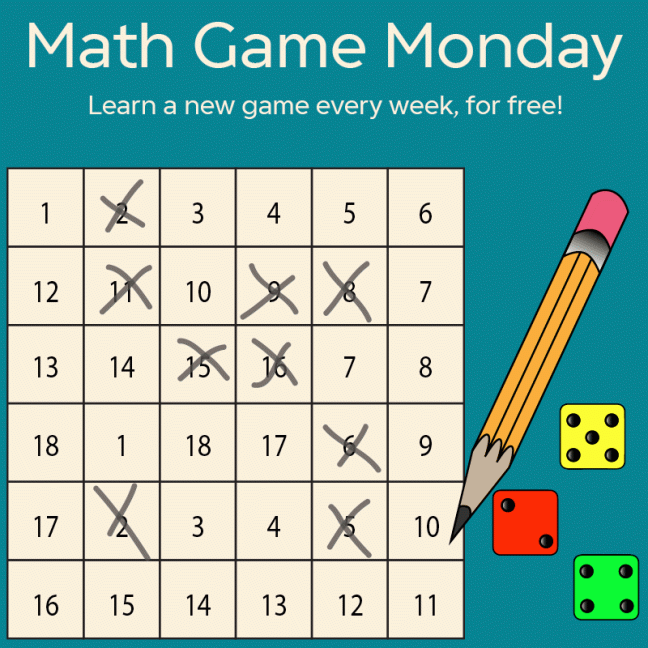
    Check out My Best (Free) Math Games for All Ages, and follow the Math Game Monday posts on my blog.
    Read Library Books

    To enrich your child’s mind with the great ideas of mathematics and whet their appetite for learning, nothing beats a “living” math book.

    A living book is one that brings our minds into direct contact with the great ideas of life.

    Check out my Math with Living Books lists to get started, and ask your librarian for more suggestions.

    For Older Students

    Michelle’s Minimalist Math Curriculum goes through 6th grade (so far). But you could use the Corbettmaths 5-a-Day problems in the same way for older students.

    And for enrichment activities to fill up your free math time, I can’t think of a better resource for all ages than the NrichMaths website.

    “When I first started homeschooling, math became the most overwhelming, unpleasant part of our day. As someone who loves math, I didn’t want to continue on a path that was leading to such bad attitudes.

    “My Minimalist Math Curriculum covers the same breadth of topics as a traditional curriculum without all the repetition. You are welcome to use what I created in whatever way serves your family.”

    Michelle, Research Parent
    Mathematics Activities for Kids

     
    * * *

    This blog is reader-supported.

    If you’d like to help fund the blog on an on-going basis, then please join me on Patreon for mathy inspiration, tips, and an ever-growing archive of printable activities.

    If you liked this post, and want to show your one-time appreciation, the place to do that is PayPal: paypal.me/DeniseGaskinsMath. If you go that route, please include your email address in the notes section, so I can say thank you.

    Which I am going to say right now. Thank you!

    “How To Make Time for Exploration” copyright © 2022 by Denise Gaskins. Image at the top of the post copyright © Aron Visuals, Andrew Ebrahim, and Melissa Askew via Unsplash.com.


    A Spring Tradition

    Homeschool Memories…

    Back when my kids were young, it was a yearly tradition. The big discount catalog came every spring, full of exciting new ideas for homeschooling.

    By that time, we would be tired of whatever books we were using and eager for something new.

    I sent the children outside to enjoy the spring sunshine, which gave me time to dream over the tiny-print wishbook. Coffee in one hand, pencil in the other, making lists and dog-earing catalog pages.

    So many exciting books and curriculum options, it seemed almost impossible to resist going wild beyond our budget.

    Continue reading A Spring Tradition

    How To Respond to Your Child’s Math Writing

    In previous posts, I encouraged parents, homeschoolers, and teachers to explore the world of math and introduced one of my favorite learning tools, the math journal. Then I shared several of my favorite types of journaling prompts to get your kids started writing about math.

    Math journal prompts offer a wide range of options for students to explore. Most of the prompts do not have a “right” or “wrong” answer. Our goal is to root around in some small corner of the world of math, to lift a stone and peek underneath it, just to see what we can find.

    The idea that being good at math means finding the right answers is a huge myth. Of course, many problems in math do have a single right answer. But even for those problems, the answer is not the real math of the problem.

    Math is all about thinking.

    It’s like taking a road trip. You may have a destination, but there are many paths you could take to get there. Different students may take different paths — they may think about the problem in different ways.

    It’s this reasoning that is the real math, and the right answer is just a side effect of reasoning well.

    Continue reading How To Respond to Your Child’s Math Writing

    5 Ways To Enrich Your Student’s Experience of Math

    In previous posts, I encouraged parents, homeschoolers, and teachers to explore the world of math and introduced one of my favorite learning tools, the math journal.

    But you may be wondering, what can my students do with their journal? How do I find good math prompts?

    Here are five different ways your children can explore math through writing, classified by the type of reasoning involved.

    #1: Game Prompts

    Ask your children to play a number or strategy game and then write about it.

    Game prompts break through the idea that math is dull and boring. They help students develop a positive attitude toward math while practicing their number skills or strategic thinking.

    Continue reading 5 Ways To Enrich Your Student’s Experience of Math

    Why Math Game Monday?

    Learn a new game with Math Game Monday

    There’s a new Math Game Monday this week.

    Have your kids tried it yet?

    This week’s game is one of my favorites for early elementary grades, a logic game that makes children think about numbers and strategy.

    Or, if you’re reading this post later and missed that one, there’s another great new game this week for you to play.

    Check it out:

    Visit Math Game Monday

    Continue reading Why Math Game Monday?