Online Game: Math Caching

In the treasure-hunting game of Geocaching (pronounced “geo-cashing”), players use GPS systems to locate boxes hidden at different geographical locations across the country.

Now, the creative people at Mathbits.com have come up with an online treasure-hunting activity for junior high and high school students, called MathCaching. Students solve mathematical problems to find hidden “boxes” on the Internet. Each box reveals clues to the location of the next one.

The MathCaching game covers pre-algebra through trigonometry topics, with calculus levels under development. For more information, visit the MathCaching site, or read the post on my Frugal Homeschooling blog.
The Olympics: Math Puzzles and a Game


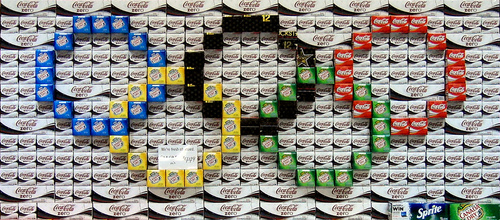
[Photo by striatic.]

Maybe it’s because school is out for the summer, but there don’t seem to be all that many Olympics-related math resources on the Web. I did find one cool game, however, and a nice stack of word problems. I hope you enjoy them!

Update: Be sure to see my blog post Olympic Logic for more links and puzzles!

Continue reading The Olympics: Math Puzzles and a Game

Crazy 4 Math Contest

I heard of this contest in an e-mail from ClickSchooling:

Kids, share your creative math ideas! Describe how you use math in any activity you love to do — a sport, game, craft, hobby, or anything else.

Send in a description of the activity and how it uses math, as well as any drawing(s) or diagram(s). There are many great prizes to be won. Please ensure you’ve read and understand our contest’s rules and regulations before entering.

Sounds like fun! If you want to enter, act quickly. Entries must be submitted online by July 30th. Visit Crazy4Math.com for more information and to check out the winners from previous years.

Math Game: What Number Am I?

Photo by jaycoxfilm.

Math concepts: mental calculations, math vocabulary, and anything else you want to include
Number of players: any number, but I think it works best with two players who alternate asking questions
Equipment: imagination and, if necessary, scratch paper

Many years ago, I read a magazine article by mathematical music critic Edward Rothstein, wherein he described a game he invented for his daughter:

  • “What number am I? If you add me to myself, you get four.”

Rather than explaining the rules of the game, let me tell you a story…

Continue reading Math Game: What Number Am I?

Hit Me! (A Math Game)

Photo by paparutzi.

Math concepts: addition, subtraction, negative numbers, mental math, absolute value
Number of players: any number
Equipment: math cards (two decks may be needed for a large group)

Set Up

One player (the dealer) shuffles the math cards and deals one card face down for each player, beginning with the player on his left and proceeding in turn around the table. Then he deals one card face up beside each face down card.

Continue reading Hit Me! (A Math Game)

The Function Machine Game

Math concepts: odd numbers, even numbers, greater-than/less-than, rounding off, addition, subtraction, multiplication, division, fractions, negative numbers, prime numbers, square numbers, problem solving, mental math
Number of players: two or more
Equipment: pencil (or pen) and paper for every player

Continue reading The Function Machine Game

Game: Avoid Three, or Tic-Tac-No!

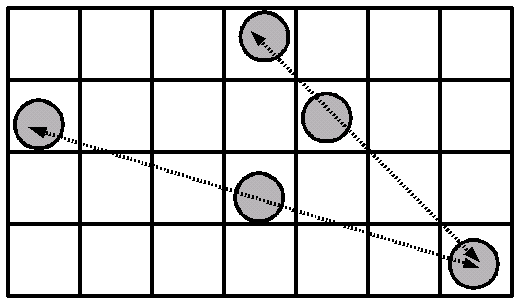
Math concepts: slope, logical strategy
Number of players: 2 or more
Equipment: 4×4 or larger grid, pebbles or other tokens to mark squares

Set Up

Alexandria Jones and her brother Leon played Avoid Three with pebbles on a grid scratched in the sand, but you can also use pencils or markers on graph paper. You need a rectangular playing area at least 4×4 squares large. The bigger your grid, the longer your game.

Continue reading Game: Avoid Three, or Tic-Tac-No!

Substitute Teacher Experiments with Combinatorics


Photo by peigianlong.

Here is a puzzle from Just a Substitute Teacher:

Lesson plan entry: “Hand out worksheet packets and have students staple before starting. They know what to do.”

Sounds simple enough! Four numbered sheets, eight total pages, printed front and back. What could go wrong?

Do you know how many possible combinations four pieces of paper can be arranged for stapling?

Continue reading Substitute Teacher Experiments with Combinatorics

Answers to Leon’s Figurate Number Puzzles

Remember the Math Adventurer’s Rule: Figure it out for yourself! Whenever I give a problem in an Alexandria Jones story, I will try to post the answer soon afterward. But don’t peek! If I tell you the answer, you miss out on the fun of solving the puzzle. So if you haven’t worked these problems yet, go back to the original post. Figure them out for yourself — and then check the answers just to prove that you got them right.

Continue reading Answers to Leon’s Figurate Number Puzzles